 NEET Notes
Home > Chemistry > Organic > Biomolecules
Biomolecules
On this page · 19 sections
- 01Syllabus map
- 02Carbohydrates and their classification
- 03Glucose: preparation and open-chain structure
- 04Glucose: D/L notation, cyclic structure and anomers
- 05Fructose
- 06Disaccharides
- 07Polysaccharides and importance of carbohydrates
- 08Table: the carbohydrate family at a glance
- 09Amino acids
- 10Proteins: peptide bond and four levels of structure
- 11Denaturation of proteins
- 12Ladder: reducing or non-reducing sugar
- 13Enzymes
- 14Vitamins
- 15Table: vitamins, sources and deficiency diseases
- 16Nucleic acids
- 17Table: DNA vs RNA
- 18Hormones
- 19Trap pairs: the confusions NEET tests
Biomolecules from NCERT XII Ch 10: carbohydrate structures and sugars, amino acids and protein structure, enzymes, vitamins, nucleic acids and hormones, with 5 NEET PYQs.
Syllabus map
- NMC Unit: CHEM-U19, Biomolecules. NCERT Chapter 10 covers the whole unit: carbohydrates, proteins, enzymes, vitamins, nucleic acids and hormones.
- Subtopics in this chapter (NCERT XII, Ch 10): carbohydrates and their classification (10.1); monosaccharides (10.1.2); glucose (10.1.2.1); fructose (10.1.2.2); disaccharides (10.1.3); polysaccharides (10.1.4); importance of carbohydrates (10.1.5); proteins (10.2); amino acids (10.2.1); classification of amino acids (10.2.2); structure of proteins (10.2.3); denaturation of proteins (10.2.4); enzymes (10.3); mechanism of enzyme action (10.3.1); vitamins (10.4); classification of vitamins (10.4.1); nucleic acids (10.5); chemical composition of nucleic acids (10.5.1); structure of nucleic acids (10.5.2); biological functions of nucleic acids (10.5.3); hormones (10.6).
- Subtopic checklist: (1) general formula of carbohydrates and its exceptions; (2) glucose preparation and the six evidences for its open-chain structure; (3) D/L notation, cyclic hemiacetal structure, anomers and pyranose/furanose rings; (4) sucrose, maltose and lactose linkages and reducing behaviour; (5) starch, cellulose and glycogen; (6) amino acid classification, zwitterion and essential amino acids; (7) peptide bond and the four levels of protein structure; (8) denaturation; (9) enzyme action and activation energy; (10) vitamin classification and Table 10.3; (11) nucleoside vs nucleotide, phosphodiester linkage and the DNA double helix; (12) hormone classes and examples.
- Extra information (beyond NCERT): none. Everything in this chapter is in NCERT Chapter 10. The NMC syllabus lists hormones (general introduction) and vitamins, and both are in the rationalised NCERT chapter (10.6 and 10.4), so no extra section is needed for them.
- Excluded topics: carbohydrate chemistry of the Biology Class 11 chapter (Biomolecules, Ch 9), DNA replication and protein synthesis (Class 12 Biology, Molecular Basis of Inheritance). Do not import their facts into this chapter.
- Estimated revision time: 11 minutes. Jump links: Syllabus map, Carbohydrates and their classification, Glucose: preparation and open-chain structure, Glucose: D/L notation, cyclic structure and anomers, Fructose, Disaccharides, Polysaccharides and importance of carbohydrates, Table: the carbohydrate family at a glance, Amino acids, Proteins: peptide bond and four levels of structure, Denaturation of proteins, Ladder: reducing or non-reducing sugar, Enzymes, Vitamins, Table: vitamins, sources and deficiency diseases, Nucleic acids, Table: DNA vs RNA, Hormones, Trap pairs: the confusions NEET tests.
Suggest an edit
Carbohydrates and their classification
- Carbohydrates are primarily produced by plants and form a very large group of naturally occurring organic compounds. Common examples are cane sugar, glucose and starch.
- Most of them have a general formula, Cx($H_2O$)y, and were considered as hydrates of carbon, from where the name carbohydrate was derived. The molecular formula of glucose ($C_6H_{12}O_6$) fits into this general formula, C6($H_2O$)6.
- The formula is not a safe test. Acetic acid ($CH_3COOH$) fits into this general formula, C2($H_2O$)2, but is not a carbohydrate. Similarly, rhamnose, $C_6H_{12}O_5$, is a carbohydrate but does not fit in this definition.
- Chemically, the carbohydrates may be defined as optically active polyhydroxy aldehydes or ketones or the compounds which produce such units on hydrolysis. Some of the carbohydrates, which are sweet in taste, are also called sugars. The most common sugar, used in our homes, is named sucrose, whereas the sugar present in milk is known as lactose. Carbohydrates are also called saccharides (Greek: sakcharon means sugar).
- Classification by behaviour on hydrolysis: (i) Monosaccharides: a carbohydrate that cannot be hydrolysed further to give a simpler unit of polyhydroxy aldehyde or ketone. About 20 monosaccharides are known to occur in nature. Some common examples are glucose, fructose, ribose, etc. (ii) Oligosaccharides: carbohydrates that yield two to ten monosaccharide units on hydrolysis. They are further classified as disaccharides, trisaccharides, tetrasaccharides, etc. Amongst these the most common are disaccharides. One molecule of sucrose on hydrolysis gives one molecule of glucose and one molecule of fructose, whereas maltose gives two molecules of only glucose. (iii) Polysaccharides: carbohydrates which yield a large number of monosaccharide units on hydrolysis. Some common examples are starch, cellulose, glycogen, gums, etc. Polysaccharides are not sweet in taste, hence they are also called non-sugars.
- Reducing vs non-reducing: all those carbohydrates which reduce Fehling's solution and Tollens' reagent are referred to as reducing sugars. All monosaccharides whether aldose or ketose are reducing sugars.
Suggest an edit
Glucose: preparation and open-chain structure
- Glucose occurs freely in nature as well as in the combined form. It is present in sweet fruits and honey. Ripe grapes also contain glucose in large amounts.
- Preparation 1, from sucrose: if sucrose is boiled with dilute $HCl$ or $H_2SO_4$ in alcoholic solution, glucose and fructose are obtained in equal amounts. $C_{12}H_{22}O_{11}$ + $H_2O$ gives $C_6H_{12}O_6$ (glucose) + $C_6H_{12}O_6$ (fructose).
- Preparation 2, from starch: commercially glucose is obtained by hydrolysis of starch by boiling it with dilute $H_2SO_4$ at 393 K under pressure (2-3 atm). ($C_6H_{10}O_5$)n + nH2O gives nC6H12O6.
- Glucose is an aldohexose and is also known as dextrose. It is the monomer of many of the larger carbohydrates, namely starch and cellulose. It is probably the most abundant organic compound on earth.
- Its molecular formula was found to be $C_6H_{12}O_6$. The open-chain structure was assigned from the following evidences:
- 1. On prolonged heating with $HI$, it forms n-hexane, suggesting that all the six carbon atoms are linked in a straight chain.
- 2. Glucose reacts with hydroxylamine to form an oxime and adds a molecule of hydrogen cyanide to give cyanohydrin. These reactions confirm the presence of a carbonyl group (>C=O) in glucose.
- 3. Glucose gets oxidised to six carbon carboxylic acid (gluconic acid) on reaction with a mild oxidising agent like bromine water. This indicates that the carbonyl group is present as an aldehydic group.
- 4. Acetylation of glucose with acetic anhydride gives glucose pentaacetate which confirms the presence of five -OH groups. Since it exists as a stable compound, five -OH groups should be attached to different carbon atoms.
- 5. On oxidation with nitric acid, glucose as well as gluconic acid both yield a dicarboxylic acid, saccharic acid. This indicates the presence of a primary alcoholic (-OH) group in glucose.
- 6. The exact spatial arrangement of different -OH groups was given by Fischer after studying many other properties. Glucose is structure I, gluconic acid is structure II and saccharic acid is structure III.
- Open-chain structure: CHO at the top, (CHOH)4 in the middle, $CH_2OH$ at the bottom.
Suggest an edit
Glucose: D/L notation, cyclic structure and anomers
- Glucose is correctly named as D(+)-glucose. 'D' before the name of glucose represents the configuration whereas '(+)' represents dextrorotatory nature of the molecule. It should be remembered that 'D' and 'L' have no relation with the optical activity of the compound. They are also not related to letter 'd' and 'l'.
- The letters 'D' or 'L' before the name of any compound indicate the relative configuration of a particular stereoisomer of a compound with respect to configuration of some other compound, configuration of which is known. In the case of carbohydrates, this refers to their relation with a particular isomer of glyceraldehyde. Glyceraldehyde contains one asymmetric carbon atom and exists in two enantiomeric forms.
- (+) Isomer of glyceraldehyde has 'D' configuration. It means that when its structural formula is written on paper, the -OH group lies on right hand side. All those compounds which can be chemically correlated to D(+) isomer of glyceraldehyde are said to have D-configuration, whereas those which can be correlated to 'L' (-) isomer of glyceraldehyde are said to have L-configuration. In L(-) isomer the -OH group is on left hand side.
- For assigning the configuration of monosaccharides, it is the lowest asymmetric carbon atom which is compared. As in (+) glucose, -OH on the lowest asymmetric carbon is on the right side which is comparable to (+) glyceraldehyde, so (+) glucose is assigned D-configuration. Other asymmetric carbon atoms of glucose are not considered for this comparison. The structure of glucose and glyceraldehyde is written in a way that the most oxidised carbon (in this case -CHO) is at the top.
- The open-chain structure of glucose explained most of its properties, but three reactions and facts could not be explained by this structure: 1. Despite having the aldehyde group, glucose does not give Schiff's test and it does not form the hydrogensulphite addition product with $NaHSO_3$. 2. The pentaacetate of glucose does not react with hydroxylamine indicating the absence of free -CHO group. 3. Glucose is found to exist in two different crystalline forms which are named as alpha and beta. The alpha-form of glucose (m.p. 419 K) is obtained by crystallisation from concentrated solution of glucose at 303 K while the beta-form (m.p. 423 K) is obtained by crystallisation from hot and saturated aqueous solution at 371 K.
- This behaviour could not be explained by the open chain structure. It was proposed that one of the -OH groups may add to the -CHO group and form a cyclic hemiacetal structure. It was found that glucose forms a six-membered ring in which -OH at C-5 is involved in ring formation. This explains the absence of -CHO group and also existence of glucose in two forms. These two cyclic forms exist in equilibrium with open chain structure.
- The two cyclic hemiacetal forms of glucose differ only in the configuration of the hydroxyl group at C1, called anomeric carbon (the aldehyde carbon before cyclisation). Such isomers, i.e., alpha-form and beta-form, are called anomers. The six membered cyclic structure of glucose is called pyranose structure (alpha- or beta-), in analogy with pyran. Pyran is a cyclic organic compound with one oxygen atom and five carbon atoms in the ring. The cyclic structure of glucose is more correctly represented by Haworth structure.
Suggest an edit
Fructose
- Fructose is an important ketohexose. It is obtained along with glucose by the hydrolysis of disaccharide, sucrose. It is a natural monosaccharide found in fruits, honey and vegetables. In its pure form it is used as a sweetener.
- Fructose also has the molecular formula $C_6H_{12}O_6$ and on the basis of its reactions it was found to contain a ketonic functional group at carbon number 2 and six carbons in straight chain as in the case of glucose. It belongs to D-series and is a laevorotatory compound. It is appropriately written as D-(-)-fructose.
- It also exists in two cyclic forms which are obtained by the addition of -OH at C5 to the keto group. The ring, thus formed is a five membered ring and is named as furanose with analogy to the compound furan. Furan is a five membered cyclic compound with one oxygen and four carbon atoms.
- The cyclic structures of two anomers of fructose are represented by Haworth structures.
Suggest an edit
Disaccharides
- Disaccharides on hydrolysis with dilute acids or enzymes yield two molecules of either the same or different monosaccharides. The two monosaccharides are joined together by an oxide linkage formed by the loss of a water molecule. Such a linkage between two monosaccharide units through oxygen atom is called glycosidic linkage.
- In disaccharides, if the reducing groups of monosaccharides i.e., aldehydic or ketonic groups are bonded, these are non-reducing sugars, e.g., sucrose. On the other hand, sugars in which these functional groups are free, are called reducing sugars, for example, maltose and lactose.
- (i) Sucrose: one of the common disaccharides is sucrose which on hydrolysis gives equimolar mixture of D-(+)-glucose and D-(-)-fructose. These two monosaccharides are held together by a glycosidic linkage between C1 of alpha-D-glucose and C2 of beta-D-fructose. Since the reducing groups of glucose and fructose are involved in glycosidic bond formation, sucrose is a non reducing sugar.
- Sucrose is dextrorotatory but after hydrolysis gives dextrorotatory glucose and laevorotatory fructose. Since the laevorotation of fructose (-92.4 degrees) is more than dextrorotation of glucose (+52.5 degrees), the mixture is laevorotatory. Thus, hydrolysis of sucrose brings about a change in the sign of rotation, from dextro (+) to laevo (-) and the product is named as invert sugar.
- (ii) Maltose: another disaccharide, maltose is composed of two alpha-D-glucose units in which C1 of one glucose (I) is linked to $C_4$ of another glucose unit (II). The free aldehyde group can be produced at C1 of second glucose in solution and it shows reducing properties so it is a reducing sugar.
- (iii) Lactose: it is more commonly known as milk sugar since this disaccharide is found in milk. It is composed of beta-D-galactose and beta-D-glucose. The linkage is between C1 of galactose and $C_4$ of glucose. Free aldehyde group may be produced at C1 of glucose unit, hence it is also a reducing sugar.
Suggest an edit
Practice1 question
Try it now. A wrong answer costs nothing here, try again until you get it.
Which of the following is a non-reducing sugar?
NCERT 10.1.3: in sucrose the reducing groups of glucose and fructose are both involved in the glycosidic bond, so sucrose is a non-reducing sugar. Maltose and lactose have a free aldehyde group and are reducing.
Polysaccharides and importance of carbohydrates
- Polysaccharides contain a large number of monosaccharide units joined together by glycosidic linkages. These are the most commonly encountered carbohydrates in nature. They mainly act as the food storage or structural materials.
- (i) Starch: starch is the main storage polysaccharide of plants. It is the most important dietary source for human beings. High content of starch is found in cereals, roots, tubers and some vegetables. It is a polymer of alpha-glucose and consists of two components, Amylose and Amylopectin. Amylose is water soluble component which constitutes about 15-20% of starch. Chemically amylose is a long unbranched chain with 200-1000 alpha-D-(+)-glucose units held together by C1-C4 glycosidic linkage. Amylopectin is insoluble in water and constitutes about 80-85% of starch. It is a branched chain polymer of alpha-D-glucose units in which chain is formed by C1-C4 glycosidic linkage whereas branching occurs by C1-C6 glycosidic linkage.
- (ii) Cellulose: cellulose occurs exclusively in plants and it is the most abundant organic substance in plant kingdom. It is a predominant constituent of cell wall of plant cells. Cellulose is a straight chain polysaccharide composed only of beta-D-glucose units which are joined by glycosidic linkage between C1 of one glucose unit and $C_4$ of the next glucose unit.
- (iii) Glycogen: the carbohydrates are stored in animal body as glycogen. It is also known as animal starch because its structure is similar to amylopectin and is rather more highly branched. It is present in liver, muscles and brain. When the body needs glucose, enzymes break the glycogen down to glucose. Glycogen is also found in yeast and fungi.
- Importance of carbohydrates: carbohydrates are essential for life in both plants and animals. They form a major portion of our food. Honey has been used for a long time as an instant source of energy by 'Vaids' in ayurvedic system of medicine. Carbohydrates are used as storage molecules as starch in plants and glycogen in animals. NCERT 10.1.5 notes cell walls of bacteria and plants contain cellulose (for Biology questions, remember bacterial cell walls are peptidoglycan while plant cell walls are cellulose). We build furniture, etc. from cellulose in the form of wood and clothe ourselves with cellulose in the form of cotton fibre. They provide raw materials for many important industries like textiles, paper, lacquers and breweries.
- Two aldopentoses viz. D-ribose and 2-deoxy-D-ribose are present in nucleic acids. Carbohydrates are found in biosystem in combination with many proteins and lipids.
Suggest an edit
Table: the carbohydrate family at a glance
- Monosaccharides are classified by carbon number and by functional group (NCERT Table 10.1).
| Carbon atoms | General term | Aldose | Ketose |
|---|---|---|---|
| 3 | Triose | Aldotriose | Ketotriose |
| 4 | Tetrose | Aldotetrose | Ketotetrose |
| 5 | Pentose | Aldopentose | Ketopentose |
| 6 | Hexose | Aldohexose | Ketohexose |
| 7 | Heptose | Aldoheptose | Ketoheptose |
- Source: NCERT XII, Ch 10, Table 10.1.
| Disaccharide | Units on hydrolysis | Glycosidic linkage | Reducing? |
|---|---|---|---|
| Sucrose | Glucose + fructose | C1 of alpha-D-glucose to C2 of beta-D-fructose | No, non-reducing |
| Maltose | alpha-D-glucose + alpha-D-glucose | C1 of one alpha-D-glucose to $C_4$ of the other | Yes, reducing |
| Lactose | beta-D-galactose + beta-D-glucose | C1 of beta-D-galactose to $C_4$ of beta-D-glucose | Yes, reducing |
- Source: NCERT XII, Ch 10, 10.1.3.
| Polysaccharide | Made of | Linkages | Role |
|---|---|---|---|
| Starch | alpha-D-glucose | Amylose 15-20%, unbranched, C1-C4; amylopectin 80-85%, branched, C1-C4 chain with C1-C6 branching | Storage in plants |
| Cellulose | beta-D-glucose only | Straight chain, C1-C4 | Plant cell wall; most abundant organic substance in the plant kingdom |
| Glycogen | alpha-D-glucose | Like amylopectin, more highly branched | Storage in animals (liver, muscles, brain); also in yeast and fungi |
- Source: NCERT XII, Ch 10, 10.1.4.
Suggest an edit
Practice1 question
Try it now. A wrong answer costs nothing here, try again until you get it.
What are the expected products of hydrolysis of lactose?
NCERT 10.1.3: lactose is composed of beta-D-galactose and beta-D-glucose, linked C1 of galactose to $C_4$ of glucose, so hydrolysis gives galactose and glucose.
Amino acids
- Amino acids contain amino (-NH2) and carboxyl (-COOH) functional groups. Depending upon the relative position of amino group with respect to carboxyl group, the amino acids can be classified as alpha, beta, gamma, delta and so on. Only alpha-amino acids are obtained on hydrolysis of proteins. They may contain other functional groups also.
- All alpha-amino acids have trivial names, which usually reflect the property of that compound or its source. Glycine is so named since it has sweet taste (in Greek glykos means sweet) and tyrosine was first obtained from cheese (in Greek, tyros means cheese). Amino acids are generally represented by a three letter symbol, sometimes one letter symbol is also used.
- Structures of some commonly occurring amino acids along with their 3-letter and 1-letter symbols are given in NCERT Table 10.2: Gly G, Ala A, Val V, Leu L, Ile I, Arg R, Lys K, Glu E, Asp D, Gln Q, Asn N, Thr T, Ser S, Cys C, Met M, Phe F, Tyr Y, Trp W, His H, Pro P.
- Classification (10.2.2): amino acids are classified as acidic, basic or neutral depending upon the relative number of amino and carboxyl groups in their molecule. Equal number of amino and carboxyl groups makes it neutral; more number of amino than carboxyl groups makes it basic and more carboxyl groups as compared to amino groups makes it acidic.
- Examples from NCERT Table 10.2: acidic amino acids (extra -COOH) include aspartic acid and glutamic acid; basic amino acids (extra basic nitrogen) include lysine, arginine and histidine; neutral amino acids (equal amino and carboxyl groups) include glycine, alanine, valine, serine and tyrosine.
- Essential vs non-essential: the amino acids which can be synthesised in the body are known as non-essential amino acids. Those which cannot be synthesised in the body and must be obtained through diet are known as essential amino acids, marked with asterisk in Table 10.2. NCERT marks ten as essential: valine, leucine, isoleucine, arginine, lysine, threonine, methionine, phenylalanine, tryptophan and histidine.
- Amino acids are usually colourless, crystalline solids. These are water-soluble, high melting solids and behave like salts rather than simple amines or carboxylic acids. This behaviour is due to the presence of both acidic (carboxyl group) and basic (amino group) groups in the same molecule.
- In aqueous solution, the carboxyl group can lose a proton and amino group can accept a proton, giving rise to a dipolar ion known as zwitter ion. This is neutral but contains both positive and negative charges.
- In zwitter ionic form, amino acids show amphoteric behaviour as they react both with acids and bases.
- Except glycine, all other naturally occurring alpha-amino acids are optically active, since the alpha-carbon atom is asymmetric. These exist both in 'D' and 'L' forms. Most naturally occurring amino acids have L-configuration. L-Amino acids are represented by writing the -NH2 group on left hand side.
Suggest an edit
Proteins: peptide bond and four levels of structure
- Proteins are the most abundant biomolecules of the living system. Chief sources of proteins are milk, cheese, pulses, peanuts, fish, meat, etc. They occur in every part of the body and form the fundamental basis of structure and functions of life. They are also required for growth and maintenance of body. The word protein is derived from Greek word, "proteios" which means primary or of prime importance. All proteins are polymers of alpha-amino acids.
- Peptide bond: proteins are the polymers of alpha-amino acids and they are connected to each other by peptide bond or peptide linkage. Chemically, peptide linkage is an amide formed between -COOH group and -NH2 group. The reaction between two molecules of similar or different amino acids proceeds through the combination of the amino group of one molecule with the carboxyl group of the other. This results in the elimination of a water molecule and formation of a peptide bond -CO-NH-. The product of the reaction is called a dipeptide because it is made up of two amino acids. For example, when carboxyl group of glycine combines with the amino group of alanine we get a dipeptide, glycylalanine.
- If a third amino acid combines to a dipeptide, the product is called a tripeptide. A tripeptide contains three amino acids linked by two peptide linkages. Similarly when four, five or six amino acids are linked, the respective products are known as tetrapeptide, pentapeptide or hexapeptide, respectively. When the number of such amino acids is more than ten, then the products are called polypeptides. A polypeptide with more than hundred amino acid residues, having molecular mass higher than 10,000u is called a protein. However, the distinction between a polypeptide and a protein is not very sharp. Polypeptides with fewer amino acids are likely to be called proteins if they ordinarily have a well defined conformation of a protein such as insulin which contains 51 amino acids.
- Fibrous proteins: when the polypeptide chains run parallel and are held together by hydrogen and disulphide bonds, then fibre-like structure is formed. Such proteins are generally insoluble in water. Some common examples are keratin (present in hair, wool, silk) and myosin (present in muscles), etc.
- Globular proteins: this structure results when the chains of polypeptides coil around to give a spherical shape. These are usually soluble in water. Insulin and albumins are the common examples of globular proteins.
- Four levels of structure: (i) Primary structure of proteins: each polypeptide in a protein has amino acids linked with each other in a specific sequence and it is this sequence of amino acids that is said to be the primary structure of that protein. Any change in this primary structure i.e., the sequence of amino acids creates a different protein. (ii) Secondary structure of proteins: the secondary structure of protein refers to the shape in which a long polypeptide chain can exist. They are found to exist in two different types of structures viz. alpha-helix and beta-pleated sheet structure. These structures arise due to the regular folding of the backbone of the polypeptide chain due to hydrogen bonding between -C=O and -NH- groups of the peptide bond. (iii) Tertiary structure of proteins: the tertiary structure of proteins represents overall folding of the polypeptide chains i.e., further folding of the secondary structure. It gives rise to two major molecular shapes viz. fibrous and globular. (iv) Quaternary structure of proteins: some of the proteins are composed of two or more polypeptide chains referred to as sub-units. The spatial arrangement of these subunits with respect to each other is known as quaternary structure.
- Alpha-helix: the polypeptide chain forms all possible hydrogen bonds by twisting into a right handed screw (helix) with the -NH group of each amino acid residue hydrogen bonded to the -C=O of an adjacent turn of the helix (NCERT Fig. 10.1).
- Beta-pleated sheet: all peptide chains are stretched out to nearly maximum extension and then laid side by side which are held together by intermolecular hydrogen bonds. The structure resembles the pleated folds of drapery and therefore is known as beta-pleated sheet (NCERT Fig. 10.2).
- The main forces which stabilise the secondary and tertiary structures of proteins are hydrogen bonds, disulphide linkages, van der Waals and electrostatic forces of attraction.
- A diagrammatic representation of all these four structures is given in NCERT Fig. 10.3 where each coloured ball represents an amino acid.
Suggest an edit
Practice1 question
Try it now. A wrong answer costs nothing here, try again until you get it.
How many amino acids does NCERT mark as essential in Table 10.2?
NCERT Table 10.2 marks ten amino acids with an asterisk as essential: valine, leucine, isoleucine, arginine, lysine, threonine, methionine, phenylalanine, tryptophan and histidine.
Denaturation of proteins
- Protein found in a biological system with a unique three-dimensional structure and biological activity is called a native protein.
- When a protein in its native form is subjected to physical change like change in temperature or chemical change like change in $\mathrm{pH}$, the hydrogen bonds are disturbed. Due to this, globules unfold and helix get uncoiled and protein loses its biological activity. This is called denaturation of protein.
- During denaturation secondary and tertiary structures are destroyed but primary structure remains intact.
- The coagulation of egg white on boiling is a common example of denaturation. Another example is curdling of milk which is caused due to the formation of lactic acid by the bacteria present in milk.
Suggest an edit
Ladder: reducing or non-reducing sugar
- First ask: is the sugar a monosaccharide? All monosaccharides, whether aldose or ketose, are reducing sugars.
- Disaccharide: ask whether the reducing groups of both units are tied up in the glycosidic bond. If both are bonded, the sugar is non-reducing: sucrose, where C1 of alpha-D-glucose is linked to C2 of beta-D-fructose.
- If one reducing group is free, the sugar is reducing: maltose, where the free aldehyde group can be produced at C1 of the second glucose, and lactose, where a free aldehyde group may be produced at C1 of the glucose unit.
- Polysaccharides are non-sugars: they are not sweet in taste and are not tested as reducing sugars.
- How to use the ladder in a question: name the units first, then check the linkage. Sucrose hides both anomeric carbons in the bond, so nothing is free to reduce Fehling's solution or Tollens' reagent.
Suggest an edit
Enzymes
- Life is possible due to the coordination of various chemical reactions in living organisms. An example is the digestion of food, absorption of appropriate molecules and ultimately production of energy. This process involves a sequence of reactions and all these reactions occur in the body under very mild conditions. This occurs with the help of certain biocatalysts called enzymes. Almost all the enzymes are globular proteins.
- Enzymes are very specific for a particular reaction and for a particular substrate. They are generally named after the compound or class of compounds upon which they work. For example, the enzyme that catalyses hydrolysis of maltose into glucose is named as maltase. Maltose gives 2 molecules of glucose on hydrolysis by maltase.
- Sometimes enzymes are also named after the reaction, where they are used. For example, the enzymes which catalyse the oxidation of one substrate with simultaneous reduction of another substrate are named as oxidoreductase enzymes. The ending of the name of an enzyme is -ase.
- Enzymes are needed only in small quantities for the progress of a reaction. Similar to the action of chemical catalysts, enzymes are said to reduce the magnitude of activation energy. For example, activation energy for acid hydrolysis of sucrose is 6.22 kJ mol-1, while the activation energy is only 2.15 kJ mol-1 when hydrolysed by the enzyme, sucrase.
- Note: NCERT 10.3.1 notes that the detailed catalytic mechanism of enzyme action is treated separately, so this chapter does not repeat that mechanism; it covers only enzyme specificity, naming and lowering of activation energy.
Suggest an edit
Vitamins
- It has been observed that certain organic compounds are required in small amounts in our diet but their deficiency causes specific diseases. These compounds are called vitamins. Most of the vitamins cannot be synthesised in our body but plants can synthesise almost all of them, so they are considered as essential food factors. However, the bacteria of the gut can produce some of the vitamins required by us. All the vitamins are generally available in our diet.
- Different vitamins belong to various chemical classes and it is difficult to define them on the basis of structure. They are generally regarded as organic compounds required in the diet in small amounts to perform specific biological functions for normal maintenance of optimum growth and health of the organism.
- Vitamins are designated by alphabets A, B, C, D, etc. Some of them are further named as sub-groups e.g. B1, B2, B6, B12, etc. Excess of vitamins is also harmful and vitamin pills should not be taken without the advice of doctor.
- The term "Vitamine" was coined from the word vital + amine since the earlier identified compounds had amino groups. Later work showed that most of them did not contain amino groups, so the letter 'e' was dropped and the term vitamin is used these days.
- Classification (10.4.1): (i) Fat soluble vitamins: vitamins which are soluble in fat and oils but insoluble in water are kept in this group. These are vitamins A, D, E and K. They are stored in liver and adipose (fat storing) tissues. (ii) Water soluble vitamins: B group vitamins and vitamin C are soluble in water so they are grouped together. Water soluble vitamins must be supplied regularly in diet because they are readily excreted in urine and cannot be stored (except vitamin B12) in our body.
Suggest an edit
Practice1 question
Try it now. A wrong answer costs nothing here, try again until you get it.
Why can vitamin C not be stored in our body?
NCERT 10.4.1: B group vitamins and vitamin C are water soluble, must be supplied regularly in diet because they are readily excreted in urine and cannot be stored (except vitamin B12).
Table: vitamins, sources and deficiency diseases
- Some important vitamins, their sources and diseases caused by their deficiency are listed in NCERT Table 10.3.
| Sl. No. | Name of Vitamins | Sources | Deficiency diseases |
|---|---|---|---|
| 1 | Vitamin A | Fish liver oil, carrots, butter and milk | Xerophthalmia (hardening of cornea of eye), Night blindness |
| 2 | Vitamin B1 (Thiamine) | Yeast, milk, green vegetables and cereals | Beri beri (loss of appetite, retarded growth) |
| 3 | Vitamin B2 (Riboflavin) | Milk, eggwhite, liver, kidney | Cheilosis (fissuring at corners of mouth and lips), digestive disorders and burning sensation of the skin |
| 4 | Vitamin B6 (Pyridoxine) | Yeast, milk, egg yolk, cereals and grams | Convulsions |
| 5 | Vitamin B12 | Meat, fish, egg and curd | Pernicious anaemia (RBC deficient in haemoglobin) |
| 6 | Vitamin C (Ascorbic acid) | Citrus fruits, amla and green leafy vegetables | Scurvy (bleeding gums) |
| 7 | Vitamin D | Exposure to sunlight, fish and egg yolk | Rickets (bone deformities in children) and osteomalacia (soft bones and joint pain in adults) |
| 8 | Vitamin E | Vegetable oils like wheat germ oil, sunflower oil, etc. | Increased fragility of RBCs and muscular weakness |
| 9 | Vitamin K | Green leafy vegetables | Increased blood clotting time |
- Source: NCERT XII, Ch 10, Table 10.3.
Suggest an edit
Nucleic acids
- Every generation of each and every species resembles its ancestors in many ways. How are these characteristics transmitted from one generation to the next? It has been observed that nucleus of a living cell is responsible for this transmission of inherent characters, also called heredity. The particles in nucleus of the cell, responsible for heredity, are called chromosomes which are made up of proteins and another type of biomolecules called nucleic acids. These are mainly of two types, the deoxyribonucleic acid (DNA) and ribonucleic acid (RNA). Since nucleic acids are long chain polymers of nucleotides, so they are also called polynucleotides.
- Chemical composition (10.5.1): complete hydrolysis of DNA (or RNA) yields a pentose sugar, phosphoric acid and nitrogen containing heterocyclic compounds (called bases). In DNA molecules, the sugar moiety is beta-D-2-deoxyribose whereas in RNA molecule, it is beta-D-ribose.
- DNA contains four bases viz. adenine (A), guanine (G), cytosine (C) and thymine (T). RNA also contains four bases, the first three bases are same as in DNA but the fourth one is uracil (U).
- Structure (10.5.2): a unit formed by the attachment of a base to 1' position of sugar is known as nucleoside. In nucleosides, the sugar carbons are numbered as 1', 2', 3', etc. in order to distinguish these from the bases (NCERT Fig. 10.5a). When nucleoside is linked to phosphoric acid at 5'-position of sugar moiety, we get a nucleotide (NCERT Fig. 10.5b).
- Nucleotides are joined together by phosphodiester linkage between 5' and 3' carbon atoms of the pentose sugar. The formation of a typical dinucleotide is shown in NCERT Fig. 10.6.
- Information regarding the sequence of nucleotides in the chain of a nucleic acid is called its primary structure.
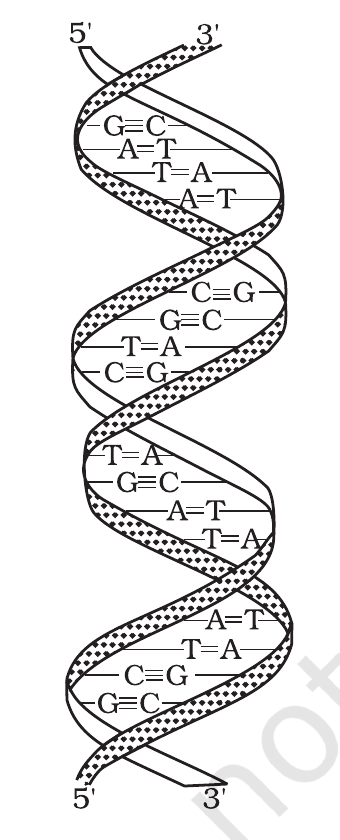
- Secondary structure: James Watson and Francis Crick gave a double strand helix structure for DNA (NCERT Fig. 10.7). Two nucleic acid chains are wound about each other and held together by hydrogen bonds between pairs of bases. The two strands are complementary to each other because the hydrogen bonds are formed between specific pairs of bases. Adenine forms hydrogen bonds with thymine whereas cytosine forms hydrogen bonds with guanine. In NCERT Fig. 10.7 the G-C pairs are drawn with three lines and the A-T pairs with two lines.
- In secondary structure of RNA single stranded helix is present which sometimes folds back on itself. RNA molecules are of three types and they perform different functions. They are named as messenger RNA (m-RNA), ribosomal RNA (r-RNA) and transfer RNA (t-RNA).
- Biological functions (10.5.3): DNA is the chemical basis of heredity and may be regarded as the reserve of genetic information. DNA is exclusively responsible for maintaining the identity of different species of organisms over millions of years. A DNA molecule is capable of self duplication during cell division and identical DNA strands are transferred to daughter cells. Another important function of nucleic acids is the protein synthesis in the cell. Actually, the proteins are synthesised by various RNA molecules in the cell but the message for the synthesis of a particular protein is present in DNA.
- DNA fingerprinting: it is known that every individual has unique fingerprints, but these can be altered by surgery. A sequence of bases on DNA is also unique for a person and information regarding this is called DNA fingerprinting. It is same for every cell and cannot be altered by any known treatment. DNA fingerprinting is now used (i) in forensic laboratories for identification of criminals, (ii) to determine paternity of an individual, (iii) to identify the dead bodies in any accident by comparing the DNA's of parents or children, (iv) to identify racial groups to rewrite biological evolution.
- James Dewey Watson, born in Chicago in 1928, shared the 1962 Nobel Prize in Physiology and Medicine with Francis Crick and Maurice Wilkins for the discovery of the structure of DNA. They proposed that the DNA molecule takes the shape of a double helix, an elegantly simple structure that resembles a gently twisted ladder.
Suggest an edit
Practice1 question
Try it now. A wrong answer costs nothing here, try again until you get it.
A nucleotide from DNA containing thymine is hydrolysed. What products are formed?
NCERT 10.5.1: complete hydrolysis of DNA yields a pentose sugar (beta-D-2-deoxyribose), phosphoric acid and bases. For a thymine nucleotide the base is thymine.
Table: DNA vs RNA
- The structural and functional differences between DNA and RNA, from NCERT 10.5.
| Feature | DNA | RNA |
|---|---|---|
| Sugar | beta-D-2-deoxyribose | beta-D-ribose |
| Bases | Adenine, guanine, cytosine, thymine | Adenine, guanine, cytosine, uracil |
| Strands | Double strand helix (Watson and Crick) | Single stranded helix, sometimes folds back on itself |
| Types | One main type | m-RNA, r-RNA, t-RNA |
| Function | Chemical basis of heredity; reserve of genetic information; self duplication during cell division | Protein synthesis; the message for a particular protein is present in DNA and is carried out by RNA molecules |
- Source: NCERT XII, Ch 10, 10.5.1, 10.5.2 and 10.5.3.
Suggest an edit
Hormones
- Hormones are molecules that act as intercellular messengers. They are produced by endocrine glands in the body and are poured directly into the blood stream, which transports them to the site of action.
- Chemical nature: some hormones are steroids (for example estrogens and androgens), some are polypeptides (for example insulin and endorphins), and some are amino acid derivatives (for example epinephrine and norepinephrine).
- Blood glucose control: insulin is released in response to a rapid rise in blood glucose level and keeps the blood glucose level within the narrow limit, while glucagon tends to increase the glucose level in the blood. Together, these two hormones regulate the glucose level in the blood.
- Response to external stimuli: epinephrine and norepinephrine mediate responses to external stimuli.
- Growth and sex hormones: growth hormones and sex hormones play a role in growth and development. Testosterone is the major sex hormone produced in males (responsible for development of secondary male characteristics); estradiol is the main female sex hormone (responsible for development of secondary female characteristics and control of the menstrual cycle); progesterone prepares the uterus for implantation of the fertilised egg.
- Thyroid hormone: thyroxine produced in the thyroid gland is an iodinated derivative of the amino acid tyrosine. Abnormally low levels of thyroxine lead to hypothyroidism (letharginess and obesity); increased levels cause hyperthyroidism. Low iodine in the diet may lead to hypothyroidism and enlargement of the thyroid gland (controlled largely by adding sodium iodide to commercial table salt, iodised salt).
- Adrenal cortex steroid hormones: glucocorticoids control carbohydrate metabolism, modulate inflammatory reactions and are involved in reactions to stress; mineralocorticoids control the level of excretion of water and salt by the kidney. Failure of the adrenal cortex to function properly results in Addison's disease (hypoglycaemia, weakness and increased susceptibility to stress, fatal unless treated with glucocorticoids and mineralocorticoids).
Suggest an edit
Trap pairs: the confusions NEET tests
- Sucrose vs maltose: sucrose is non-reducing because both reducing groups are bonded in the glycosidic linkage; maltose is reducing because a free aldehyde group can be produced at C1 of the second glucose. Lactose is also reducing.
- D/L vs (+)/(-): D and L describe configuration relative to glyceraldehyde; (+) and (-) describe the direction of rotation of plane polarised light. D(+)-glucose is dextrorotatory, but D-(-)-fructose is laevorotatory although both are D sugars.
- Denaturation: secondary and tertiary structures are destroyed, but the primary structure remains intact. A denatured protein loses biological activity but its amino acid sequence is unchanged.
- Zwitterion vs neutral molecule: an amino acid in zwitter ionic form is neutral overall but carries both a positive and a negative charge. Glycine is the only naturally occurring alpha-amino acid that is not optically active.
- Nucleoside vs nucleotide: a nucleoside is base + sugar; a nucleotide is nucleoside + phosphoric acid at the 5' position. The 2023 NEET question prints "phosphorous acid" in Statement II; NCERT 10.5.2 says phosphoric acid, so that statement is false.
- Enzyme vs polysaccharide: almost all enzymes are globular proteins, not polysaccharides. They are specific biocatalysts that lower activation energy.
Suggest an edit
Trap Boxes
Sucrose is a reducing sugar?
Wrong idea: Sucrose is a sugar, and all sugars reduce Fehling's solution and Tollens' reagent.
Sucrose is a non-reducing sugar: the reducing groups of glucose and fructose are both involved in the glycosidic bond between C1 of alpha-D-glucose and C2 of beta-D-fructose, so no free aldehydic or ketonic group is left.
NCERT XII, Ch 10, 10.1.3
D means dextrorotatory?
Wrong idea: D(+)-glucose is D because it rotates light to the right, and every D sugar is dextrorotatory.
D and L describe configuration relative to glyceraldehyde, not rotation. D-(-)-fructose is a D sugar but laevorotatory, with specific rotation -92.4 degrees.
NCERT XII, Ch 10, 10.1.2.1
Denaturation destroys the primary structure?
Wrong idea: Boiling an egg breaks the protein down to its amino acids, destroying the primary structure.
Denaturation destroys the secondary and tertiary structures but the primary structure remains intact. The coagulated egg white still has the same amino acid sequence; only the shape and biological activity are lost.
NCERT XII, Ch 10, 10.2.4
All amino acids are optically active?
Wrong idea: Every naturally occurring alpha-amino acid is optically active because each has an asymmetric alpha-carbon.
Glycine is the exception: its side chain is hydrogen, so its alpha-carbon is not asymmetric and glycine is not optically active. Most naturally occurring amino acids have L-configuration.
NCERT XII, Ch 10, 10.2.1 and 10.2.2
DNA and RNA have the same sugar and the same bases?
Wrong idea: DNA and RNA differ only in that DNA is double stranded and RNA is single stranded.
DNA has beta-D-2-deoxyribose and thymine; RNA has beta-D-ribose and uracil instead of thymine. Adenine, guanine and cytosine are common to both.
NCERT XII, Ch 10, 10.5.1 and 10.5.2
Chapter test
5 NEET PYQs. +4 for a correct answer, -1 for a wrong answer, exactly like NEET. Finish the test to earn a medal.
Q1: NEET (UG) 2023, Code F1, Q71
Given below are two statements:
Statement I : A unit formed by the attachment of a base to 1' position of sugar is known as nucleoside.
Statement II : When nucleoside is linked to phosphorous acid at 5'-position of sugar moiety, we get nucleotide.
In the light of the above statements, choose the correct answer from the options given below :
NCERT 10.5.2: a nucleoside is a base attached to the 1' position of sugar, so Statement I is true. A nucleotide is a nucleoside linked to phosphoric acid at the 5' position, not phosphorous acid, so Statement II is false.
Q2: NEET (UG) 2022, Code R1, Q52
The incorrect statement regarding enzymes is
NCERT 10.3: almost all enzymes are globular proteins, not polysaccharides. They are specific biocatalysts that reduce the activation energy.
Q3: NEET (UG) 2021, Code P3, Q61
The RBC deficiency is deficiency disease of :
NCERT Table 10.3: deficiency of vitamin B12 causes pernicious anaemia, which is RBC deficient in haemoglobin.
Q4: NEET (UG) 2020, Code G5, Q121
Which of the following is a basic amino acid ?
NCERT 10.2.2: an amino acid with more amino groups than carboxyl groups is basic. Lysine has two amino groups and one carboxyl group.
Q5: NEET (UG) 2020, Code G5, Q91
Sucrose on hydrolysis gives :
NCERT 10.1.3: sucrose on hydrolysis gives an equimolar mixture of D-(+)-glucose and D-(-)-fructose, linked C1 of alpha-D-glucose to C2 of beta-D-fructose.
Score: 0 · Answered 0 of 5
Flashcards
Tap a card to flip it over and see the answer. Tap it again to flip it back.
Give the molecular formula of glucose and the general formula most carbohydrates fit.
Tap to flipGlucose is $C_6H_{12}O_6$. Most carbohydrates fit Cx($H_2O$)y: glucose fits C6($H_2O$)6. The formula is not a safe test: acetic acid $CH_3COOH$ fits C2($H_2O$)2 but is not a carbohydrate, and rhamnose $C_6H_{12}O_5$ is a carbohydrate but does not fit.
Tap to flip backGive the specific rotations of glucose and fructose, and state what invert sugar is.
Tap to flipGlucose +52.5 degrees, fructose -92.4 degrees. Sucrose is dextrorotatory, but its hydrolysis mixture is laevorotatory because the laevorotation of fructose is greater; the product is named invert sugar.
Tap to flip backGlucose has an aldehyde group, so why does it not give Schiff's test or a hydrogensulphite addition product?
Tap to flipIn solution glucose exists mainly as a cyclic hemiacetal, formed by addition of the -OH at C-5 to the -CHO group. There is no free aldehyde group: the pentaacetate of glucose also does not react with hydroxylamine.
Tap to flip backName the aldoses and ketoses with 3, 4, 5, 6 and 7 carbon atoms.
Tap to flip3 carbons: aldotriose, ketotriose. 4: aldotetrose, ketotetrose. 5: aldopentose, ketopentose. 6: aldohexose, ketohexose. 7: aldoheptose, ketoheptose. Glucose is an aldohexose; fructose is a ketohexose.
Tap to flip backWrite the hydrolysis of sucrose.
Tap to flip$C_{12}H_{22}O_{11}$ + $H_2O$ gives $C_6H_{12}O_6$ (glucose) + $C_6H_{12}O_6$ (fructose), in equal amounts, on boiling with dilute $HCl$ or $H_2SO_4$ in alcoholic solution. The linkage broken is the glycosidic linkage between C1 of alpha-D-glucose and C2 of beta-D-fructose.
Tap to flip backWhat are the two components of starch, their shares, and their linkages?
Tap to flipAmylose, 15-20% of starch: long unbranched chain of 200-1000 alpha-D-(+)-glucose units, C1-C4 linkage, water soluble. Amylopectin, 80-85%: branched chain, C1-C4 chain with C1-C6 branching, insoluble in water.
Tap to flip backHow many amino acids does NCERT mark as essential, and which are they?
Tap to flipTen, marked with an asterisk in Table 10.2: valine, leucine, isoleucine, arginine, lysine, threonine, methionine, phenylalanine, tryptophan and histidine. The other ten can be synthesised in the body.
Tap to flip backWhat is a peptide bond, and how does it form?
Tap to flipA peptide bond (-CO-NH-) is an amide formed between the -COOH group of one amino acid and the -NH2 group of the next, with elimination of a water molecule. Glycine + alanine gives the dipeptide glycylalanine.
Tap to flip backName the four levels of protein structure in order.
Tap to flipPrimary: amino acid sequence. Secondary: alpha-helix and beta-pleated sheet. Tertiary: overall folding of the polypeptide chain. Quaternary: spatial arrangement of subunits.
Tap to flip backGive the activation energy for acid hydrolysis of sucrose and for hydrolysis by sucrase.
Tap to flipAcid hydrolysis: 6.22 kJ mol-1. Hydrolysis by the enzyme sucrase: 2.15 kJ mol-1. Enzymes reduce the magnitude of activation energy.
Tap to flip backClassify vitamins A, B1, B2, B6, B12, C, D, E and K as fat soluble or water soluble.
Tap to flipFat soluble: A, D, E, K. They are stored in liver and adipose tissues. Water soluble: B group vitamins and vitamin C. They must be supplied regularly because they are readily excreted in urine and cannot be stored, except vitamin B12.
Tap to flip backWhich bases are in DNA, which are in RNA, and which sugar does each contain?
Tap to flipDNA: adenine, guanine, cytosine, thymine; sugar beta-D-2-deoxyribose. RNA: adenine, guanine, cytosine, uracil; sugar beta-D-ribose. DNA is a double strand helix; RNA is a single stranded helix.
Tap to flip back