 NEET Notes
Home > Chemistry > Physical > Some Basic Concepts of Chemistry
Some Basic Concepts of Chemistry
On this page · 18 sections
- 01Syllabus map
- 02Importance of chemistry
- 03Nature of matter: states and classification
- 04Properties of matter and their measurement
- 05Table 1: SI base units and prefixes
- 06Mass, volume, density and temperature
- 07Scientific notation
- 08Significant figures, precision and accuracy
- 09Dimensional analysis
- 10Laws of chemical combination
- 11Table 2: Laws of chemical combination at a glance
- 12Dalton's atomic theory
- 13Table 3: Atomic, molecular and formula mass
- 14Mole concept and molar mass
- 15Percentage composition and empirical formula
- 16Stoichiometry and limiting reagent
- 17Table 4: Concentration of solutions
- 18Trap pairs: the confusions NEET tests
Matter, SI units, significant figures, the five laws of chemical combination, Dalton's theory, atomic masses, the mole, percentage composition and stoichiometry, all from NCERT Chapter 1.
Syllabus map
- NMC Unit: CHEM-U01, Some Basic Concepts of Chemistry. NCERT Chapter 1, Some Basic Concepts of Chemistry (Class XI).
- Subtopics in this chapter (NCERT XI, Ch 1): importance of chemistry; nature of matter and states of matter; classification of matter; properties of matter and their measurement; the SI system; mass, weight, volume, density and temperature; uncertainty in measurement, scientific notation, significant figures, precision, accuracy and dimensional analysis; laws of chemical combination; Dalton's atomic theory; atomic and molecular masses; mole concept and molar masses; percentage composition and empirical and molecular formulae; stoichiometry and stoichiometric calculations, limiting reagent and reactions in solutions.
- Subtopic checklist: (1) three states of matter and their particle arrangement; (2) homogeneous and heterogeneous mixtures; (3) elements, compounds and mixtures; (4) physical vs chemical properties; (5) seven SI base units and prefixes; (6) density and temperature scales; (7) scientific notation and significant figure rules; (8) precision vs accuracy; (9) dimensional analysis; (10) five laws of chemical combination with examples; (11) Dalton's four postulates; (12) atomic mass, average atomic mass, molecular mass, formula mass; (13) Avogadro constant and molar mass; (14) mass per cent and empirical formula steps; (15) stoichiometry, limiting reagent, molarity, molality, mole fraction, mass per cent.
- Extra information (beyond NCERT): none. This chapter stays inside NCERT Chapter 1 and the NMC CHEM-U01 syllabus.
- Excluded topics: atomic structure is Chapter 2 and chemical bonding is Chapter 4; do not import their facts into this chapter.
- Estimated revision time: 10 minutes. Jump links: Syllabus Map, Importance of Chemistry, Nature of Matter, Properties of Matter, SI Units, Mass Volume Density Temperature, Scientific Notation, Significant Figures, Dimensional Analysis, Laws of Chemical Combination, Laws at a Glance, Dalton's Atomic Theory, Atomic Molecular Formula Mass, Mole Concept, Percentage Composition, Stoichiometry, Concentration of Solutions, Trap Pairs.
Suggest an edit
Importance of chemistry
Chemistry plays a central role in science and is often intertwined with other branches of science. Principles of chemistry apply in diverse areas, such as weather patterns, functioning of brain and operation of a computer, production in chemical industries, manufacturing fertilisers, alkalis, acids, salts, dyes, polymers, drugs, soaps, detergents, metals and alloys, including new material.
Chemistry contributes in a big way to the national economy and to meeting human needs for food, healthcare products and other material aimed at improving the quality of life. Large-scale production of fertilisers and improved varieties of pesticides and insecticides are examples. Chemistry provides methods for the isolation of life-saving drugs from natural sources and makes possible synthesis of such drugs. Cisplatin and taxol are effective in cancer therapy. The drug AZT (Azidothymidine) is used for helping AIDS patients.
With a better understanding of chemical principles it has become possible to design and synthesise new material having specific magnetic, electric and optical properties, such as superconducting ceramics, conducting polymers and optical fibres.
Chemistry has helped in dealing with environmental degradation. Safer alternatives to environmentally hazardous refrigerants like CFCs (chlorofluorocarbons), responsible for ozone depletion in the stratosphere, have been synthesised. Management of the Green House gases, like methane and carbon dioxide, continues to be a matter of grave concern. Understanding of biochemical processes, use of enzymes for large-scale production of chemicals and synthesis of new exotic material are intellectual challenges for the future generation of chemists.
Suggest an edit
Nature of matter: states and classification
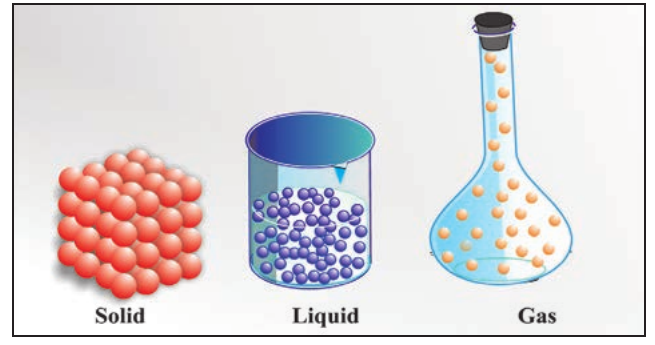
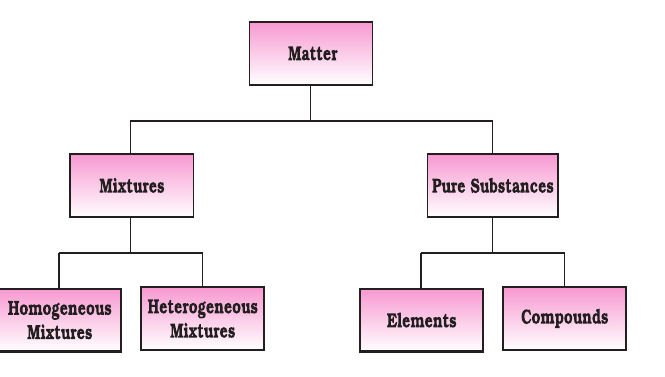
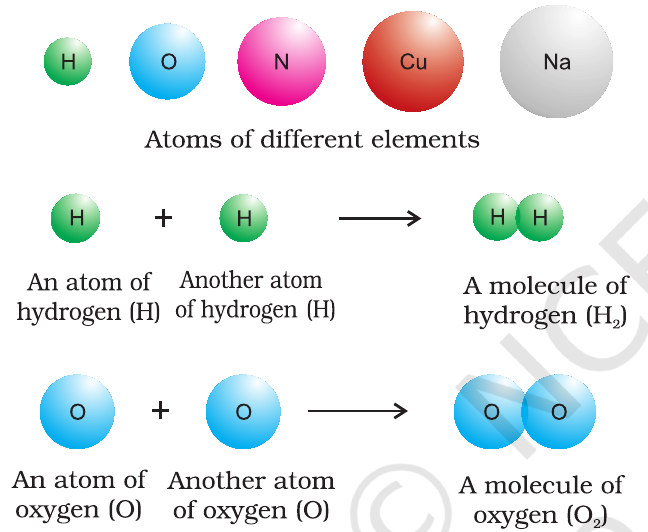
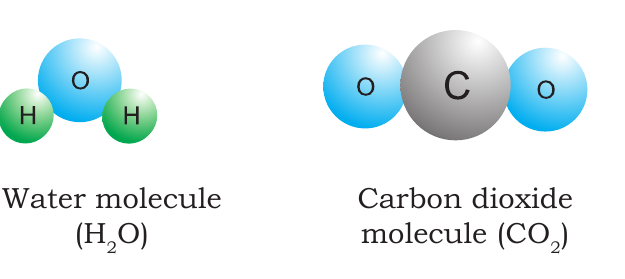
Anything which has mass and occupies space is called matter. Everything around us, for example, book, pen, pencil, water, air and all living beings, is composed of matter.
Matter can exist in three physical states: solid, liquid and gas. Particles are held very close to each other in solids in an orderly fashion and there is not much freedom of movement. In liquids, the particles are close to each other but they can move around. In gases, the particles are far apart as compared to those in solid or liquid states and their movement is easy and fast.
- Solids have definite volume and definite shape.
- Liquids have definite volume but do not have definite shape. They take the shape of the container in which they are placed.
- Gases have neither definite volume nor definite shape. They completely occupy the space in the container in which they are placed.
These three states of matter are interconvertible by changing the conditions of temperature and pressure. On heating, a solid usually changes to a liquid, and the liquid on further heating changes to gas (or vapour). In the reverse process, a gas on cooling liquifies to the liquid and the liquid on further cooling freezes to the solid.
At the macroscopic or bulk level, matter can be classified as mixture or pure substance. When all constituent particles of a substance are same in chemical nature, it is said to be a pure substance. A mixture contains particles of two or more pure substances which may be present in it in any ratio, so its composition is variable. Pure substances forming a mixture are called its components.
A mixture may be homogeneous or heterogeneous. In a homogeneous mixture, the components completely mix with each other, the particles are uniformly distributed and the composition is uniform throughout. Sugar solution and air are examples of homogeneous mixtures. In a heterogeneous mixture, the composition is not uniform throughout and sometimes different components are visible. Mixtures of salt and sugar, and grains and pulses along with some dirt, are heterogeneous mixtures. The components of a mixture can be separated by using physical methods, such as simple hand-picking, filtration, crystallisation and distillation.
Pure substances have fixed composition. Copper, silver, gold, water and glucose are some examples. Glucose contains carbon, hydrogen and oxygen in a fixed ratio. The constituents of a pure substance cannot be separated by simple physical methods.
Pure substances can further be classified into elements and compounds. Particles of an element consist of only one type of atoms. Sodium, copper, silver, hydrogen and oxygen are some examples of elements. Some elements, such as sodium or copper, contain atoms as their constituent particles, whereas in some others, the constituent particles are molecules formed by two or more atoms. These particles may exist as atoms or molecules. Hydrogen, nitrogen and oxygen gases consist of molecules in which two atoms combine.
When two or more atoms of different elements combine together in a definite ratio, the molecule of a compound is obtained. The constituents of a compound cannot be separated into simpler substances by physical methods; they can be separated by chemical methods. Water, ammonia, carbon dioxide and sugar are examples of compounds. A water molecule comprises two hydrogen atoms and one oxygen atom. A molecule of carbon dioxide contains two oxygen atoms combined with one carbon atom.
The atoms of different elements are present in a compound in a fixed and definite ratio, and this ratio is characteristic of a particular compound. The properties of a compound are different from those of its constituent elements. Hydrogen and oxygen are gases, whereas water, the compound formed by their combination, is a liquid. Hydrogen burns with a pop sound and oxygen is a supporter of combustion, but water is used as a fire extinguisher.
Suggest an edit
Practice1 question
Try it now. A wrong answer costs nothing here, try again until you get it.
Which one of the following is a homogeneous mixture?
NCERT 1.2.2: air is a homogeneous mixture, its components mix completely and its composition is uniform throughout. Salt and sugar, and grains with dirt, are heterogeneous.
Properties of matter and their measurement
Every substance has unique or characteristic properties. These properties can be classified into two categories: physical properties, such as colour, odour, melting point, boiling point and density, and chemical properties, like composition, combustibility and reactivity with acids and bases.
Physical properties can be measured or observed without changing the identity or the composition of the substance. The measurement or observation of chemical properties requires a chemical change to occur. Examples of chemical properties are characteristic reactions of different substances; these include acidity or basicity and combustibility.
Quantitative measurement of properties is required for scientific investigation. Any quantitative observation or measurement is represented by a number followed by units in which it is measured. For example, the length of a room can be represented as 6 m; here, 6 is the number and m denotes metre, the unit in which the length is measured.
Earlier, two different systems of measurement, the English System and the Metric System, were used in different parts of the world. The metric system, which originated in France in late eighteenth century, was more convenient as it was based on the decimal system. Later, need of a common standard system was felt by the scientific community. Such a system was established in 1960 and is discussed in the next section.
Suggest an edit
Table 1: SI base units and prefixes
The International System of Units (in French Le Système International d'Unités, abbreviated as SI) was established by the 11th General Conference on Weights and Measures (CGPM from Conference Generale des Poids et Mesures). The SI system has seven base units and they pertain to the seven fundamental scientific quantities. Other physical quantities, such as speed, volume and density, can be derived from these quantities.
| Base physical quantity | Symbol for quantity | Name of SI unit | Symbol for SI unit |
|---|---|---|---|
| Length | $l$ | metre | m |
| Mass | $m$ | kilogram | kg |
| Time | $t$ | second | s |
| Electric current | $I$ | ampere | A |
| Thermodynamic temperature | $T$ | kelvin | K |
| Amount of substance | $n$ | mole | mol |
| Luminous intensity | $I_v$ | candela | cd |
The SI system allows the use of prefixes to indicate the multiples or submultiples of a unit.
| Multiple | Prefix | Symbol |
|---|---|---|
| $10^{-24}$ | yocto | y |
| $10^{-21}$ | zepto | z |
| $10^{-18}$ | atto | a |
| $10^{-15}$ | femto | f |
| $10^{-12}$ | pico | p |
| $10^{-9}$ | nano | n |
| $10^{-6}$ | micro | µ |
| $10^{-3}$ | milli | m |
| $10^{-2}$ | centi | c |
| $10^{-1}$ | deci | d |
| 10 | deca | da |
| $10^{2}$ | hecto | h |
| $10^{3}$ | kilo | k |
| $10^{6}$ | mega | M |
| $10^{9}$ | giga | G |
| $10^{12}$ | tera | T |
| $10^{15}$ | peta | P |
| $10^{18}$ | exa | E |
| $10^{21}$ | zeta | Z |
| $10^{24}$ | yotta | Y |
Table 1.2: Definitions of SI Base Units:
| Unit | Definition |
|---|---|
| Unit of length: metre | The metre, symbol m, is the SI unit of length. It is defined by taking the fixed numerical value of the speed of light in vacuum $c$ to be 299792458 when expressed in the unit m s$^{-1}$, where the second is defined in terms of the caesium frequency $\Delta\nu_{Cs}$. |
| Unit of mass: kilogram | The kilogram, symbol kg, is the SI unit of mass. It is defined by taking the fixed numerical value of the Planck constant $h$ to be 6.62607015×$10^{-34}$ when expressed in the unit J s, which is equal to kg m$^{2}$ s$^{-1}$, where the metre and the second are defined in terms of $c$ and $\Delta\nu_{Cs}$. |
| Unit of time: second | The second, symbol s, is the SI unit of time. It is defined by taking the fixed numerical value of the caesium frequency $\Delta\nu_{Cs}$, the unperturbed ground-state hyperfine transition frequency of the caesium-133 atom, to be 9192631770 when expressed in the unit Hz, which is equal to s$^{-1}$. |
| Unit of electric current: ampere | The ampere, symbol A, is the SI unit of electric current. It is defined by taking the fixed numerical value of the elementary charge $e$ to be 1.602176634×$10^{-19}$ when expressed in the unit C, which is equal to A s, where the second is defined in terms of $\Delta\nu_{Cs}$. |
| Unit of thermodynamic temperature: kelvin | The Kelvin, symbol k, is the SI unit of thermodynamic temperature. It is defined by taking the fixed numerical value of the Boltzmann constant $k$ to be 1.380649×$10^{-23}$ when expressed in the unit J K$^{-1}$, which is equal to kg m$^{2}$ s$^{-2}$ K$^{-1}$, where the kilogram, metre and second are defined in terms of $h$, $c$ and $\Delta\nu_{Cs}$. |
| Unit of amount of substance: mole | The mole, symbol mol, is the SI unit of amount of substance. One mole contains exactly 6.02214076×$10^{23}$ elementary entities. This number is the fixed numerical value of the Avogadro constant, $N_A$, when expressed in the unit mol$^{-1}$ and is called the Avogadro number. The amount of substance, symbol $n$, of a system is a measure of the number of specified elementary entities. An elementary entity may be an atom, a molecule, an ion, an electron, any other particle or specified group of particles. |
| Unit of luminous intensity: Candela | The candela, symbol cd, is the SI unit of luminous intensity in a given direction. It is defined by taking the fixed numerical value of the luminous efficacy of monochromatic radiation of frequency 540×$10^{12}$ Hz, $K_{cd}$, to be 683 when expressed in the unit lm W$^{-1}$, which is equal to cd sr W$^{-1}$, or cd sr kg$^{-1}$ m$^{-2}$ s$^{3}$, where the kilogram, metre and second are defined in terms of $h$, $c$ and $\Delta\nu_{Cs}$. |
Source: NCERT XI, Ch 1, 1.3.3, Tables 1.1, 1.2 and 1.3.
Suggest an edit
Practice1 question
Try it now. A wrong answer costs nothing here, try again until you get it.
What is the SI unit of amount of substance?
NCERT 1.3.3, Table 1.1: the SI base unit for amount of substance is the mole, symbol mol.
Mass, volume, density and temperature
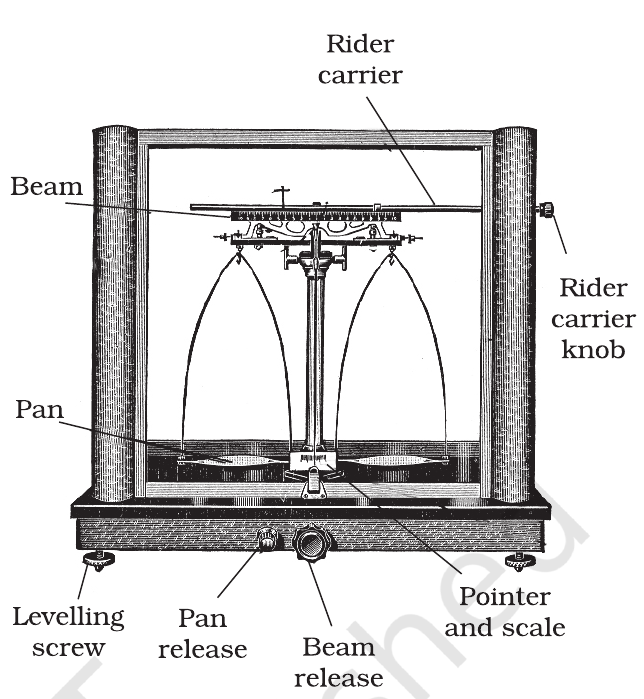
Mass of a substance is the amount of matter present in it, while weight is the force exerted by gravity on an object. The mass of a substance is constant, whereas its weight may vary from one place to another due to change in gravity. The mass of a substance can be determined accurately in the laboratory by using an analytical balance. The SI unit of mass is kilogram. However, its fraction named as gram (1 kg = 1000 g) is used in laboratories due to the smaller amounts of chemicals used in chemical reactions.
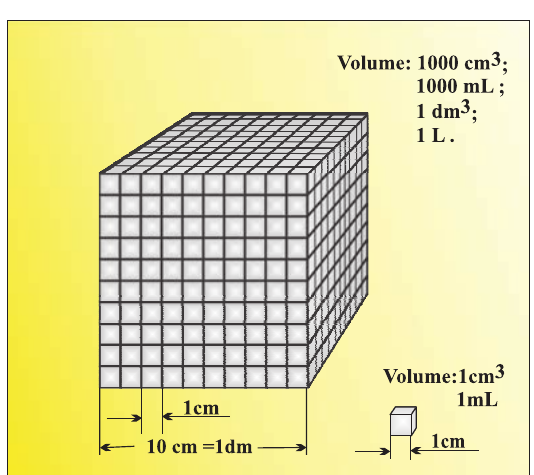
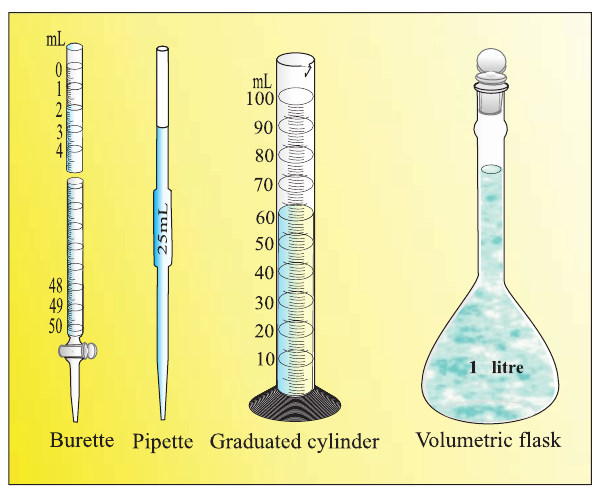
Volume is the amount of space occupied by a substance. It has the units of (length)^3, so in the SI system, volume has units of m3. In chemistry laboratories, smaller volumes are used, so volume is often denoted in cm3 or dm3 units. A common unit, litre (L), which is not an SI unit, is used for measurement of volume of liquids. 1 L = 1000 mL, 1000 cm3 = 1 dm3. In the laboratory, the volume of liquids or solutions can be measured by graduated cylinder, burette and pipette. A volumetric flask is used to prepare a known volume of a solution.
Density = Mass / Volume. Density of a substance is its amount of mass per unit volume. SI unit of density is kg m-3. This unit is quite large and a chemist often expresses density in g cm-3, where mass is expressed in gram and volume is expressed in cm3. Density tells us about how closely the particles of a substance are packed. If density is more, it means particles are more closely packed.
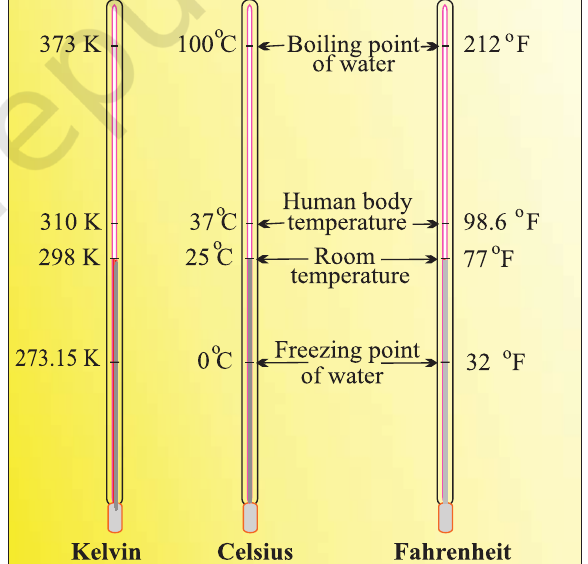
There are three common scales to measure temperature: °C (degree celsius), °F (degree fahrenheit) and K (kelvin). Here, K is the SI unit. The thermometer with celsius scale is calibrated from 0 to 100, where these two temperatures are the freezing point and the boiling point of water, respectively. The fahrenheit scale is represented between 32 to 212.
°F = (9/5)(°C) + 32
K = °C + 273.15
It is interesting to note that temperature below 0 °C (negative values) are possible in Celsius scale but in Kelvin scale, negative temperature is not possible.
Suggest an edit
Scientific notation
Chemistry is the study of atoms and molecules, which have extremely low masses and are present in extremely large numbers, so a chemist has to deal with numbers as large as 602,200,000,000,000,000,000,000 for the molecules of 2 g of hydrogen gas or as small as 0.00000000000000000000000166 g, the mass of a H atom.
This problem is solved by using scientific notation, that is, exponential notation in which any number can be represented in the form N x $10^{n}$, where n is an exponent having positive or negative values and N is a number (called digit term) which varies between 1.000... and 9.999....
232.508 can be written as 2.32508 x $10^{2}$ in scientific notation. The decimal had to be moved to the left by two places and same is the exponent (2) of 10. Similarly, 0.00016 can be written as 1.6 x $10^{-4}$. Here, the decimal has to be moved four places to the right and (-4) is the exponent.
Multiplication and division follow the same rules as for exponential numbers. (5.6 x $10^{5}$) x (6.9 x $10^{8}$) = 3.864 x $10^{14}$. (9.8 x $10^{-2}$) x (2.5 x $10^{-6}$) = 2.450 x $10^{-7}$. (2.7 x $10^{-3}$) / (5.5 x $10^{4}$) = 4.909 x $10^{-8}$.
For addition and subtraction, first the numbers are written in such a way that they have the same exponent. After that, the coefficients (digit terms) are added or subtracted. (6.65 x $10^{4}$) + (8.95 x $10^{3}$) = (6.65 x $10^{4}$) + (0.895 x $10^{4}$) = 7.545 x $10^{4}$. (2.5 x $10^{-2}$) - (4.8 x $10^{-3}$) = (2.5 x $10^{-2}$) - (0.48 x $10^{-2}$) = 2.02 x $10^{-2}$.
Suggest an edit
Significant figures, precision and accuracy
Every experimental measurement has some amount of uncertainty associated with it because of limitation of measuring instrument and the skill of the person making the measurement. The uncertainty in the experimental or the calculated values is indicated by mentioning the number of significant figures. Significant figures are meaningful digits which are known with certainty plus one which is estimated or uncertain. Unless otherwise stated, an uncertainty of ±1 in the last digit is always understood.
Rules for determining the number of significant figures:
- All non-zero digits are significant. In 285 cm, there are three significant figures and in 0.25 mL, there are two significant figures.
- Zeros preceding the first non-zero digit are not significant. Such zero indicates the position of the decimal point. 0.03 has one significant figure and 0.0052 has two significant figures.
- Zeros between two non-zero digits are significant. 2.005 has four significant figures.
- Zeros at the end or right of a number are significant, provided they are on the right side of the decimal point. 0.200 g has three significant figures. But terminal zeros are not significant if there is no decimal point. 100 has only one significant figure, but 100. has three significant figures and 100.0 has four significant figures. Such numbers are better represented in scientific notation: 1 x $10^{2}$ for one significant figure, 1.0 x $10^{2}$ for two significant figures and 1.00 x $10^{2}$ for three significant figures.
- Counting numbers of objects, for example, 2 balls or 20 eggs, have infinite significant figures as these are exact numbers.
- In numbers written in scientific notation, all digits are significant. 4.01 x $10^{2}$ has three significant figures, and 8.256 x $10^{-3}$ has four significant figures.
Precision refers to the closeness of various measurements for the same quantity. Accuracy is the agreement of a particular value to the true value of the result. If the true value for a result is 2.00 g and student A takes two measurements and reports 1.95 g and 1.93 g, these values are precise as they are close to each other but are not accurate. Student B obtains 1.94 g and 2.05 g; these observations are neither precise nor accurate. Student C reports 2.01 g and 1.99 g; these values are both precise and accurate. Table 1.4: Data to Illustrate Precision and Accuracy:
| Measurement 1 | Measurement 2 | Average (g) | |
|---|---|---|---|
| Student A | 1.95 | 1.93 | 1.940 |
| Student B | 1.94 | 2.05 | 1.995 |
| Student C | 2.01 | 1.99 | 2.000 |
Addition and subtraction of significant figures: the result cannot have more digits to the right of the decimal point than either of the original numbers. 12.11 + 18.0 + 1.012 = 31.122, reported as 31.1, because 18.0 has only one digit after the decimal point.
Multiplication and division of significant figures: the result must be reported with no more significant figures than in the measurement with the fewest significant figures. 2.5 x 1.25 = 3.125, reported as 3.1, since 2.5 has two significant figures.
Rounding off rules:
- If the rightmost digit to be removed is more than 5, the preceding number is increased by one. 1.386 rounded to 1.39.
- If the rightmost digit to be removed is less than 5, the preceding number is not changed. 4.334 rounded to 4.33.
- If the rightmost digit to be removed is 5, then the preceding number is not changed if it is an even number but it is increased by one if it is an odd number. 6.35 rounded to 6.4, but 6.25 rounded to 6.2.
Suggest an edit
Practice1 question
Try it now. A wrong answer costs nothing here, try again until you get it.
How many significant figures are present in 0.0052?
NCERT 1.4.2, rule 2: zeros before the first non-zero digit are not significant. 0.0052 has two significant figures.
Dimensional analysis
Often while calculating, there is a need to convert units from one system to the other. The method used to accomplish this is called factor label method or unit factor method or dimensional analysis.
We know that 1 in = 2.54 cm. From this equivalence, we can write 1 in / 2.54 cm = 1 = 2.54 cm / 1 in. Both of these are called unit factors. If some number is multiplied by these unit factors (that is, 1), it will not be affected otherwise. A piece of metal is 3 in long. 3 in = 3 in x (2.54 cm / 1 in) = 3 x 2.54 cm = 7.62 cm. The unit factor by which multiplication is to be done is that unit factor which gives the desired units; the numerator should have that part which is required in the desired result. Units can be handled just like other numerical parts: they can be cancelled, divided, multiplied and squared.
A jug contains 2 L of milk. Calculate the volume of the milk in m3. Since 1 L = 1000 cm3 and 1 m = 100 cm, 2 L = 2 x 1000 cm3 x (1 m3 / $10^{6}$ cm3) = 2 x $10^{-3}$ m3.
How many seconds are there in 2 days? 1 day = 24 h, 1 h = 60 min, 1 min = 60 s. 2 days x (24 h / 1 day) x (60 min / 1 h) x (60 s / 1 min) = 2 x 24 x 60 x 60 s = 172800 s.
Suggest an edit
Laws of chemical combination
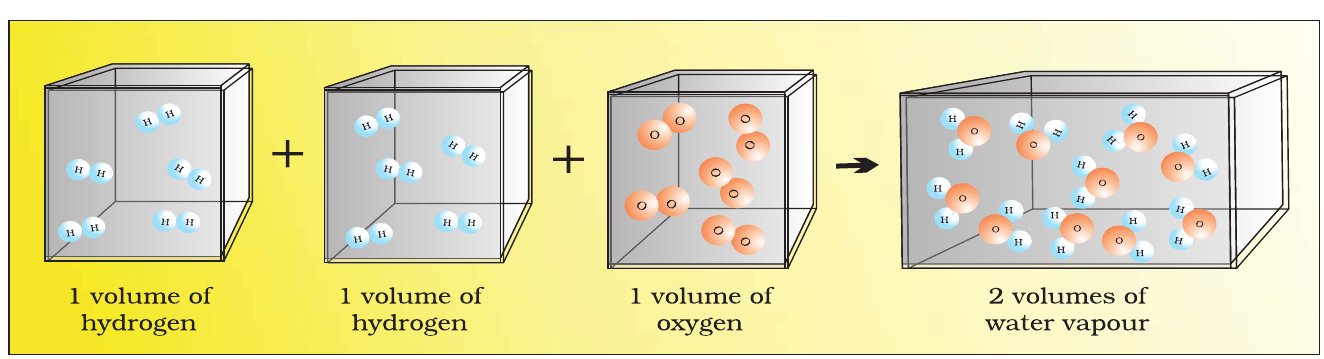
The combination of elements to form compounds is governed by five basic laws.
Law of Conservation of Mass (Antoine Lavoisier, 1789): In all physical and chemical changes, there is no net change in mass during the process. Matter can neither be created nor destroyed. This law formed the basis for several later developments in chemistry.
Law of Definite Proportions (Joseph Proust): A given compound always contains exactly the same proportion of elements by weight. Proust worked with two samples of cupric carbonate, one of natural origin and the other synthetic. Both had the same composition:
| Sample | % of copper | % of carbon | % of oxygen | |
|---|---|---|---|---|
| Natural Sample | 51.35 | 9.74 | 38.91 | |
| Synthetic Sample | 51.35 | 9.74 | 38.91 | Irrespective of the source, a given compound always contains same elements combined together in the same proportion by mass. It is sometimes also referred to as Law of Definite Composition. |
Law of Multiple Proportions (Dalton, 1803): If two elements can combine to form more than one compound, the masses of one element that combine with a fixed mass of the other element are in the ratio of small whole numbers. Hydrogen combines with oxygen to form water and hydrogen peroxide. Hydrogen + Oxygen -> Water: 2 g + 16 g = 18 g. Hydrogen + Oxygen -> Hydrogen Peroxide: 2 g + 32 g = 34 g. The masses of oxygen (16 g and 32 g) which combine with a fixed mass of hydrogen (2 g) bear a simple ratio, 16:32 or 1:2.
Gay-Lussac's Law of Gaseous Volumes (Gay-Lussac, 1808): When gases combine or are produced in a chemical reaction they do so in a simple ratio by volume, provided all gases are at the same temperature and pressure. 100 mL of hydrogen combine with 50 mL of oxygen to give 100 mL of water vapour. The volumes of hydrogen and oxygen which combine (100 mL and 50 mL) bear a simple ratio of 2:1.
Avogadro's Law (Avogadro, 1811): Equal volumes of all gases at the same temperature and pressure should contain equal number of molecules. Two volumes of hydrogen combine with one volume of oxygen to give two volumes of water without leaving any unreacted oxygen (Fig. 1.9). Avogadro could explain this by considering the molecules to be polyatomic: hydrogen and oxygen as diatomic. After about 50 years, in 1860, the first international conference on chemistry was held in Karlsruhe, Germany. At the meeting, Stanislao Cannizzaro presented a sketch of a course of chemical philosophy which emphasised the importance of Avogadro's work.
Suggest an edit
Practice1 question
Try it now. A wrong answer costs nothing here, try again until you get it.
100 mL of hydrogen combines with 50 mL of oxygen to give 100 mL of water vapour. What is the volume ratio of hydrogen to oxygen?
NCERT 1.5.4: 100 mL of hydrogen combine with 50 mL of oxygen to give 100 mL of water vapour, a simple volume ratio of 2:1.
Table 2: Laws of chemical combination at a glance
| Law | Given by | Statement | NCERT example |
|---|---|---|---|
| Law of Conservation of Mass | Lavoisier, 1789 | Matter can neither be created nor destroyed; no net change in mass in physical and chemical changes | Combustion reactions studied by Lavoisier |
| Law of Definite Proportions | Proust | A given compound always contains exactly the same proportion of elements by weight | Cupric carbonate, natural and synthetic: Cu 51.35%, C 9.74%, O 38.91% |
| Law of Multiple Proportions | Dalton, 1803 | Masses of one element combining with a fixed mass of the other are in the ratio of small whole numbers | $H_2O$: 2 g H + 16 g O; $H_2O_2$: 2 g H + 32 g O; ratio 1:2 |
| Gay-Lussac's Law of Gaseous Volumes | Gay-Lussac, 1808 | Gases combine or are produced in a simple ratio by volume at the same temperature and pressure | 100 mL $H_2$ + 50 mL $O_2$ -> 100 mL water vapour; ratio 2:1 |
| Avogadro's Law | Avogadro, 1811 | Equal volumes of all gases at the same temperature and pressure contain equal number of molecules | 2 volumes $H_2$ + 1 volume $O_2$ -> 2 volumes water vapour (Fig. 1.9) |
Source: NCERT XI, Ch 1, 1.5.
Suggest an edit
Dalton's atomic theory
Although the origin of the idea that matter is composed of small indivisible particles called 'a-tomio' (meaning, indivisible) dates back to the time of Democritus, a Greek Philosopher (460-370 BC), it again started emerging as a result of several experimental studies which led to the laws mentioned above.
In 1808, Dalton published 'A New System of Chemical Philosophy', in which he proposed:
- Matter consists of indivisible atoms.
- All atoms of a given element have identical properties, including identical mass. Atoms of different elements differ in mass.
- Compounds are formed when atoms of different elements combine in a fixed ratio.
- Chemical reactions involve reorganisation of atoms. These are neither created nor destroyed in a chemical reaction.
Dalton's theory could explain the laws of chemical combination. However, it could not explain the laws of gaseous volumes. It could not provide the reason for combining of atoms, which was answered later by other scientists.
Suggest an edit
Table 3: Atomic, molecular and formula mass
The present system of atomic masses is based on carbon-12 as the standard and has been agreed upon in 1961. Carbon-12 is one of the isotopes of carbon and can be represented as 12C. In this system, 12C is assigned a mass of exactly 12 atomic mass unit (amu) and masses of all other atoms are given relative to this standard. One atomic mass unit is defined as a mass exactly equal to one-twelfth of the mass of one carbon-12 atom. 1 amu = 1.66056 x $10^{-24}$ g. At present, 'amu' has been replaced by 'u', which is known as unified mass. Mass of an atom of hydrogen = 1.6736 x $10^{-24}$ g; in terms of amu, the mass of hydrogen atom = 1.0078 amu = 1.0080 amu. The mass of oxygen-16 (16O) atom would be 15.995 amu.
Many naturally occurring elements exist as more than one isotope. When we take into account the existence of these isotopes and their relative abundance (per cent occurrence), the average atomic mass of that element can be computed. The atomic masses mentioned in the periodic table for different elements actually represent their average atomic masses.
Molecular mass is the sum of atomic masses of the elements present in a molecule. It is obtained by multiplying the atomic mass of each element by the number of its atoms and adding them together.
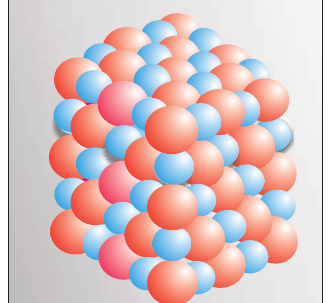
Some substances, such as sodium chloride, do not contain discrete molecules as their constituent units. In such compounds, positive (sodium) and negative (chloride) entities are arranged in a three-dimensional structure (NCERT Fig. 1.10). In sodium chloride, one $Na^+$ ion is surrounded by six $Cl^-$ ions and vice-versa. The formula, such as $NaCl$, is used to calculate the formula mass instead of molecular mass, as in the solid state sodium chloride does not exist as a single entity.
| Term | What it means | NCERT value |
|---|---|---|
| Atomic mass | Mass of one atom relative to 12C = 12 u exactly | H = 1.0080 u; 16O = 15.995 u; 1 amu = 1.66056 x $10^{-24}$ g |
| Average atomic mass | Weighted mean over isotopes by relative abundance | Carbon = 12.011 u (12C 98.892%, 13C 1.108%, 14C 2 x $10^{-10}$%) |
| Molecular mass | Sum of atomic masses of all atoms in the molecule | $CH_4$ = 16.043 u; $H_2O$ = 18.02 u; glucose $C_6H_{12}O_6$ = 180.162 u |
| Formula mass | Sum of atomic masses in the formula unit, used where no discrete molecule exists | $NaCl$ = 23.0 u + 35.5 u = 58.5 u |
Carbon isotopes and their relative abundances (NCERT §1.7.2):
| Isotope | Relative Abundance (%) | Atomic Mass (amu) |
|---|---|---|
| 12C | 98.892 | 12 |
| 13C | 1.108 | 13.00335 |
| 14C | 2 × $10^{-10}$ | 14.00317 |
From these data, the average atomic mass of carbon = (0.98892)(12 u) + (0.01108)(13.00335 u) + (2 × $10^{-12}$)(14.00317 u) = 12.011 u.
Source: NCERT XI, Ch 1, 1.7.
Suggest an edit
Mole concept and molar mass
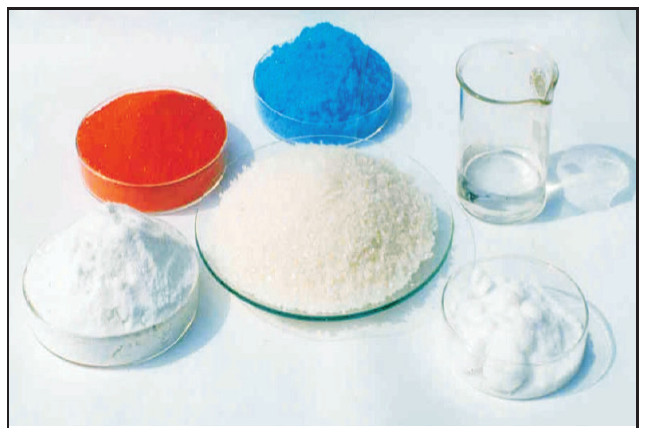
Atoms and molecules are extremely small in size and their numbers in even a small amount of any substance is really very large. To handle such large numbers, a unit of convenient magnitude is required. Just as we denote one dozen for 12 items, score for 20 items and gross for 144 items, we use the idea of mole to count entities at the microscopic level (atoms, molecules, particles, electrons, ions).
In the SI system, mole (symbol, mol) was introduced as the seventh base quantity for the amount of a substance. The mole, symbol mol, is the SI unit of amount of substance. One mole contains exactly 6.02214076 x $10^{23}$ elementary entities. This number is the fixed numerical value of the Avogadro constant, $N_A$, when expressed in the unit mol-1 and is called the Avogadro number. The amount of substance, symbol n, of a system is a measure of the number of specified elementary entities. Written with all zeroes, without using any powers of ten, the Avogadro number is 602213670000000000000000. An elementary entity may be an atom, a molecule, an ion, an electron, any other particle or specified group of particles. The mole of a substance always contains the same number of entities, no matter what the substance may be.
In order to determine this number precisely, the mass of a carbon-12 atom was determined by a mass spectrometer and found to be equal to 1.992648 x $10^{-23}$ g. Knowing that one mole of carbon weighs 12 g, the number of atoms in it is 12 g/mol divided by 1.992648 x $10^{-23}$ g per 12C atom = 6.0221367 x $10^{23}$ atoms/mol.
- 1 mol of hydrogen atoms = 6.022 x $10^{23}$ atoms
- 1 mol of water molecules = 6.022 x $10^{23}$ water molecules
- 1 mol of sodium chloride = 6.022 x $10^{23}$ formula units of sodium chloride
The mass of one mole of a substance in grams is called its molar mass. The molar mass in grams is numerically equal to atomic/molecular/formula mass in u.
- Molar mass of water = 18.02 g mol-1
- Molar mass of sodium chloride = 58.5 g mol-1
Suggest an edit
Practice1 question
Try it now. A wrong answer costs nothing here, try again until you get it.
One mole of water molecules contains how many molecules?
NCERT 1.8: one mole of water molecules is 6.022 x $10^{23}$ water molecules.
Percentage composition and empirical formula
Many a time, information regarding the percentage of a particular element present in a compound is required. One can check the purity of a given sample by analysing this data.
Mass per cent of an element = (mass of that element in the compound x 100) / molar mass of the compound
For water ($H_2O$), molar mass = 18.02 g. Mass per cent of hydrogen = 11.18. Mass per cent of oxygen = 88.79. For ethanol ($C_2H_5OH$), molar mass = (2 x 12.01 + 6 x 1.008 + 16.00) g = 46.068 g. Mass per cent of carbon = 52.14%. Mass per cent of hydrogen = 13.13%. Mass per cent of oxygen = 34.73%.
An empirical formula represents the simplest whole number ratio of various atoms present in a compound, whereas the molecular formula shows the exact number of different types of atoms present in a molecule of a compound. If the mass per cent of various elements present in a compound is known, its empirical formula can be determined. The molecular formula can further be obtained if the molar mass is known.
Problem 1.2: a compound contains 4.07% hydrogen, 24.27% carbon and 71.65% chlorine. Its molar mass is 98.96 g. Step 1: use 100 g of the compound, so 4.07 g hydrogen, 24.27 g carbon and 71.65 g chlorine are present. Step 2: divide by atomic masses to get moles: hydrogen 4.04, carbon 2.021, chlorine 2.021. Step 3: divide each mole value by the smallest number, 2.021, giving a ratio of 2:1:1 for H:C:Cl. Step 4: the empirical formula is $CH_2Cl$. Step 5: empirical formula mass = 12.01 + (2 x 1.008) + 35.453 = 49.48 g. Divide molar mass by empirical formula mass: 98.96 / 49.48 = 2 = n. Multiply the empirical formula by n: the molecular formula is $C_2H_4Cl_2$.
Suggest an edit
Stoichiometry and limiting reagent
The word 'stoichiometry' is derived from two Greek words, stoicheion (meaning, element) and metron (meaning, measure). Stoichiometry deals with the calculation of masses (sometimes volumes also) of the reactants and the products involved in a chemical reaction.
A balanced chemical equation has the same number of atoms of each element on both sides of the equation, by the law of conservation of mass. Many chemical equations can be balanced by trial and error. Always remember that subscripts in formulas of reactants and products cannot be changed to balance an equation. 4Fe(s) + 3O2(g) -> 2Fe2O3(s) and 2Mg(s) + $O_2$(g) -> 2MgO(s) are balanced. $P_4$(s) + $O_2$(g) -> $P_4O_{10}$(s) is not balanced; placing the coefficient 5 on the left of oxygen gives $P_4$(s) + 5O2(g) -> $P_4O_{10}$(s). Combustion of propane: $C_3H_8$(g) + 5O2(g) -> 3CO2(g) + 4H2O(l). The equation shows three carbon atoms, eight hydrogen atoms and 10 oxygen atoms on each side.
Combustion of methane: $CH_4$(g) + 2O2(g) -> $CO_2$(g) + 2H2O(g). The coefficients 2 for $O_2$ and $H_2O$ are called stoichiometric coefficients. They represent the number of molecules (and moles as well) taking part in the reaction or formed in the reaction.
- One mole of $CH_4$(g) reacts with two moles of $O_2$(g) to give one mole of $CO_2$(g) and two moles of $H_2O$(g)
- One molecule of $CH_4$(g) reacts with 2 molecules of $O_2$(g) to give one molecule of $CO_2$(g) and 2 molecules of $H_2O$(g)
- 22.7 L of $CH_4$(g) reacts with 45.4 L of $O_2$(g) to give 22.7 L of $CO_2$(g) and 45.4 L of $H_2O$(g)
- 16 g of $CH_4$(g) reacts with 2 x 32 g of $O_2$(g) to give 44 g of $CO_2$(g) and 2 x 18 g of $H_2O$(g)
From these relationships, the given data can be interconverted as follows: mass ⇌ moles ⇌ no. of molecules; Mass / Volume = Density.
Problem 1.3: 16 g of methane gives 36 g of water on combustion, because 1 mol of $CH_4$ gives 2 mol of $H_2O$, and 2 mol of water = 2 x 18 = 36 g. Problem 1.4: 22 g of $CO_2$ is 0.5 mol, so 0.5 mol of $CH_4$ is required to produce it.
Limiting reagent: many a time, reactions are carried out with amounts of reactants different from the amounts required by a balanced chemical reaction. One reactant is in more amount than required. The reactant which is present in the least amount gets consumed after some time and after that further reaction does not take place whatever be the amount of the other reactant. Hence, the reactant which gets consumed first limits the amount of product formed and is therefore called the limiting reagent.
Problem 1.5: 50.0 kg of $N_2$(g) and 10.0 kg of $H_2$(g) are mixed to produce $NH_3$(g). Moles of $N_2$ = 17.86 x $10^{2}$ mol; moles of $H_2$ = 4.96 x $10^{3}$ mol. 1 mol of $N_2$ requires 3 mol of $H_2$, so 17.86 x $10^{2}$ mol of $N_2$ would need 5.36 x $10^{3}$ mol of $H_2$, but only 4.96 x $10^{3}$ mol of $H_2$ is available. Dihydrogen is the limiting reagent. $NH_3$ formed = 3.30 x $10^{3}$ mol = 56.1 kg.
Suggest an edit
Table 4: Concentration of solutions
A majority of reactions in the laboratories are carried out in solutions. The concentration of a solution, or the amount of substance present in its given volume, can be expressed in four ways: mass per cent or weight per cent (w/w %), mole fraction, molarity and molality.
| Way | Definition | NCERT worked value |
|---|---|---|
| Mass per cent (w/w %) | Mass of solute x 100 / mass of solution | Problem 1.6: 2 g of substance A in 18 g of water gives 10% mass per cent of the solute |
| Mole fraction | Ratio of number of moles of a particular component to the total number of moles of the solution; xA = nA / (nA + nB) | Mole fractions of all components add to 1 |
| Molarity (M) | Number of moles of solute / volume of solution in litres | Problem 1.7: 4 g of $NaOH$ in 250 mL of solution is 0.4 M; dilution uses M1 x V1 = M2 x V2 |
| Molality (m) | Number of moles of solute / mass of solvent in kg | Problem 1.8: 3 M $NaCl$ solution of density 1.25 g mL-1 has molality 2.79 m |
Molarity is the most widely used unit and is denoted by M. 1 M $NaOH$ means 1 mol of $NaOH$ present in 1 litre of the solution. For a 0.2 M solution, 0.2 moles of $NaOH$ dissolved in 1 litre solution are required. 200 mL of 1 M $NaOH$ diluted to 1 litre gives 0.2 M. The number of moles of solute stays the same on dilution; only the amount of solvent changes.
Note that molarity of a solution depends upon temperature because volume of a solution is temperature dependent. Molality of a solution does not change with temperature since mass remains unaffected with temperature. A solution of higher concentration used for dilution is also known as stock solution.
Source: NCERT XI, Ch 1, 1.10.2.
Suggest an edit
Trap pairs: the confusions NEET tests
- Mass vs weight: mass is the amount of matter in a substance and stays constant; weight is the force exerted by gravity on an object and may vary from one place to another.
- Homogeneous vs heterogeneous mixture: in a homogeneous mixture the composition is uniform throughout (sugar solution, air); in a heterogeneous mixture it is not uniform and components may be visible (salt and sugar, grains and pulses with dirt).
- Physical vs chemical property: a physical property is measured without changing the identity or composition of the substance; a chemical property can only be observed when a chemical change occurs.
- Precision vs accuracy: precision is closeness of repeated measurements to each other; accuracy is agreement with the true value. Student A (1.95, 1.93 g) is precise but not accurate; student C (2.01, 1.99 g) is both.
- Addition vs multiplication of significant figures: in addition and subtraction, the result keeps the fewest decimal places (31.1); in multiplication and division, it keeps the fewest significant figures (3.1 from 2.5 x 1.25).
- Molarity vs molality: molarity is moles per litre of solution and changes with temperature; molality is moles per kg of solvent and does not change with temperature.
- 0.50 mol vs 0.50 M: 0.50 mol is an amount of substance; 0.50 M is a concentration, 0.50 mol of solute in 1 litre of solution.
- Empirical vs molecular formula: empirical is the simplest whole number ratio ($CH_2Cl$); molecular is the exact number of atoms ($C_2H_4Cl_2$ when n = 2).
- Limiting reagent vs excess reagent: the limiting reagent is consumed first and decides how much product forms; the excess reagent is left over and decides nothing.
- Gay-Lussac vs Avogadro: Gay-Lussac gives the simple ratio by volume (2:1 for hydrogen to oxygen); Avogadro says equal volumes at the same temperature and pressure contain equal numbers of molecules.
Suggest an edit
Trap Boxes
Mass and weight are the same?
Wrong idea: A substance weighs the same everywhere because its mass is fixed.
Mass is the amount of matter and stays constant; weight is the force of gravity on the object and changes from place to place.
NCERT XI, Ch 1, 1.3.4
Molarity never changes with temperature?
Wrong idea: A 1 M solution stays 1 M when heated because the moles of solute stay the same.
Molarity depends on volume, and volume changes with temperature, so molarity changes. Molality uses mass of solvent, so it does not change with temperature.
NCERT XI, Ch 1, 1.10.2
The reactant in excess decides the product?
Wrong idea: If one reactant is in excess, the product formed is decided by that excess reactant.
The limiting reagent is the reactant consumed first; it limits the amount of product formed, whatever the amount of the other reactant.
NCERT XI, Ch 1, 1.10.1
9.99 - 0.0099 = 9.9801?
Wrong idea: The answer keeps all digits the calculator shows, so 9.99 m - 0.0099 m = 9.9801 m.
In subtraction the result keeps the fewest decimal places of the numbers used. 9.99 has two places, so the answer is 9.98 m.
NCERT XI, Ch 1, 1.4.2
Empirical formula is the molecular formula?
Wrong idea: $CH_2Cl$ is the molecular formula of the compound in Problem 1.2.
$CH_2Cl$ is the empirical formula, the simplest whole number ratio. With molar mass 98.96 g and empirical formula mass 49.48 g, n = 2, so the molecular formula is $C_2H_4Cl_2$.
NCERT XI, Ch 1, 1.9.1
Chapter test
5 NEET PYQs. +4 for a correct answer, -1 for a wrong answer, exactly like NEET. Finish the test to earn a medal.
Q1: NEET (UG) 2023, Code F1, Q81
Weight (g) of two moles of the organic compound, which is obtained by heating sodium ethanoate with sodium hydroxide in presence of calcium oxide is :
Sodium ethanoate with soda lime gives methane, $CH_4$. Its molar mass is 12 + 4 = 16 g mol-1, so two moles weigh 32 g.
Q2: NEET (UG) 2022, Code R1, Q44
The volume occupied by the molecules contained in 4.5 kg water at STP, if the intermolecular forces vanish away is
4.5 kg of water is 4500/18 = 250 mol. At STP (1 atm, 273 K), one mole of an ideal gas occupies 22.4 L, so 250 mol occupies 250 x 22.4 L = 5600 L = 5.6 m3.
Q3: NEET (UG) 2021, Code P3, Q82
An organic compound contains 78% (by wt.) carbon and remaining percentage of hydrogen. The right option for the empirical formula of this compound is : [Atomic wt. of C is 12, H is 1]
78 g C is 78/12 = 6.5 mol and 22 g H is 22/1 = 22 mol. The ratio 6.5:22 is 1:3.38, about 1:3, so the empirical formula is $CH_3$.
Q4: NEET (UG) 2020, Code G5, Q171
Taking into account of the significant figures, what is the value of 9.99 m - 0.0099 m?
In subtraction the result keeps the fewest decimal places of the numbers used. 9.99 has two places after the point, so 9.99 - 0.0099 = 9.98 m.
Q5: NEET (UG) 2020, Code G5, Q117
Which one of the followings has maximum number of atoms?
1 g of Li is 1/7 mol of atoms, more than 1 g of Mg (1/24 mol), 1 g of $O_2$ (1/16 mol of O atoms) or 1 g of Ag (1/108 mol). The lightest element gives the most atoms per gram.
Score: 0 · Answered 0 of 5
Flashcards
Tap a card to flip it over and see the answer. Tap it again to flip it back.
What is the formula for density, and in which units is it usually expressed by chemists?
Tap to flipDensity = Mass / Volume. SI unit kg m-3; chemists usually use g cm-3.
Tap to flip backHow many elementary entities does one mole contain?
Tap to flip6.02214076 x $10^{23}$ elementary entities. It is the fixed numerical value of the Avogadro constant, NA.
Tap to flip backWhat is 1 amu in grams, and how is the atomic mass unit defined?
Tap to flip1 amu = 1.66056 x $10^{-24}$ g. One atomic mass unit is exactly one-twelfth of the mass of one carbon-12 atom.
Tap to flip backHow is the kelvin scale related to the celsius scale?
Tap to flipK = °C + 273.15. There is no negative temperature on the kelvin scale.
Tap to flip backHow is the fahrenheit scale related to the celsius scale?
Tap to flip°F = (9/5)(°C) + 32. The celsius scale runs 0 to 100 for freezing to boiling water; fahrenheit runs 32 to 212.
Tap to flip backWhat is the formula for the mass per cent of an element in a compound?
Tap to flipMass per cent of an element = (mass of that element in the compound x 100) / molar mass of the compound.
Tap to flip backWhat is the definition of molarity?
Tap to flipMolarity (M) = number of moles of solute / volume of solution in litres.
Tap to flip backWhat is the definition of molality?
Tap to flipMolality (m) = number of moles of solute / mass of solvent in kg.
Tap to flip backList the five laws of chemical combination in the order NCERT gives them.
Tap to flipLaw of Conservation of Mass, Law of Definite Proportions, Law of Multiple Proportions, Gay-Lussac's Law of Gaseous Volumes, Avogadro's Law.
Tap to flip backWhy does molarity change with temperature while molality does not?
Tap to flipMolarity changes with temperature because volume changes with temperature. Molality uses mass of solvent, so it does not change with temperature.
Tap to flip backWhat is the average atomic mass of carbon, and which isotope is most abundant?
Tap to flipAverage atomic mass of carbon is 12.011 u, from 12C 98.892%, 13C 1.108% and 14C 2 x $10^{-10}$%.
Tap to flip backWrite the balanced equation for the combustion of methane and state what it means in moles.
Tap to flip$CH_4$(g) + 2O2(g) -> $CO_2$(g) + 2H2O(g). One mole of methane reacts with two moles of oxygen to give one mole of carbon dioxide and two moles of water.
Tap to flip back