 NEET Notes
Home > Chemistry > Physical > Equilibrium
Equilibrium
On this page · 18 sections
- 01Syllabus map
- 02Equilibrium in physical processes
- 03Dynamic chemical equilibrium
- 04Law of chemical equilibrium and Kc
- 05Table: how K changes when the equation changes
- 06Homogeneous equilibria and Kp = Kc(RT)^delta n
- 07Heterogeneous equilibria
- 08Using K: extent of reaction and direction from Qc
- 09Table: Qc against Kc, and the three extent bands
- 10Calculating equilibrium concentrations
- 11Relationship between K, Q and Gibbs energy
- 12Le Chatelier: concentration and pressure
- 13Ladder: inert gas, temperature and catalyst
- 14Acids and bases: Arrhenius, Bronsted-Lowry, Lewis
- 15Ionization of water, Kw and the $\mathrm{pH}$ scale
- 16Table: Ka, Kb, $\mathrm{p}K_a$ and pKb
- 17Common ion effect, hydrolysis and buffers
- 18Ladder: Ksp, Qsp and precipitation calls
Equilibrium is dynamic: forward and reverse rates match, Kc and Kp fix the mixture, Le Chatelier predicts shifts, and Ka, Kb, $\mathrm{pH}$ and Ksp govern ionic equilibria.
Syllabus map
- NMC Unit: CHEM-U06, Equilibrium. NCERT XI, Ch 6, sections 6.1 to 6.13.
- Subtopics in this chapter: equilibrium in physical processes (6.1); equilibrium in chemical processes (6.2); law of chemical equilibrium and equilibrium constant (6.3); homogeneous equilibria (6.4); heterogeneous equilibria (6.5); applications of equilibrium constants (6.6); K, Q and Gibbs energy (6.7); factors affecting equilibria (6.8); ionic equilibrium in solution (6.9); acids, bases and salts (6.10); ionization of acids and bases (6.11); buffer solutions (6.12); solubility equilibria of sparingly soluble salts (6.13).
- Subtopic checklist: (1) five features of physical equilibria; (2) dynamic chemical equilibrium; (3) Kc expression and Table 6.4 relations; (4) Kp = Kc(RT)^delta n; (5) pure solids and liquids dropped from K expressions; (6) extent bands and Qc direction rules; (7) three-step equilibrium concentration method; (8) delta G0 = -RT ln K; (9) Le Chatelier for concentration, pressure, inert gas, temperature and catalyst; (10) Arrhenius, Bronsted-Lowry and Lewis acids and bases; (11) Kw, $\mathrm{pH}$ scale and pKw = 14; (12) Ka, Kb and Ka x Kb = Kw; (13) polyprotic acids and acid strength factors; (14) common ion effect; (15) salt hydrolysis $\mathrm{pH}$ rules; (16) Henderson-Hasselbalch buffers; (17) Ksp, Qsp and solubility.
- Extra information (beyond NCERT): none.
- Excluded topics: no topic from this unit is dropped; the chapter as printed covers the full NMC Unit 6.
- Estimated revision time: 12 minutes. Jump links: Syllabus Map, Physical Equilibria, Dynamic Equilibrium, Law of Equilibrium, K Relations Table, Homogeneous Equilibria, Heterogeneous Equilibria, Extent and Direction, Qc Table, Equilibrium Concentrations, K Q and Gibbs Energy, Concentration and Pressure, Inert Gas Temperature Catalyst, Three Acid Base Concepts, Water Kw and $\mathrm{pH}$, Ka Kb Table, Common Ion Hydrolysis Buffers, Ksp Ladder.
Suggest an edit
Equilibrium in physical processes
- A physical equilibrium is dynamic: the two opposing processes keep running at the same rate, so all measurable properties stay constant. It is possible only in a closed system at a given temperature.
- Solid-liquid: ice and water in a perfectly insulated flask at 273 K and atmospheric pressure stay in equilibrium; the temperature at which solid and liquid coexist at atmospheric pressure is the normal melting point or normal freezing point.
- Liquid-vapour: at equilibrium the rate of evaporation equals the rate of condensation, and the pressure stays constant as the equilibrium vapour pressure. Water boils at 100°C at 1.013 bar; the normal boiling point is the temperature at which liquid and vapour are in equilibrium at 1 atm, and it falls at high altitude.
- Solid-vapour: solid iodine in a closed vessel fills with violet vapour until the colour stops changing; camphor and $NH_4Cl$ behave the same way, $I_2$(solid) giving $I_2$(vapour).
- Dissolution of solids: a saturated solution holds a dynamic equilibrium between solute in the solid and solute in solution, with rate of dissolution equal to rate of crystallisation. Radioactive sugar dropped into a saturated solution of ordinary sugar appears in both phases, proving the exchange never stops.
- Dissolution of gases: governed by Henry's law, the mass of gas dissolved is proportional to the pressure of the gas above the solvent. Soda water goes flat on opening because $CO_2$ escapes to a new equilibrium at the lower partial pressure.
- Table 6.1 conclusions: liquid-vapour, vapour pressure is constant at a given temperature; solid-liquid, melting point is fixed at constant pressure; solute in solution, concentration is constant at a given temperature; gas in liquid, [gas(aq)]/[gas(g)] is constant at a given temperature.
- General features (6.1.5): (i) equilibrium is possible only in a closed system at a given temperature; (ii) both opposing processes occur at the same rate, a dynamic but stable condition; (iii) all measurable properties remain constant; (iv) equilibrium is marked by a constant value of one of its parameters at a given temperature; (v) the size of that quantity shows how far the process has gone before equilibrium.
Suggest an edit
Dynamic chemical equilibrium
- Chemical reactions can run in both directions. When the rates of the forward and reverse reactions become equal, the concentrations of reactants and products stay constant: this is chemical equilibrium, and it is dynamic.
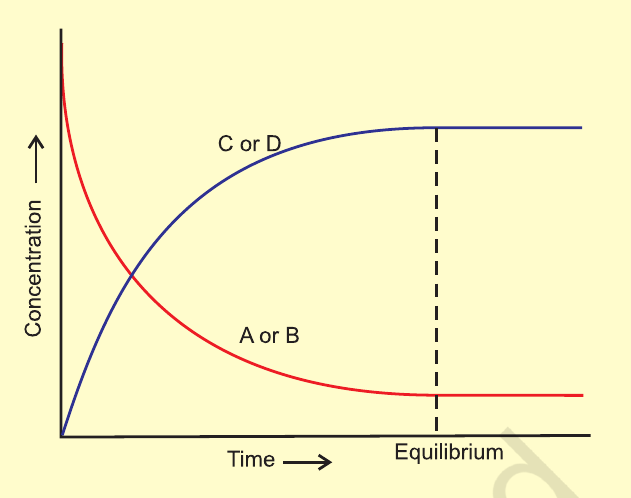
- For a general reversible reaction A + B giving C + D, products C and D build up and reactants A and B fall (NCERT Fig. 6.2). The forward rate falls and the reverse rate rises until the two rates match.
- Equilibrium can be reached from either direction: starting with only C and D gives the same equilibrium as starting with only A and B. For $H_2$(g) + $I_2$(g) giving 2HI(g), starting with $HI$ alone also reaches the same mixture (NCERT Fig. 6.5).
- Haber proved the dynamic nature with deuterium: ammonia made from D2 instead of $H_2$ reaches the same composition, and mixing the $H_2$ and D2 mixtures gives $NH_3$, NH2D, NHD2 and ND3, so the forward and reverse reactions keep running after equilibrium.
- Fig. 6.2 reading: the red curve (A or B) falls from a high start and the blue curve (C or D) rises from zero; both flatten at the dashed line marked Equilibrium and stay flat after it.
Suggest an edit
Law of chemical equilibrium and Kc
- Law of chemical equilibrium: at a given temperature, the ratio of products to reactants, each raised to its stoichiometric coefficient, has a constant value Kc. For aA + bB giving cC + dD, Kc = [C]^c [D]^d / [A]^a [B]^b.
- The value comes from experiment: for $H_2$(g) + $I_2$(g) giving 2HI(g), six runs with different starting concentrations all give the same Kc (Tables 6.2 and 6.3).
- Problem 6.1: for $N_2$(g) + 3H2(g) giving 2NH3(g) at 500 K, [$N_2$] = 1.5 x $10^{-2}$ M, [$H_2$] = 3.0 x $10^{-2}$ M and [$NH_3$] = 1.2 x $10^{-2}$ M give Kc = 3.55 x $10^{2}$.
- Problem 6.2: for $N_2$(g) + $O_2$(g) giving 2NO(g) at 800 K, [$N_2$] = 3.0 x $10^{-3}$ M, [$O_2$] = 4.2 x $10^{-3}$ M and [$NO$] = 2.8 x $10^{-3}$ M give Kc = 0.622.
- Kc is fixed at a given temperature for a given balanced equation. It does not depend on the starting concentrations, and it says nothing about how fast equilibrium is reached.
Suggest an edit
Practice1 question
Try it now. A wrong answer costs nothing here, try again until you get it.
For the reversible reaction A + B giving C + D, what happens to the two rates as the products build up?
NCERT 6.2: as products C and D build up, the forward rate falls and the reverse rate rises until the two rates are equal and concentrations stop changing.
Table: how K changes when the equation changes
| Chemical equation | Equilibrium constant |
|---|---|
| aA + bB ⇌ cC + dD | Kc = [C]^c [D]^d / [A]^a [B]^b |
| cC + dD ⇌ aA + bB (reversed) | K'c = 1 / Kc |
| naA + nbB ⇌ ncC + ndD (multiplied by n) | K''c = (Kc)^n |
| 1/2 $H_2$(g) + 1/2 $I_2$(g) ⇌ $HI$(g) (halved) | K''c = [$HI$] / ([$H_2$]^1/2 [$I_2$]^1/2) = (Kc)^1/2 |
Always state the balanced equation when quoting K: Kc and K'c have different numerical values for the same chemical change written differently (NCERT Table 6.4).
- Worked check from NCERT: for $H_2$ + $I_2$ giving 2HI, Kc stays the same across runs; writing the equation as 1/2 $H_2$ + 1/2 $I_2$ giving $HI$ gives the square root of that Kc.
Suggest an edit
Homogeneous equilibria and Kp = Kc(RT)^delta n
- In a homogeneous system all reactants and products are in the same phase, for example $N_2$(g) + 3H2(g) giving 2NH3(g), ester hydrolysis in water, and $Fe^{3+}$(aq) + $SCN^-$(aq) giving [Fe(SCN)]2+(aq).
- For gases it is easier to use partial pressures. From pV = nRT, p = cRT, so pressure is proportional to concentration at constant temperature.
- Kp = Kc(RT)^delta n, where delta n = moles of gaseous products minus moles of gaseous reactants. Use R = 0.0831 bar L mol-1 K-1 and pressure in bar, because the standard state for pressure is 1 bar.
- For $H_2$(g) + $I_2$(g) giving 2HI(g), delta n = 0, so Kp = Kc. For $N_2$(g) + 3H2(g) giving 2NH3(g), delta n = -2, so Kp = Kc(RT)^-2.
- Problem 6.3: for $PCl_5$ giving $PCl_3$ + $Cl_2$ at 500 K, [$PCl_5$] = 1.41 M and [$PCl_3$] = [$Cl_2$] = 1.59 M give Kc = 1.79.
- Problem 6.5: for 2NOCl(g) giving 2NO(g) + $Cl_2$(g) at 1069 K, Kc = 3.75 x $10^{-6}$ and delta n = 1 give Kp = 3.75 x $10^{-6}$ x (0.0831 x 1069) = 0.033.
- Units: for $H_2$ + $I_2$ giving 2HI, Kc and Kp have no unit; for $N_2O_4$(g) giving 2NO2(g), Kc has unit mol/L and Kp has unit bar. With standard states fixed, both can be written as dimensionless numbers.
Suggest an edit
Practice1 question
Try it now. A wrong answer costs nothing here, try again until you get it.
For $N_2$(g) + 3H2(g) giving 2NH3(g), which relation links Kp and Kc?
NCERT 6.4.1: Kp = Kc(RT)^delta n, and for $N_2$ + 3H2 giving 2NH3, delta n = 2 - 4 = -2, so Kp = Kc(RT)^-2.
Heterogeneous equilibria
- Equilibrium in a system with more than one phase is heterogeneous, for example water vapour over liquid water, $H_2O$(l) giving $H_2O$(g), and a solid in its saturated solution.
- Pure solids and liquids have constant molar concentration, so they are left out of the equilibrium expression. Their concentrations do not appear, but the pure solid or liquid must actually be present at equilibrium.
- Calcium carbonate: $CaCO_3$(s) giving $CaO$(s) + $CO_2$(g), so K'c = [$CO_2$(g)] and Kp = $pCO_2$. At 1100 K the $CO_2$ pressure in equilibrium with $CaCO_3$ and $CaO$ is 2.0 x $10^{5}$ Pa, so Kp = 2.00.
- Nickel purification: Ni(s) + 4CO(g) giving Ni($CO$)4(g), so Kc = [Ni($CO$)4] / [$CO$]^4.
- Silver oxide in acid: $Ag_2O$(s) + 2HNO3(aq) giving 2AgNO3(aq) + $H_2O$(l), so Kc = [$AgNO_3$]^2 / [$HNO_3$]^2.
- Trap: never put [$CaCO_3$(s)] or [$CaO$(s)] in the expression, and never write a heterogeneous K without checking that the solid or liquid is still present.
Suggest an edit
Using K: extent of reaction and direction from Qc
- K tells how far a reaction goes, not how fast. A high K means products dominate; a low K means reactants dominate.
- If Kc > $10^{3}$, products predominate and the reaction goes nearly to completion: $H_2$ with $O_2$ at 500 K, Kc = 2.4 x $10^{47}$; $H_2$ + $Cl_2$ giving 2HCl at 300 K, Kc = 4.0 x $10^{31}$; $H_2$ + $Br_2$ giving 2HBr at 300 K, Kc = 5.4 x $10^{18}$.
- If Kc < 10^-3, reactants predominate and the reaction hardly proceeds: decomposition of H2O at 500 K, Kc = 4.1 x 10^-48; N2 + O2 giving 2NO at 298 K, Kc = 4.8 x 10^-31.
- If Kc lies from 10^-3 to 10^3, both reactants and products are present in appreciable amounts: H2 + I2 giving HI, Kc = 57.0 at 700 K; N2O4 giving 2NO2, Kc = 4.64 x 10^-3 at 25°C.
- Reaction quotient Qc has the same form as Kc but uses concentrations at any time, not equilibrium values. For aA + bB giving cC + dD, Qc = [C]^c [D]^d / [A]^a [B]^b.
- If Qc < Kc, the net reaction goes from left to right. If Qc > Kc, it goes from right to left. If Qc = Kc, the mixture is already at equilibrium and no net reaction occurs.
- Worked: for $H_2$ + $I_2$ giving 2HI at 700 K, Kc = 57.0. With [$H_2$] = 0.10 M, [$I_2$] = 0.20 M and [$HI$] = 0.40 M, Qc = (0.40)^2 / (0.10 x 0.20) = 8.0, which is less than Kc, so more $HI$ forms until Qc = Kc.
- Problem 6.7: for 2A giving B + C, Kc = 2 x $10^{-3}$. With [A] = [B] = [C] = 3 x $10^{-4}$ M, Qc = 1, which is greater than Kc, so the reaction goes in the reverse direction.
Suggest an edit
Table: Qc against Kc, and the three extent bands
| Comparison or band | Prediction | NCERT example |
|---|---|---|
| Qc < Kc | Net reaction goes left to right (forward) | H2 + I2 ⇌ 2HI at 700 K with Qc = 8.0 < Kc = 57.0 |
| Qc > Kc | Net reaction goes right to left (reverse) | 2A ⇌ B + C with Qc = 1 > Kc = 2 x $10^{-3}$ |
| Qc = Kc | No net reaction; system is at equilibrium | Equilibrium mixture |
| Kc > $10^{3}$ | Products predominate; goes nearly to completion | $H_2$ + $O_2$ (Kc = 2.4 x $10^{47}$ at 500 K); $H_2$ + $Cl_2$ (Kc = 4.0 x $10^{31}$ at 300 K) |
| $10^{-3}$ <= Kc <= $10^{3}$ | Appreciable amounts of reactants and products | $H_2$ + $I_2$ (Kc = 57.0 at 700 K); $N_2O_4$ ⇌ 2NO2 (Kc = 4.64 x $10^{-3}$ at 25°C) |
| Kc < $10^{-3}$ | Reactants predominate; reaction hardly proceeds | $H_2O$ decomposition (Kc = 4.1 x $10^{-48}$ at 500 K); $N_2$ + $O_2$ ⇌ 2NO (Kc = 4.8 x $10^{-31}$ at 298 K) |
Remember: K does not give any information about the rate at which equilibrium is reached. Source: NCERT XI, Ch 6, 6.6.
Suggest an edit
Calculating equilibrium concentrations
- NCERT three steps when only initial concentrations are known: Step 1, write the balanced equation. Step 2, make a table of initial concentration, change on going to equilibrium, and equilibrium concentration, using x for the amount that reacts. Step 3, put the equilibrium concentrations into the Kc expression and solve for x.
- Problem 6.4: for $CO$(g) + $H_2O$(g) giving $CO_2$(g) + $H_2$(g), Kc = 4.24 at 800 K, starting with 0.10 M each of $CO$ and $H_2O$. At equilibrium [$CO_2$] = [$H_2$] = 0.067 M and [$CO$] = [$H_2O$] = 0.033 M.
- The quadratic gives two roots, x = 0.067 and x = 0.194. The value 0.194 is rejected because it would make a reactant concentration larger than its starting concentration.
- The same ICE table works with partial pressures for gases: write initial pressure, change, and equilibrium pressure, then use Kp.
Suggest an edit
Relationship between K, Q and Gibbs energy
- K is linked to thermodynamics, not to rate. If delta G is negative, the reaction is spontaneous and goes forward. If delta G is positive, the reaction is non-spontaneous and the reverse reaction runs instead. If delta G is 0, the reaction has reached equilibrium and no free energy is left to drive it.
- delta G = delta G0 + RT ln Q. At equilibrium delta G = 0 and Q = K, so delta G0 = -RT ln K, or ln K = -delta G0 / RT.
- If delta G0 < 0, then -delta G0 / RT is positive and K > 1, so products predominate. If delta G0 > 0, then K < 1, so only a very small amount of product forms.
- Problem 6.10: phosphorylation of glucose has delta G0 = 13.8 kJ/mol at 298 K, giving Kc = 3.81 x $10^{-3}$.
- Problem 6.11: hydrolysis of sucrose has Kc = 2 x $10^{13}$ at 300 K, giving delta G0 = -7.64 x $10^{4}$ J mol-1. This is the same reaction and Kc used in NEET 2020, Code G5, Q125.
Suggest an edit
Le Chatelier: concentration and pressure
- Le Chatelier's principle: a change in any factor that fixes the equilibrium conditions makes the system change so as to reduce or counteract the effect of the change. It applies to all physical and chemical equilibria.
- Concentration: adding a reactant or product is relieved by net reaction in the direction that consumes what was added; removing one is relieved by net reaction that replenishes it. Adding $H_2$ to $H_2$ + $I_2$ giving 2HI shifts the equilibrium right, so more $HI$ forms.
- In Qc terms, adding $H_2$ makes Qc fall below Kc, so the reaction moves forward until Qc = Kc again. Continuous removal of a product keeps Qc below Kc, so the reaction keeps moving forward.
- Industry uses this: ammonia is liquefied and removed so the Haber reaction keeps moving forward, and $CO_2$ is constantly removed from the kiln when $CaO$ is made from $CaCO_3$.
- Experiment: $Fe^{3+}$(aq) + $SCN^-$(aq) giving [Fe(SCN)]2+(aq) is deep red. Adding KSCN deepens the colour; adding oxalic acid removes $Fe^{3+}$ as [Fe($C_2O_4$)3]3- and the red colour fades; adding $HgCl_2$ removes $SCN^-$ as [Hg(SCN)4]2- and the colour fades too.
- Pressure: a pressure change from changing the volume matters only when the total moles of gas differ on the two sides. For $CO$(g) + 3H2(g) giving $CH_4$(g) + $H_2O$(g), 4 mol of gas become 2 mol, so halving the volume doubles the pressure and shifts the equilibrium forward.
- For C(s) + $CO_2$(g) giving 2CO(g), raising the pressure shifts the equilibrium in the reverse direction because the forward direction increases the moles of gas. Pressure changes do not affect solids and liquids, since their volumes barely change with pressure.
Suggest an edit
Practice1 question
Try it now. A wrong answer costs nothing here, try again until you get it.
$H_2$ is added to the equilibrium mixture $H_2$(g) + $I_2$(g) giving 2HI(g). Which way does the equilibrium shift?
NCERT 6.8.1: adding $H_2$ makes Qc fall below Kc, so the reaction moves forward and more $H_2$ and $I_2$ react to form $HI$.
Ladder: inert gas, temperature and catalyst
- Inert gas at constant volume: adding argon, which does not take part, leaves the partial pressures and molar concentrations unchanged, so the equilibrium is undisturbed. Q changes only if the added gas is a reactant or product.
- Temperature changes Kc itself, unlike concentration or pressure changes. For an exothermic reaction (negative delta H), K decreases as temperature rises. For an endothermic reaction (positive delta H), K increases as temperature rises.
- Ammonia synthesis, $N_2$ + 3H2 giving 2NH3, has delta H = -92.38 kJ mol-1, so raising the temperature shifts it left and lowers the ammonia yield. Low temperature favours yield but slows the reaction, so a catalyst is used.
- Experiment: 2NO2(g) giving $N_2O_4$(g) has delta H = -57.2 kJ mol-1. $NO_2$ is brown and $N_2O_4$ is colourless. In a freezing mixture the brown colour fades; in hot water at 363 K the brown colour deepens.
- Experiment: [Co($H_2O$)6]2+ + 4Cl- giving [$CoCl_4$]2- + 6H2O is pink on the left and blue on the right (note: NCERT Ch 6 misprints 3+ on the aqua complex, but cobalt(II) is 2+ so charge balances). Cooling turns the mixture pink; the room-temperature mixture is blue.
- Catalyst: it gives a new low-energy pathway and lowers the activation energy by the same amount for forward and reverse reactions. It does not affect the equilibrium composition, does not appear in the balanced equation, and does not appear in the K expression. If K is exceedingly small, a catalyst is of little help.
- Haber optimum: around 500°C and 200 atm with an iron catalyst. Contact process: 2SO2 + $O_2$ giving 2SO3 has Kc = 1.7 x $10^{26}$, yet the uncatalysed oxidation is very slow, so platinum or $V_2O_5$ is used.
Suggest an edit
Acids and bases: Arrhenius, Bronsted-Lowry, Lewis
- Ionic equilibrium (6.9): Michael Faraday classified substances into electrolytes (conduct electricity in aqueous solution) and non-electrolytes. Strong electrolytes ionise almost completely in water (e.g. $NaCl$), whereas weak electrolytes are only partially dissociated (in acetic acid, less than 5% ionises) and establish an ionic equilibrium between ions and unionised molecules.
- Arrhenius: an acid dissociates in water to give $H^+$(aq) and a base gives $OH^-$(aq). HX(aq) + $H_2O$(l) gives $H_3O^+$(aq) + X-(aq). Its limit: it works only for aqueous solutions and cannot explain the basicity of ammonia, which has no hydroxyl group.
- A bare proton cannot exist free in water; it bonds to water to give hydronium, $H_3O^+$. In this chapter $H^+$(aq) and $H_3O^+$(aq) mean the same hydrated proton.
- Bronsted-Lowry: an acid is a proton donor and a base is a proton acceptor. $NH_3$ in water acts as a base by accepting a proton, while water acts as the acid; in the reverse step $NH_4^+$ is the acid and $OH^-$ is the base.
- A conjugate acid-base pair differs by one proton only. The conjugate base has one proton less, the conjugate acid has one extra proton. A strong acid has a weak conjugate base, and vice versa.
- Problem 6.12: conjugate bases of HF, $H_2SO_4$ and $HCO_3^-$ are $F^-$, $HSO_4^-$ and $CO_3^{2-}$. Problem 6.13: conjugate acids of $NH_2^-$, $NH_3$ and $HCOO^-$ are $NH_3$, $NH_4^+$ and HCOOH.
- Problem 6.14: $H_2O$ gives $H_3O^+$ and $OH^-$; $HCO_3^-$ gives $H_2CO_3$ and $CO_3^{2-}$; $HSO_4^-$ gives $H_2SO_4$ and $SO_4^{2-}$; $NH_3$ gives $NH_4^+$ and $NH_2^-$. All four can act as both Bronsted acid and base.
- Lewis: an acid accepts an electron pair and a base donates an electron pair. $BF_3$ has no proton yet acts as an acid by accepting the lone pair of $NH_3$ to give $BF_3$:$NH_3$. $AlCl_3$, $Co^{3+}$ and $Mg^{2+}$ are Lewis acids; $H_2O$, $NH_3$ and $OH^-$ are Lewis bases.
- Problem 6.15: $OH^-$ is a Lewis base, $F^-$ is a Lewis base, $H^+$ is a Lewis acid, and $BCl_3$ is a Lewis acid.
Suggest an edit
Practice1 question
Try it now. A wrong answer costs nothing here, try again until you get it.
Which one of these species acts as a Lewis acid?
NCERT 6.10.3: a Lewis acid accepts an electron pair. $BF_3$ is electron deficient and accepts the lone pair of $NH_3$; $H_2O$, $NH_3$ and $OH^-$ donate a pair, so they are Lewis bases.
Ionization of water, Kw and the $\mathrm{pH}$ scale
- Water is both an acid and a base. In pure water one $H_2O$ donates a proton and another accepts it: $H_2O$(l) + $H_2O$(l) giving $H_3O^+$(aq) + $OH^-$(aq).
- The ionic product of water is Kw = [$H^+$][$OH^-$] = 1.0 x $10^{-14}$ M^2 at 298 K. Experiment gives [$H^+$] = 1.0 x $10^{-7}$ M, and since dissociation makes equal numbers of $H^+$ and $OH^-$, [$OH^-$] is also 1.0 x $10^{-7}$ M. Kw changes with temperature because it is an equilibrium constant.
- Pure water is 55.55 M, so the ratio of dissociated to undissociated water is about 2 in $10^{9}$: equilibrium lies far towards undissociated water.
- Acidic: [$H_3O^+$] > [$OH^-$]. Neutral: [$H_3O^+$] = [$OH^-$]. Basic: [$H_3O^+$] < [$OH^-$].
- $\mathrm{pH}$ = -log[$H^+$]. An acidic solution of $10^{-2}$ M $HCl$ has $\mathrm{pH}$ 2; a $NaOH$ solution with [$OH^-$] = $10^{-4}$ M has [$H_3O^+$] = $10^{-10}$ M and $\mathrm{pH}$ 10. Pure water at 25°C has $\mathrm{pH}$ 7. Acidic solutions have $\mathrm{pH}$ below 7 and basic solutions above 7.
- pKw = $\mathrm{pH}$ + $\mathrm{pOH}$ = 14 at 298 K. The scale is logarithmic: one $\mathrm{pH}$ unit means [$H^+$] changes by a factor of 10, and a change of 100 in [$H^+$] changes $\mathrm{pH}$ by 2 units.
- Problem 6.16: a soft drink with [$H^+$] = 3.8 x $10^{-3}$ M has $\mathrm{pH}$ 2.42 and is acidic. Problem 6.17: a 1.0 x $10^{-8}$ M $HCl$ solution has $\mathrm{pH}$ 6.98, not 8, because the $H_3O^+$ from water itself must be counted.
- $\mathrm{pH}$ values from Table 6.5: gastric juice about 1.2, lemon juice about 2.2, soft drinks and vinegar about 3.0, tomato juice about 4.2, black coffee 5.0, milk 6.8, human blood 7.4, egg white and sea water 7.8, milk of magnesia 10, lime water 10.5, 0.1 M $NaOH$ 13, 1 M $HCl$ about 0, concentrated $HCl$ about -1. $\mathrm{pH}$ paper reads 1 to 14 with accuracy about 0.5; a $\mathrm{pH}$ meter reads to 0.001.
Suggest an edit
Table: Ka, Kb, $\mathrm{p}K_a$ and pKb
- Weak acid HX: HA(aq) + $H_2O$(l) giving $H_3O^+$(aq) + A-(aq), with Ka = [$H^+$][A-] / [HA] = c x alpha^2 / (1 - alpha), where c is the initial concentration and alpha is the degree of ionization. Larger Ka means a stronger acid. $\mathrm{p}K_a$ = -log Ka.
- Weak base MOH: Kb = [M+][$OH^-$] / [MOH] = c x alpha^2 / (1 - alpha). pKb = -log Kb.
| Weak acid (298 K) | Ka | Weak base (298 K) | Kb |
|---|---|---|---|
| HF | 3.5 x $10^{-4}$ | Dimethylamine | 5.4 x $10^{-4}$ |
| $HNO_2$ | 4.5 x $10^{-4}$ | Triethylamine | 6.45 x $10^{-5}$ |
| HCOOH | 1.8 x $10^{-4}$ | Ammonia | 1.77 x $10^{-5}$ |
| Benzoic acid | 6.5 x $10^{-5}$ | Quinine | 1.10 x $10^{-6}$ |
| Acetic acid | 1.74 x $10^{-5}$ | Pyridine | 1.77 x $10^{-9}$ |
| Niacin | 1.5 x $10^{-5}$ | Aniline | 4.27 x $10^{-10}$ |
| HClO | 3.0 x $10^{-8}$ | Urea | 1.3 x $10^{-14}$ |
| HCN | 4.9 x $10^{-10}$ | - | - |
| Phenol | 1.3 x $10^{-10}$ | - | - |
- Conjugate pair rule: Ka x Kb = Kw, and $\mathrm{p}K_a$ + pKb = pKw = 14 at 298 K. For $NH_4^+$ and $NH_3$, Ka = 5.6 x $10^{-10}$ and Kb = 1.8 x $10^{-5}$.
- Worked NCERT problems: Problem 6.18 (0.02 M HF, Ka = 3.2 x $10^{-4}$ -> alpha = 0.12, $\mathrm{pH}$ 2.62); Problem 6.19 (0.1 M monobasic acid, $\mathrm{pH}$ 4.50 -> Ka = 1.0 x $10^{-8}$, $\mathrm{p}K_a$ = 8); Problem 6.20 (0.08 M HOCl, Ka = 2.5 x $10^{-5}$ -> [$H^+$] = 1.41 x $10^{-3}$ M, $\mathrm{pH}$ 2.85, 1.76% dissociation); Problem 6.23 (0.05 M $NH_3$ -> alpha = 0.018, [$OH^-$] = 9.4 x $10^{-4}$ M, $\mathrm{pH}$ 10.97).
- Polyprotic acids ionise in steps and Ka1 > Ka2 > Ka3, because removing a proton from a negative ion is harder. The $H_3O^+$ in solution comes mainly from the first step. Source: NCERT XI, Ch 6, 6.11, Tables 6.6 and 6.7.
Suggest an edit
Common ion effect, hydrolysis and buffers
- Common ion effect: adding a substance that supplies an ion already present in a dissociation equilibrium shifts that equilibrium. It is Le Chatelier's principle applied to ions.
- Adding acetate to acetic acid lowers [$H^+$]. Adding 0.05 M acetate to 0.05 M acetic acid gives [$H^+$] = 1.8 x $10^{-5}$ M and $\mathrm{pH}$ 4.74. Adding $H^+$ from outside pushes the equilibrium back towards undissociated acetic acid.
- Acid strength factors: down a group, H-A bond strength decides, so HF << $HCl$ << $HBr$ << $HI$ and $H_2S$ is stronger than $H_2O$. Across a row, H-A bond polarity decides, so $CH_4$ < $NH_3$ < $H_2O$ < HF.
- Hydrolysis: cations of strong bases ($Na^+$, $K^+$, $Ca^{2+}$, $Ba^{2+}$) and anions of strong acids ($Cl^-$, $Br^-$, $NO_3^-$, $ClO_4^-$) only get hydrated and do not hydrolyse, so salts of a strong acid and a strong base are neutral with $\mathrm{pH}$ 7.
- Salt of a weak acid and a strong base, for example $CH_3COONa$, gives a basic solution with $\mathrm{pH}$ above 7 because acetate hydrolyses to acetic acid and $OH^-$. Salt of a strong acid and a weak base, for example $NH_4Cl$, gives an acidic solution with $\mathrm{pH}$ below 7 because $NH_4^+$ hydrolyses to $NH_4OH$ and $H^+$.
- Salt of a weak acid and a weak base, for example $CH_3COONH_4$: $\mathrm{pH}$ = 7 + 1/2($\mathrm{p}K_a$ - pKb), independent of concentration. Problem 6.25: with $\mathrm{p}K_a$ 4.76 and pKb 4.75, $\mathrm{pH}$ = 7.005.
- Buffer solutions resist change in $\mathrm{pH}$ on dilution or on adding small amounts of acid or alkali. Acetic acid plus sodium acetate buffers around $\mathrm{pH}$ 4.75; ammonium chloride plus ammonium hydroxide buffers around $\mathrm{pH}$ 9.25.
- Henderson-Hasselbalch equation: $\mathrm{pH}$ = $\mathrm{p}K_a$ + log([salt]/[acid]). If salt and acid have the same molar concentration, $\mathrm{pH}$ = $\mathrm{p}K_a$, so pick an acid whose $\mathrm{p}K_a$ is close to the wanted $\mathrm{pH}$. For a basic buffer, $\mathrm{pOH}$ = pKb + log([conjugate acid]/[base]). Dilution does not change the $\mathrm{pH}$ because the ratio under the log stays the same.
Suggest an edit
Practice1 question
Try it now. A wrong answer costs nothing here, try again until you get it.
An acetic acid and sodium acetate buffer is made with equal molar concentrations of acid and salt. What is its $\mathrm{pH}$?
NCERT 6.12.1: $\mathrm{pH}$ = $\mathrm{p}K_a$ + log([salt]/[acid]). When the salt and acid have the same molar concentration, log 1 = 0 and $\mathrm{pH}$ = $\mathrm{p}K_a$.
Ladder: Ksp, Qsp and precipitation calls
- A salt dissolves only if solvation enthalpy beats lattice enthalpy. Solubility classes: soluble above 0.1 M, slightly soluble from 0.01 M to 0.1 M, sparingly soluble below 0.01 M.
- Solubility product: for $BaSO_4$(s) giving $Ba^{2+}$(aq) + $SO_4^{2-}$(aq), Ksp = [$Ba^{2+}$][$SO_4^{2-}$] = 1.1 x $10^{-10}$ at 298 K. With molar solubility S, Ksp = S^2, so S = 1.05 x $10^{-5}$ mol L-1.
- General salt MxXy(s) giving xM^p+ + yX^q-: Ksp = (xS)^x (yS)^y = x^x y^y S^(x+y), so S = (Ksp / x^x y^y)^(1/(x+y)).
- Worked: for Zr3($PO_4$)4, Ksp = (3S)^3 (4S)^4 = 6912 S^7. Problem 6.26: A2X3 with Ksp = 1.1 x $10^{-23}$ has S = 1.0 x $10^{-5}$ mol/L from Ksp = 108 S^5.
- Qsp is the same product with non-equilibrium concentrations. At equilibrium Ksp = Qsp. If Qsp < Ksp, more solid dissolves; if Qsp > Ksp, precipitation occurs until Qsp = Ksp again.
- Comparing Ksp values directly works only for salts of the same type. Problem 6.27: Ni(OH)2 with Ksp 2.0 x $10^{-15}$ is more soluble than AgCN with Ksp 6 x $10^{-17}$, with S = 0.58 x $10^{-4}$ mol/L against 7.8 x $10^{-9}$ mol/L.
- Common ion on solubility: Problem 6.28, Ni(OH)2 in 0.10 M $NaOH$ has solubility S = 2.0 x $10^{-13}$ M, because the $OH^-$ already present pushes the equilibrium back. Passing $HCl$ gas through saturated $NaCl$ precipitates pure $NaCl$ by the same effect.
- The solubility of salts of weak acids rises at lower $\mathrm{pH}$, because the anion is protonated and its free concentration falls, so more salt dissolves to keep Ksp = Qsp.
Suggest an edit
Trap Boxes
Adding more reactant changes Kc?
Wrong idea: Adding more reactant to an equilibrium mixture raises Kc, so the equilibrium constant itself moves.
Kc is fixed at a given temperature for a given balanced equation and does not change when you add reactant or product. Only the reaction quotient Qc changes, and the mixture shifts until Qc equals Kc again.
NCERT XI, Ch 6, 6.6
A catalyst shifts equilibrium towards products?
Wrong idea: Adding a catalyst to the Haber process pushes the equilibrium towards more ammonia.
A catalyst lowers the activation energy by the same amount for the forward and reverse reactions, so both run faster and equilibrium is reached sooner, but the composition and K stay the same.
NCERT XI, Ch 6, 6.8.5
Any pressure rise shifts every equilibrium?
Wrong idea: Raising the pressure always shifts the equilibrium, and adding argon at constant volume shifts it too.
Pressure shifts a gaseous equilibrium only when the moles of gas differ on the two sides. Adding an inert gas at constant volume changes neither partial pressures nor concentrations, so nothing shifts.
NCERT XI, Ch 6, 6.8
Neutral always means $\mathrm{pH}$ 7?
Wrong idea: A neutral solution always has $\mathrm{pH}$ 7 at every temperature.
Neutral $\mathrm{pH}$ is 7 only at 298 K, where Kw = 1.0 x $10^{-14}$. Kw is an equilibrium constant, so it changes with temperature and the neutral $\mathrm{pH}$ moves with it.
NCERT XI, Ch 6, 6.11
The smaller Ksp is always the less soluble salt?
Wrong idea: Any salt with a smaller Ksp is always less soluble than a salt with a larger Ksp, regardless of its formula.
Ksp values can be compared directly only for salts with the same stoichiometry. For different types such as AB (Ksp = S^2) and AB2 (Ksp = 4S^3), always calculate molar solubility S from Ksp = x^x y^y S^(x+y) before comparing which salt is more soluble.
NCERT XI, Ch 6, 6.13
Chapter test
5 NEET PYQs. +4 for a correct answer, -1 for a wrong answer, exactly like NEET. Finish the test to earn a medal.
Q1: NEET (UG) 2023, Code F1, Q93
The equilibrium concentrations of the species in the reaction A + B ⇌ C + D are 2, 3, 10 and 6 mol L-1, respectively at 300 K. $\Delta G$° for the reaction is (R = 2 cal/mol K)
Kc = [C][D]/[A][B] = (10 x 6)/(2 x 3) = 10. $\Delta G$° = -RT ln Kc = -2 x 300 x 2.303 x log10(10) = -1381.80 cal.
Q2: NEET (UG) 2022, Code R1, Q56
The $\mathrm{pH}$ of the solution containing 50 mL each of 0.10 M sodium acetate and 0.01 M acetic acid is [Given $\mathrm{p}K_a$ of $CH_3COOH$ = 4.57]
Henderson-Hasselbalch: $\mathrm{pH}$ = $\mathrm{p}K_a$ + log([salt]/[acid]) = 4.57 + log(0.10/0.01) = 4.57 + 1 = 5.57. Equal volumes cancel out of the ratio.
Q3: NEET (UG) 2021, Code P3, Q68
The pKb of dimethylamine and $\mathrm{p}K_a$ of acetic acid are 3.27 and 4.77 respectively at T (K). The correct option for the $\mathrm{pH}$ of dimethylammonium acetate solution is :
For a salt of a weak acid and a weak base, $\mathrm{pH}$ = 7 + 1/2($\mathrm{p}K_a$ - pKb) = 7 + 1/2(4.77 - 3.27) = 7 + 0.75 = 7.75.
Q4: NEET (UG) 2020, Code G5, Q125
Hydrolysis of sucrose is given by the following reaction. Sucrose + $H_2O$ ⇌ Glucose + Fructose. If the equilibrium constant (Kc) is 2 x $10^{13}$ at 300 K, the value of ΔrG⊖ at the same temperature will be :
NCERT Problem 6.11 uses this same reaction and Kc: ΔrG⊖ = -RT ln Kc, so the answer is -8.314 J mol-1 K-1 x 300 K x ln(2 x $10^{13}$).
Q5: NEET (UG) 2020, Code G5, Q96
Find out the solubility of Ni(OH)2 in 0.1 M $NaOH$. Given that the ionic product of Ni(OH)2 is 2 x $10^{-15}$.
Ksp = [$Ni^{2+}$][$OH^-$]^2 = S x (0.10)^2 = 2 x $10^{-15}$, so S = 2 x $10^{-13}$ M. The common ion $OH^-$ from $NaOH$ cuts the solubility far below its value in pure water.
Score: 0 · Answered 0 of 5
Flashcards
Tap a card to flip it over and see the answer. Tap it again to flip it back.
Write the equilibrium constant Kc for the general reaction aA + bB giving cC + dD.
Tap to flipKc = [C]^c [D]^d / [A]^a [B]^b for aA + bB giving cC + dD at equilibrium. Products go in the numerator, reactants in the denominator, each raised to its stoichiometric coefficient.
Tap to flip backWrite the relation between Kp and Kc, and state the value of R used with pressure in bar.
Tap to flipKp = Kc (RT)^delta n, where delta n = moles of gaseous products minus moles of gaseous reactants. R = 0.0831 bar L mol-1 K-1, and pressure is expressed in bar because the standard state is 1 bar.
Tap to flip backWrite the relations linking Gibbs energy change, reaction quotient Q and equilibrium constant K.
Tap to flipdelta G = delta G0 + RT ln Q, and at equilibrium delta G = 0 with Q = K, so delta G0 = -RT ln K. If delta G0 < 0 then K > 1; if delta G0 > 0 then K < 1.
Tap to flip backDoes a catalyst change the equilibrium constant or the equilibrium composition of a reaction?
Tap to flipA catalyst lowers the activation energy by the same amount for the forward and reverse reactions, so it speeds up both equally. It does not change the equilibrium composition and does not appear in the equilibrium constant expression.
Tap to flip backDoes adding argon to a gaseous equilibrium mixture at constant volume shift the equilibrium?
Tap to flipNo. Adding an inert gas such as argon at constant volume does not change the partial pressures or the molar concentrations of the reacting substances, so the equilibrium stays undisturbed.
Tap to flip backState the three Kc bands NCERT uses to judge how far a reaction goes at equilibrium.
Tap to flipKc > $10^{3}$: products predominate, reaction goes nearly to completion. Kc from $10^{-3}$ to $10^{3}$: appreciable amounts of both reactants and products. Kc < $10^{-3}$: reactants predominate, reaction hardly proceeds.
Tap to flip backGive Kw, the hydrogen ion concentration of pure water, and the $\mathrm{pH}$ + $\mathrm{pOH}$ sum at 298 K.
Tap to flipKw = [$H^+$][$OH^-$] = 1.0 x $10^{-14}$ M^2 at 298 K, with [$H^+$] = [$OH^-$] = 1.0 x $10^{-7}$ M in pure water. pKw = $\mathrm{pH}$ + $\mathrm{pOH}$ = 14 at 298 K, so pure water has $\mathrm{pH}$ 7.
Tap to flip backWrite the relation between Ka of an acid and Kb of its conjugate base, with the $NH_4^+$ and $NH_3$ values.
Tap to flipFor a conjugate acid-base pair, Ka x Kb = Kw, and $\mathrm{p}K_a$ + pKb = pKw = 14 at 298 K. For $NH_4^+$ and $NH_3$, Ka = 5.6 x $10^{-10}$ and Kb = 1.8 x $10^{-5}$, and their product is 1.0 x $10^{-14}$.
Tap to flip backGive the conjugate bases of the Bronsted acids HF, $H_2SO_4$ and $HCO_3^-$.
Tap to flipHF gives $F^-$, $H_2SO_4$ gives $HSO_4^-$, and $HCO_3^-$ gives $CO_3^{2-}$. A conjugate base has one proton less than its acid.
Tap to flip backGive the solubility product and the molar solubility of barium sulphate at 298 K.
Tap to flipKsp = 1.1 x $10^{-10}$ at 298 K and molar solubility S = 1.05 x $10^{-5}$ mol L-1, from Ksp = S^2 for $BaSO_4$(s) giving $Ba^{2+}$(aq) + $SO_4^{2-}$(aq).
Tap to flip backOrder HF, $HCl$, $HBr$ and $HI$ by acid strength, and state the reason NCERT gives.
Tap to flipDown a group the H-A bond strength falls as the size of A grows, so acid strength rises: HF << $HCl$ << $HBr$ << $HI$. $H_2S$ is a stronger acid than $H_2O$ for the same reason.
Tap to flip backClassify $HClO_4$, $HNO_3$, HF and $CH_3COOH$ as strong or weak acids.
Tap to flipStrong: $HClO_4$, $HCl$, $HBr$, $HI$, $HNO_3$, $H_2SO_4$. Weak: $HNO_2$, HF, $CH_3COOH$. Strong acids are almost completely dissociated in water; weak acids are only partly dissociated.
Tap to flip back