 NEET Notes
Home > Chemistry > Organic > Amines
Amines
On this page · 18 sections
- 01Syllabus map
- 02Amines: what they are
- 03Structure of amines
- 04Classification of amines
- 05Nomenclature of amines
- 06Table: names of alkylamines and arylamines
- 07Preparation of amines: nitro compounds, halides, nitriles and amides
- 08Preparation of amines: Gabriel synthesis and Hoffmann bromamide degradation
- 09Physical properties of amines
- 10Basic character, pKb and basicity orders
- 11Table: pKb values and basicity orders
- 12Reactions of amines: alkylation, acylation, carbylamine, nitrous acid and Hinsberg
- 13Electrophilic substitution in aniline
- 14Ladder: tell primary, secondary and tertiary amines apart
- 15Diazonium salts: preparation and physical properties
- 16Reactions of diazonium salts
- 17Table: diazonium salt reactions at a glance
- 18Trap pairs: the confusions NEET tests
Amines from NCERT XII Ch 9: structure, names and six preparations, pKb and basicity orders, amine tests, aniline substitution and diazonium salts, with 5 NEET PYQs.
Syllabus map
- NMC Unit: CHEM-U18, Organic Compounds Containing Nitrogen. This chapter covers the amines and diazonium salts part of the unit.
- Subtopics in this chapter (NCERT XII, Ch 9): structure of amines (9.1); classification (9.2); nomenclature (9.3); preparation of amines (9.4); physical properties (9.5); chemical reactions (9.6); method of preparation of diazonium salts (9.7); physical properties of diazonium salts (9.8); chemical reactions of diazonium salts (9.9); importance of diazonium salts in synthesis of aromatic compounds (9.10).
- Subtopic checklist: (1) pyramidal structure and sp3 nitrogen; (2) primary, secondary and tertiary amines, simple and mixed; (3) common and IUPAC names; (4) six preparations of amines; (5) boiling points and solubility; (6) pKb values and basicity orders; (7) alkylation, acylation, carbylamine, nitrous acid and Hinsberg tests; (8) bromination, nitration and sulphonation of aniline; (9) diazotisation, Sandmeyer, Gattermann and coupling reactions.
- Extra information (beyond NCERT): none. Everything in this chapter is NCERT Chapter 9.
- Excluded topics: alcohols, phenols and ethers (Class 12 Ch 7) and haloalkanes and haloarenes (Class 12 Ch 6) are background only; their facts are not repeated here.
- Estimated revision time: 11 minutes. Jump links: Amines: what they are, Structure of amines, Classification of amines, Nomenclature of amines, Table: names of alkylamines and arylamines, Preparation of amines: nitro compounds, halides, nitriles and amides, Preparation of amines: Gabriel synthesis and Hoffmann bromamide degradation, Physical properties of amines, Basic character, pKb and basicity orders, Table: pKb values and basicity orders, Reactions of amines, Electrophilic substitution in aniline, Ladder: tell primary, secondary and tertiary amines apart, Diazonium salts: preparation and physical properties, Reactions of diazonium salts, Table: diazonium salt reactions at a glance, Trap pairs: the confusions NEET tests.
Suggest an edit
Amines: what they are
- Amines are derivatives of ammonia, made by replacing one, two or all the three hydrogen atoms of ammonia by alkyl and/or aryl groups.
- In nature, amines occur among proteins, vitamins, alkaloids and hormones. Synthetic examples include polymers, dye stuffs and drugs.
- Two biologically active compounds, adrenaline and ephedrine, both contain a secondary amino group and are used to increase blood pressure. Novocain, a synthetic amino compound, is used as an anaesthetic in dentistry. Benadryl, a well known antihistaminic drug, contains a tertiary amino group.
- Quaternary ammonium salts are used as surfactants. Diazonium salts are intermediates in the preparation of a variety of aromatic compounds including dyes.
- The chief commercial use of amines is as intermediates in the synthesis of medicines and fibres.
- Tertiary amines like trimethylamine are used as insect attractants.
Suggest an edit
Structure of amines
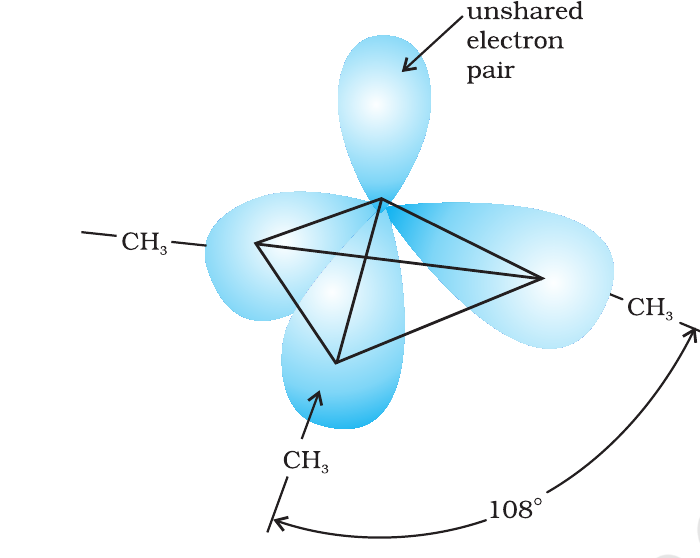
- Like ammonia, the nitrogen atom of amines is trivalent and carries an unshared pair of electrons.
- Nitrogen orbitals in amines are sp3 hybridised and the geometry of amines is pyramidal. Each of the three sp3 hybridised orbitals of nitrogen overlaps with orbitals of hydrogen or carbon depending on the composition of the amine. The fourth orbital of nitrogen contains an unshared pair of electrons.
- Due to the presence of the unshared pair of electrons, the angle C-N-E (where E is C or H) is less than 109.5 degrees; for instance, it is 108 degrees in trimethylamine, as shown in NCERT Fig. 9.1.
- Because of the unshared pair on nitrogen, amines behave as Lewis bases.
Suggest an edit
Classification of amines
- Amines are classified as primary (1°), secondary (2°) and tertiary (3°) depending on the number of hydrogen atoms replaced by alkyl or aryl groups in the ammonia molecule.
- If one hydrogen atom of ammonia is replaced by R or Ar, we get RNH2 or $ArNH_2$, a primary amine (1°).
- If two hydrogen atoms of ammonia, or one hydrogen atom of R-NH2, are replaced by another alkyl or aryl (R') group, we get R-NHR', a secondary amine (2°). The second alkyl or aryl group may be the same or different.
- Replacement of another hydrogen atom by an alkyl or aryl group leads to a tertiary amine (3°).
- Amines are said to be simple when all the alkyl or aryl groups are the same, and mixed when they are different.
Suggest an edit
Nomenclature of amines
- In the common system, an aliphatic amine is named by prefixing the alkyl group to amine, as one word, for example methylamine. In secondary and tertiary amines, when two or more groups are the same, the prefix di or tri is appended before the name of the alkyl group.
- In the IUPAC system, primary amines are named as alkanamines. The name is derived by replacement of 'e' of the alkane by the word amine. For example, $CH_3NH_2$ is named as methanamine.
- When more than one amino group is present at different positions in the parent chain, their positions are specified by giving numbers to the carbon atoms bearing the -NH2 groups, and a suitable prefix such as di or tri is attached to the amine. The letter 'e' of the suffix of the hydrocarbon part is retained. For example, $H_2N$-CH2-CH2-NH2 is named as ethane-1,2-diamine.
- To name secondary and tertiary amines, we use locant N to designate a substituent attached to a nitrogen atom. For example, $CH_3NHCH_2CH_3$ is named as N-methylethanamine and ($CH_3CH_2$)3N is named as N,N-diethylethanamine.
- In arylamines, the -NH2 group is directly attached to the benzene ring. $C_6H_5NH_2$ is the simplest arylamine. In the common system it is known as aniline, and it is also an accepted IUPAC name. In the IUPAC system, the suffix 'e' of arene is replaced by 'amine', so $C_6H_5$-NH2 is named as benzenamine.
Suggest an edit
Table: names of alkylamines and arylamines
- The common and IUPAC names of some alkylamines and arylamines are given in NCERT Table 9.1. The rows below are taken from that table.
| Amine | Common name | IUPAC name |
|---|---|---|
| $CH_3CH_2NH_2$ | Ethylamine | Ethanamine |
| $CH_3CH_2CH_2NH_2$ | n-Propylamine | Propan-1-amine |
| ($CH_3$)2CHNH2 | Isopropylamine | Propan-2-amine |
| $CH_3NHCH_2CH_3$ | Ethylmethylamine | N-Methylethanamine |
| ($CH_3$)3N | Trimethylamine | N,N-Dimethylmethanamine |
| ($C_2H_5$)2NCH2CH2CH2CH3 | N,N-Diethylbutylamine | N,N-Diethylbutan-1-amine |
| $CH_2$=$CHCH_2NH_2$ | Allylamine | Prop-2-en-1-amine |
| $H_2N$($CH_2$)6NH2 | Hexamethylenediamine | Hexane-1,6-diamine |
| $C_6H_5NH_2$ | Aniline | Aniline or Benzenamine |
| o-CH3C6H4NH2 | o-Toluidine | 2-Methylaniline |
| p-BrC6H4NH2 | p-Bromoaniline | 4-Bromobenzenamine or 4-Bromoaniline |
| $C_6H_5N$($CH_3$)2 | N,N-Dimethylaniline | N,N-Dimethylbenzenamine |
Suggest an edit
Practice1 question
Try it now. A wrong answer costs nothing here, try again until you get it.
What is the IUPAC name of ($CH_3$)2CHNH2?
NCERT Table 9.1: ($CH_3$)2CHNH2 is isopropylamine, IUPAC name propan-2-amine. The amino group is on carbon 2 of the propane chain.
Preparation of amines: nitro compounds, halides, nitriles and amides
- 1. Reduction of nitro compounds: nitro compounds are reduced to amines by passing hydrogen gas in the presence of finely divided nickel, palladium or platinum, and also by reduction with metals in acidic medium. Nitroalkanes can similarly be reduced to the corresponding alkanamines. Reduction with iron scrap and hydrochloric acid is preferred because $FeCl_2$ formed gets hydrolysed to release hydrochloric acid during the reaction, so only a small amount of hydrochloric acid is required to initiate the reaction.
- 2. Ammonolysis of alkyl halides: an alkyl or benzyl halide on reaction with an ethanolic solution of ammonia undergoes nucleophilic substitution in which the halogen atom is replaced by an amino (-NH2) group. This cleavage of the C-X bond by ammonia is known as ammonolysis. The reaction is carried out in a sealed tube at 373 K. The primary amine thus obtained behaves as a nucleophile and can further react with alkyl halide to form secondary and tertiary amines, and finally a quaternary ammonium salt. The free amine can be obtained from the ammonium salt by treatment with a strong base. Ammonolysis has the disadvantage of yielding a mixture of primary, secondary and tertiary amines and also a quaternary ammonium salt. However, primary amine is obtained as a major product by taking a large excess of ammonia. The order of reactivity of halides with amines is RI > RBr > RCl.
- Example 9.1 asks for chemical equations for (i) reaction of ethanolic $NH_3$ with $C_2H_5Cl$, and (ii) ammonolysis of benzyl chloride and reaction of the amine so formed with two moles of $CH_3Cl$.
- 3. Reduction of nitriles: nitriles on reduction with lithium aluminium hydride ($LiAlH_4$) or catalytic hydrogenation produce primary amines. This reaction is used for ascent of the amine series, that is, for preparation of amines containing one carbon atom more than the starting alkyl halide.
- 4. Reduction of amides: amides on reduction with lithium aluminium hydride yield amines.
- Example 9.2 asks for chemical equations for (i) $CH_3$-CH2-Cl into $CH_3$-CH2-CH2-NH2, and (ii) $C_6H_5$-CH2-Cl into $C_6H_5$-CH2-CH2-NH2. Both go through the nitrile, adding one carbon.
Suggest an edit
Preparation of amines: Gabriel synthesis and Hoffmann bromamide degradation
- 5. Gabriel phthalimide synthesis: Gabriel synthesis is used for the preparation of primary amines. Phthalimide on treatment with ethanolic potassium hydroxide forms the potassium salt of phthalimide, which on heating with an alkyl halide followed by alkaline hydrolysis produces the corresponding primary amine. Aromatic primary amines cannot be prepared by this method because aryl halides do not undergo nucleophilic substitution with the anion formed by phthalimide.
- 6. Hoffmann bromamide degradation reaction: Hoffmann developed a method for preparation of primary amines by treating an amide with bromine in an aqueous or ethanolic solution of sodium hydroxide. In this degradation reaction, migration of an alkyl or aryl group takes place from the carbonyl carbon of the amide to the nitrogen atom. The amine so formed contains one carbon less than that present in the amide.
- Example 9.3: (i) the amide which gives propanamine by Hoffmann bromamide reaction is butanamide, which has four carbon atoms; (ii) the amine produced by the Hoffmann degradation of benzamide is aniline (benzenamine), which has six carbon atoms.
- Intext Question 9.3 asks for: (i) benzene into aniline, (ii) benzene into N,N-dimethylaniline, (iii) $Cl^-$($CH_2$)4-Cl into hexane-1,6-diamine.
Suggest an edit
Practice1 question
Try it now. A wrong answer costs nothing here, try again until you get it.
Which method gives a primary amine with one carbon atom fewer than the starting amide?
NCERT 9.4.6: in Hoffmann bromamide degradation the amine formed has one carbon less than the amide. Gabriel synthesis gives a primary amine with the same carbon count as the alkyl halide, and nitrile reduction adds a carbon.
Physical properties of amines
- The lower aliphatic amines are gases with a fishy odour. Primary amines with three or more carbon atoms are liquid, and still higher ones are solid. Aniline and other arylamines are usually colourless but get coloured on storage due to atmospheric oxidation.
- Lower aliphatic amines are soluble in water because they can form hydrogen bonds with water molecules. Solubility decreases with increase in molar mass of amines due to increase in size of the hydrophobic alkyl part. Higher amines are essentially insoluble in water. Amines are soluble in organic solvents like alcohol, ether and benzene.
- The electronegativity of nitrogen in amines is 3.0 and of oxygen in alcohols is 3.5. Alcohols are more polar than amines and form stronger intermolecular hydrogen bonds than amines. Out of butan-1-ol and butan-1-amine, butan-1-ol is more soluble in water for this reason.
- Primary and secondary amines are engaged in intermolecular association due to hydrogen bonding between nitrogen of one molecule and hydrogen of another molecule. This intermolecular association is more in primary amines than in secondary amines, as there are two hydrogen atoms available for hydrogen bond formation in a primary amine. Tertiary amines do not have intermolecular association due to the absence of a hydrogen atom available for hydrogen bond formation. Therefore, the order of boiling points of isomeric amines is: Primary > Secondary > Tertiary. Intermolecular hydrogen bonding in primary amines is shown in NCERT Fig. 9.2.
- Boiling points of amines, alcohols and alkanes of almost the same molar mass are shown in NCERT Table 9.2: n-C4H9NH2, molar mass 73, 350.8 K; ($C_2H_5$)2NH, molar mass 73, 329.3 K; $C_2H_5N$($CH_3$)2, molar mass 73, 310.5 K; $C_2H_5CH$($CH_3$)2, molar mass 72, 300.8 K; n-C4H9OH, molar mass 74, 390.3 K.
Suggest an edit
Basic character, pKb and basicity orders
- Amines, being basic in nature, react with acids to form salts. Amine salts on treatment with a base like $NaOH$ regenerate the parent amine. Amine salts are soluble in water but insoluble in organic solvents like ether. This reaction is the basis for the separation of amines from the non-basic organic compounds insoluble in water.
- The reaction of amines with mineral acids to form ammonium salts shows that they are basic in nature. Amines have an unshared pair of electrons on the nitrogen atom, due to which they behave as Lewis base. Basic character is understood in terms of Kb and pKb values: pKb = -log Kb. Larger the value of Kb, or smaller the value of pKb, stronger is the base.
- The pKb value of ammonia is 4.75. Aliphatic amines are stronger bases than ammonia due to the +I effect of alkyl groups, which leads to high electron density on the nitrogen atom. Their pKb values lie in the range of 3 to 4.22. Aromatic amines are weaker bases than ammonia due to the electron withdrawing nature of the aryl group.
- Basicity depends on the ease of formation of the cation by accepting a proton from the acid. The more stable the cation is relative to the amine, the more basic is the amine.
- Alkanamines versus ammonia: due to the electron releasing nature of the alkyl group, it pushes electrons towards nitrogen and makes the unshared electron pair more available for sharing with the proton of the acid. The substituted ammonium ion formed gets stabilised due to dispersal of the positive charge by the +I effect of the alkyl group. Hence alkylamines are stronger bases than ammonia. In the gaseous phase, the order of basicity follows the expected order: tertiary amine > secondary amine > primary amine > $NH_3$.
- In the aqueous phase the trend is not regular. The substituted ammonium cations get stabilised not only by the electron releasing effect of the alkyl group (+I) but also by solvation with water molecules. The greater the size of the ion, the lesser will be the solvation and the less stabilised is the ion. The order of stability of ions by solvation is primary > secondary > tertiary, which is opposite to the inductive effect based order. When the alkyl group is small, like -CH3, there is no steric hindrance to H-bonding. When the alkyl group is bigger than $CH_3$, there will be steric hindrance to H-bonding. So there is a subtle interplay of the inductive effect, solvation effect and steric hindrance of the alkyl group which decides the basic strength of alkyl amines in the aqueous state.
- The order of basic strength in case of methyl substituted amines and ethyl substituted amines in aqueous solution is: ($C_2H_5$)2NH > ($C_2H_5$)3N > $C_2H_5NH_2$ > $NH_3$, and ($CH_3$)2NH > $CH_3NH_2$ > ($CH_3$)3N > $NH_3$.
- Arylamines versus ammonia: the pKb value of aniline is quite high (9.38). In aniline or other arylamines, the -NH2 group is attached directly to the benzene ring, so the unshared electron pair on the nitrogen atom is in conjugation with the benzene ring and is less available for protonation. Aniline is a resonance hybrid of five structures. The anilinium ion obtained by accepting a proton can have only two resonating structures (Kekule). Greater the number of resonating structures, greater is the stability, so aniline is more stable than the anilinium ion, and the basic nature of aniline or other aromatic amines is less than that of ammonia. In substituted anilines, electron releasing groups like -OCH3 and -CH3 increase basic strength, whereas electron withdrawing groups like -NO2, -SO3H, -COOH and -X decrease it.
- Example 9.4: the decreasing order of basic strength of $C_6H_5NH_2$, $C_2H_5NH_2$, ($C_2H_5$)2NH and $NH_3$ is ($C_2H_5$)2NH > $C_2H_5NH_2$ > $NH_3$ > $C_6H_5NH_2$.
Suggest an edit
Practice1 question
Try it now. A wrong answer costs nothing here, try again until you get it.
Which of the following is the strongest base in aqueous solution?
NCERT 9.6.1: in aqueous solution the methyl amine order is ($CH_3$)2NH > $CH_3NH_2$ > ($CH_3$)3N > $NH_3$, and aniline (pKb 9.38) is far weaker than ammonia (pKb 4.75).
Table: pKb values and basicity orders
- The pKb values of some amines in aqueous phase are given in NCERT Table 9.3. The rows below are taken from that table, with ammonia added from the text.
| Name of amine | pKb |
|---|---|
| Ammonia | 4.75 |
| Methanamine | 3.38 |
| N-Methylmethanamine | 3.27 |
| N,N-Dimethylmethanamine | 4.22 |
| Ethanamine | 3.29 |
| N-Ethylethanamine | 3.00 |
| N,N-Diethylethanamine | 3.25 |
| Benzenamine | 9.38 |
| Phenylmethanamine | 4.70 |
| N-Methylaniline | 9.30 |
| N,N-Dimethylaniline | 8.92 |
- Gas phase order of basicity (inductive effect only): tertiary amine > secondary amine > primary amine > $NH_3$.
- Aqueous solution, methyl amines: ($CH_3$)2NH > $CH_3NH_2$ > ($CH_3$)3N > $NH_3$.
- Aqueous solution, ethyl amines: ($C_2H_5$)2NH > ($C_2H_5$)3N > $C_2H_5NH_2$ > $NH_3$.
- Example 9.4, decreasing basic strength: ($C_2H_5$)2NH > $C_2H_5NH_2$ > $NH_3$ > $C_6H_5NH_2$.
- Intext Question 9.4 answers, increasing basic strength: (i) $C_6H_5NH_2$ < $NH_3$ < $C_6H_5CH_2NH_2$ < $C_2H_5NH_2$ < ($C_2H_5$)2NH; (ii) $C_6H_5NH_2$ < $C_2H_5NH_2$ < ($C_2H_5$)3N < ($C_2H_5$)2NH; (iii) $C_6H_5NH_2$ < $C_6H_5CH_2NH_2$ < ($CH_3$)3N < $CH_3NH_2$ < ($CH_3$)2NH.
Suggest an edit
Reactions of amines: alkylation, acylation, carbylamine, nitrous acid and Hinsberg
- 2. Alkylation: amines undergo alkylation on reaction with alkyl halides.
- 3. Acylation: aliphatic and aromatic primary and secondary amines react with acid chlorides, anhydrides and esters by nucleophilic substitution reaction. This reaction is known as acylation. The hydrogen atom of the -NH2 or >N-H group is replaced by the acyl group, and the products are known as amides. The reaction is carried out in the presence of a base stronger than the amine, like pyridine, which removes $HCl$ so formed and shifts the equilibrium to the right hand side. Amines also react with benzoyl chloride ($C_6H_5COCl$); this reaction is known as benzoylation. For example, $CH_3NH_2$ + $C_6H_5COCl$ -> $CH_3NHCOC_6H_5$ + $HCl$ (N-methylbenzamide). Amines form salts with carboxylic acids at room temperature.
- 4. Carbylamine reaction: aliphatic and aromatic primary amines on heating with chloroform and ethanolic potassium hydroxide form isocyanides or carbylamines, which are foul smelling substances. Secondary and tertiary amines do not show this reaction. This reaction is known as carbylamine reaction or isocyanide test and is used as a test for primary amines.
- 5. Reaction with nitrous acid: nitrous acid is prepared in situ from a mineral acid and sodium nitrite. (a) Primary aliphatic amines react with nitrous acid to form aliphatic diazonium salts which, being unstable, liberate nitrogen gas quantitatively and alcohols. Quantitative evolution of nitrogen is used in the estimation of amino acids and proteins. (b) Aromatic amines react with nitrous acid at low temperatures (273-278 K) to form diazonium salts, a very important class of compounds used for synthesis of a variety of aromatic compounds discussed in Section 9.7. Secondary and tertiary amines react with nitrous acid in a different manner.
- 6. Reaction with arylsulphonyl chloride: benzenesulphonyl chloride ($C_6H_5SO_2Cl$), also known as Hinsberg's reagent, reacts with primary and secondary amines to form sulphonamides. (a) With a primary amine (for example ethanamine) it yields an N-alkylbenzenesulphonamide (N-ethylbenzenesulphonamide). The hydrogen attached to nitrogen in the sulphonamide is strongly acidic due to the strong electron withdrawing sulphonyl group, so it is soluble in alkali. (b) With a secondary amine (for example diethylamine) it forms an N,N-dialkylbenzenesulphonamide (N,N-diethylbenzenesulphonamide). Since it does not contain any hydrogen atom attached to the nitrogen atom, it is not acidic and is insoluble in alkali. (c) Tertiary amines do not react with benzenesulphonyl chloride. This different behaviour is used for the distinction of primary, secondary and tertiary amines and also for the separation of a mixture of amines. These days benzenesulphonyl chloride is replaced by p-toluenesulphonyl chloride.
Suggest an edit
Practice1 question
Try it now. A wrong answer costs nothing here, try again until you get it.
Which amine reacts with benzenesulphonyl chloride to give a sulphonamide that dissolves in alkali?
NCERT 9.6.6: the primary amine sulphonamide has a hydrogen on nitrogen, is acidic and dissolves in alkali. The secondary amine sulphonamide has no N-H and is insoluble; tertiary amines do not react with Hinsberg's reagent.
Electrophilic substitution in aniline
- Aniline is a resonance hybrid of five structures. The ortho and para positions to the -NH2 group become centres of high electron density. Thus the -NH2 group is ortho and para directing and a powerful activating group.
- (a) Bromination: aniline reacts with bromine water at room temperature to give a white precipitate of 2,4,6-tribromoaniline.
- The main problem during electrophilic substitution of aromatic amines is their very high reactivity. To prepare a monosubstituted aniline derivative, the activating effect of the -NH2 group is controlled by protecting it by acetylation with acetic anhydride, then carrying out the desired substitution, followed by hydrolysis of the substituted amide to the substituted amine. The lone pair of electrons on nitrogen of acetanilide interacts with the oxygen atom due to resonance, so it is less available for donation to the benzene ring by resonance. Therefore the activating effect of the -NHCOCH3 group is less than that of the amino group.
- (b) Nitration: direct nitration of aniline yields tarry oxidation products in addition to the nitro derivatives. Moreover, in the strongly acidic medium, aniline is protonated to form the anilinium ion, which is meta directing. That is why, besides the ortho and para derivatives, a significant amount of meta derivative is also formed. By protecting the -NH2 group by acetylation with acetic anhydride, the nitration reaction can be controlled and the p-nitro derivative can be obtained as the major product.
- (c) Sulphonation: aniline reacts with concentrated sulphuric acid to form anilinium hydrogensulphate, which on heating with sulphuric acid at 453-473 K produces p-aminobenzene sulphonic acid, commonly known as sulphanilic acid, as the major product.
- Aniline does not undergo Friedel-Crafts reaction (alkylation and acetylation) due to salt formation with aluminium chloride, the Lewis acid used as a catalyst. Due to this, nitrogen of aniline acquires a positive charge and hence acts as a strong deactivating group for further reaction.
Suggest an edit
Ladder: tell primary, secondary and tertiary amines apart
- First ask: does the amine give the carbylamine test? Heat it with chloroform and ethanolic potassium hydroxide. A foul smelling isocyanide means a primary amine. No reaction means a secondary or tertiary amine.
- Next, use Hinsberg's reagent (benzenesulphonyl chloride, nowadays p-toluenesulphonyl chloride). A primary amine gives a sulphonamide that dissolves in alkali, because its N-H hydrogen is acidic. A secondary amine gives a sulphonamide that does not dissolve in alkali, because it has no hydrogen on nitrogen. A tertiary amine does not react at all.
- Then, use nitrous acid. A primary aliphatic amine gives nitrogen gas quantitatively and an alcohol. A primary aromatic amine gives a diazonium salt at 273-278 K. Secondary and tertiary amines react in a different manner.
- Worked examples: aniline (primary aromatic) gives the carbylamine test, gives a sulphonamide soluble in alkali, and forms benzenediazonium chloride at 273-278 K. N-methylaniline (secondary) fails the carbylamine test and gives a sulphonamide insoluble in alkali. N,N-dimethylaniline (tertiary) fails the carbylamine test and does not react with Hinsberg's reagent.
- How to use the ladder in a question: carbylamine first (primary or not), then Hinsberg solubility (primary or secondary), then nitrous acid (aliphatic primary gives nitrogen gas, aromatic primary gives a diazonium salt).
Suggest an edit
Diazonium salts: preparation and physical properties
- The diazonium salts have the general formula R-N2+ X- where R stands for an aryl group and the X- ion may be $Cl^-$, $Br^-$, $HSO_4^-$, $BF_4^-$, etc. They are named by suffixing diazonium to the name of the parent hydrocarbon from which they are formed, followed by the name of the anion such as chloride or hydrogensulphate. The $N_2^+$ group is called the diazonium group. For example, $C_6H_5N_2^+$ $Cl^-$ is named as benzenediazonium chloride and $C_6H_5N_2^+$ $HSO_4^-$ is known as benzenediazonium hydrogensulphate.
- Primary aliphatic amines form highly unstable alkyldiazonium salts. Primary aromatic amines form arenediazonium salts which are stable for a short time in solution at low temperatures (273-278 K). The stability of the arenediazonium ion is explained on the basis of resonance.
- 9.7 Method of preparation: benzenediazonium chloride is prepared by the reaction of aniline with nitrous acid at 273-278 K. Nitrous acid is produced in the reaction mixture by the reaction of sodium nitrite with hydrochloric acid. The conversion of primary aromatic amines into diazonium salts is known as diazotisation. Due to its instability, the diazonium salt is not generally stored and is used immediately after its preparation. Equation: $C_6H_5NH_2$ + $NaNO_2$ + 2HCl -> $C_6H_5N_2^+$ $Cl^-$ + $NaCl$ + 2H2O (273-278 K).
- 9.8 Physical properties: benzenediazonium chloride is a colourless crystalline solid. It is readily soluble in water and is stable in cold but reacts with water when warmed. It decomposes easily in the dry state. Benzenediazonium fluoroborate is water insoluble and stable at room temperature.
Suggest an edit
Reactions of diazonium salts
- The reactions of diazonium salts fall into two categories: (A) reactions involving displacement of nitrogen and (B) reactions involving retention of the diazo group.
- A.1 Replacement by halide or cyanide ion: the $Cl^-$, $Br^-$ and $CN^-$ nucleophiles can easily be introduced in the benzene ring in the presence of Cu(I) ion. This reaction is called the Sandmeyer reaction. Alternatively, chlorine or bromine can also be introduced by treating the diazonium salt solution with the corresponding halogen acid in the presence of copper powder. This is referred to as the Gattermann reaction. The yield in the Sandmeyer reaction is found to be better than in the Gattermann reaction.
- A.2 Replacement by iodide ion: iodine is not easily introduced into the benzene ring directly, but when the diazonium salt solution is treated with potassium iodide, iodobenzene is formed.
- A.3 Replacement by fluoride ion: when arenediazonium chloride is treated with fluoroboric acid, arene diazonium fluoroborate is precipitated, which on heating decomposes to yield aryl fluoride.
- A.4 Replacement by H: certain mild reducing agents like hypophosphorous acid (phosphinic acid) or ethanol reduce diazonium salts to arenes and themselves get oxidised to phosphorous acid and ethanal, respectively.
- A.5 Replacement by hydroxyl group: if the temperature of the diazonium salt solution is allowed to rise up to 283 K, the salt gets hydrolysed to phenol.
- A.6 Replacement by -NO2 group: when diazonium fluoroborate is heated with aqueous sodium nitrite solution in the presence of copper, the diazonium group is replaced by the -NO2 group.
- B. Coupling reactions: the azo products obtained have an extended conjugate system having both the aromatic rings joined through the -N=$N^-$ bond. These compounds are often coloured and are used as dyes. Benzenediazonium chloride reacts with phenol, in which the phenol molecule at its para position is coupled with the diazonium salt in alkaline medium ($OH^-$, 273-278 K) to form p-hydroxyazobenzene (orange dye). Similarly, the reaction of the diazonium salt with aniline in acidic medium ($H^+$, 273-278 K) yields p-aminoazobenzene (yellow dye). This is an example of electrophilic substitution reaction.
- 9.10 Importance: diazonium salts are very good intermediates for the introduction of -F, -Cl, -Br, -I, -CN, -OH and -NO2 groups into the aromatic ring. Aryl fluorides and iodides cannot be prepared by direct halogenation. The cyano group cannot be introduced by nucleophilic substitution of chlorine in chlorobenzene, but cyanobenzene can be easily obtained from diazonium salt. Thus the replacement of the diazo group by other groups is helpful in preparing those substituted aromatic compounds which cannot be prepared by direct substitution in benzene or substituted benzene.
- Example 9.5 asks for the conversion of 4-nitrotoluene to 2-bromobenzoic acid.
Suggest an edit
Practice1 question
Try it now. A wrong answer costs nothing here, try again until you get it.
Aniline is treated with $NaNO_2$ and $HCl$ at 273-278 K to give A, and A is treated with KI to give B. What is B?
NCERT 9.7 and 9.9.A.2: aniline is diazotised to benzenediazonium chloride at 273-278 K, and the diazonium salt with KI gives iodobenzene. Iodine is not easily introduced into the benzene ring directly.
Table: diazonium salt reactions at a glance
- In every displacement reaction the diazonium group is a very good leaving group and nitrogen escapes from the reaction mixture as a gas.
| Starting material | Reagent | Product |
|---|---|---|
| $C_6H_5N_2^+$ $Cl^-$ | CuCl, $HCl$ (Sandmeyer) | Chlorobenzene |
| $C_6H_5N_2^+$ $Cl^-$ | CuBr, $HBr$ (Sandmeyer) | Bromobenzene |
| $C_6H_5N_2^+$ $Cl^-$ | CuCN, KCN (Sandmeyer) | Benzonitrile |
| $C_6H_5N_2^+$ $Cl^-$ | $HCl$, Cu powder (Gattermann) | Chlorobenzene |
| $C_6H_5N_2^+$ $Cl^-$ | $HBr$, Cu powder (Gattermann) | Bromobenzene |
| $C_6H_5N_2^+$ $Cl^-$ | KI | Iodobenzene |
| $C_6H_5N_2^+$ $Cl^-$ | $HBF_4$, then heat | Fluorobenzene |
| $C_6H_5N_2^+$ $Cl^-$ | $H_3PO_2$, $H_2O$ | Benzene |
| $C_6H_5N_2^+$ $Cl^-$ | $C_2H_5OH$ | Benzene |
| $C_6H_5N_2^+$ $Cl^-$ | $H_2O$, warm to 283 K | Phenol |
| $C_6H_5N_2^+$ $BF_4^-$ | $NaNO_2$, Cu, heat | Nitrobenzene |
| $C_6H_5N_2^+$ $Cl^-$ | Phenol, $OH^-$ (para coupling) | p-Hydroxyazobenzene (orange dye) |
| $C_6H_5N_2^+$ $Cl^-$ | Aniline, $H^+$ (para coupling) | p-Aminoazobenzene (yellow dye) |
- Coupling keeps the -N=$N^-$ bond and gives coloured azo dyes; all the rows above it displace nitrogen.
Suggest an edit
Trap pairs: the confusions NEET tests
- Aniline is a stronger base than ammonia? No. Aniline has pKb 9.38 and ammonia has pKb 4.75, so aniline is much weaker. Its lone pair is in conjugation with the benzene ring, and aniline (five resonating structures) is more stable than the anilinium ion (two resonating structures).
- Aqueous basicity always follows tertiary > secondary > primary? No. That order holds only in the gas phase. In water, methyl amines follow ($CH_3$)2NH > $CH_3NH_2$ > ($CH_3$)3N > $NH_3$ and ethyl amines follow ($C_2H_5$)2NH > ($C_2H_5$)3N > $C_2H_5NH_2$ > $NH_3$, because solvation and steric hindrance change the order.
- Arenediazonium salts are stable above 300 K? No. They are stable only for a short time in solution at low temperatures (273-278 K). They decompose easily in the dry state and react with water when warmed.
- All three classes of amines give the carbylamine test? No. Only primary amines, aliphatic and aromatic, give foul smelling isocyanides with $CHCl_3$ and ethanolic $KOH$. Secondary and tertiary amines do not show the reaction.
- The Hinsberg product of a secondary amine dissolves in alkali? No. Only the primary amine sulphonamide has an N-H hydrogen, is acidic and dissolves in alkali. The secondary amine sulphonamide has no N-H and is insoluble in alkali, and tertiary amines do not react with Hinsberg's reagent at all.
- Gabriel synthesis makes any primary amine? No. It cannot make aromatic primary amines, because aryl halides do not undergo nucleophilic substitution with the phthalimide anion. Hoffmann bromamide degradation gives an amine with one carbon fewer than the amide.
- Aniline bromination gives a monosubstituted product? No. Aniline with bromine water gives a white precipitate of 2,4,6-tribromoaniline. For a monosubstituted product, protect the -NH2 group by acetylation first, then substitute, then hydrolyse.
Suggest an edit
Trap Boxes
Aniline is a stronger base than ammonia?
Wrong idea: Aniline is a stronger base than ammonia because the $NH_2$ group donates electrons to the ring.
Aniline is much weaker than ammonia: pKb 9.38 for benzenamine against 4.75 for ammonia. The $NH_2$ lone pair is in conjugation with the benzene ring, and aniline (five resonating structures) is more stable than the anilinium ion (two resonating structures).
NCERT XII, Ch 9, 9.6.1
Aqueous basicity always follows tertiary > secondary > primary?
Wrong idea: More alkyl groups always means a stronger base, so tertiary amines are the strongest bases in water too.
The tertiary > secondary > primary order holds only in the gas phase. In water, methyl amines follow ($CH_3$)2NH > $CH_3NH_2$ > ($CH_3$)3N > $NH_3$ and ethyl amines follow ($C_2H_5$)2NH > ($C_2H_5$)3N > $C_2H_5NH_2$ > $NH_3$, because of the interplay of inductive, solvation and steric effects.
NCERT XII, Ch 9, 9.6.1
Arenediazonium salts are stable above 300 K?
Wrong idea: Primary aromatic amines react with $HNO_2$ to form diazonium salts which are stable even above 300 K.
Arenediazonium salts are stable only for a short time in solution at low temperatures (273-278 K). They decompose easily in the dry state and react with water when warmed. The salt is not stored and is used immediately after preparation.
NCERT XII, Ch 9, 9.7 and 9.8
All three classes of amines give the carbylamine test?
Wrong idea: Any amine gives a foul smelling isocyanide with $CHCl_3$ and ethanolic $KOH$.
Only primary amines, aliphatic and aromatic, give the carbylamine test, forming foul smelling isocyanides with chloroform and ethanolic potassium hydroxide. Secondary and tertiary amines do not show this reaction.
NCERT XII, Ch 9, 9.6.4
The Hinsberg product of a secondary amine dissolves in alkali?
Wrong idea: Both primary and secondary amines give sulphonamides with Hinsberg's reagent that dissolve in alkali.
Only the primary amine sulphonamide has a hydrogen on nitrogen, is acidic and dissolves in alkali. The secondary amine sulphonamide has no N-H hydrogen and is insoluble in alkali. Tertiary amines do not react with Hinsberg's reagent at all.
NCERT XII, Ch 9, 9.6.6
Chapter test
5 NEET PYQs. +4 for a correct answer, -1 for a wrong answer, exactly like NEET. Finish the test to earn a medal.
Q1: NEET (UG) 2025, Code 45, Q67
The correct order of decreasing basic strength of the given amines is :
Aliphatic amines are stronger bases than aromatic amines, and in water N-ethylethanamine (pKb 3.00) is stronger than ethanamine (pKb 3.29). N-methylaniline (pKb 9.30) is slightly stronger than benzenamine (pKb 9.38).
Q2: NEET (UG) 2023, Code F1, Q82
Which of the following reactions will NOT give primary amine as the product?
Methyl isocyanide ($CH_3NC$) on reduction with $LiAlH_4$ gives a secondary amine, $CH_3NHCH_3$. The nitrile gives $CH_3CH_2NH_2$, the amide with $LiAlH_4$ gives $CH_3CH_2NH_2$, and the amide with $Br_2$/$KOH$ gives $CH_3NH_2$ by Hoffmann bromamide degradation.
Q3: NEET (UG) 2022, Code R1, Q63
Given below are two statements:
Statement I: Primary aliphatic amines react with $HNO_2$ to give unstable diazonium salts.
Statement II: Primary aromatic amines react with $HNO_2$ to form diazonium salts which are stable even above 300 K.
In the light of the above statements, choose the most appropriate answer from the options given below:
Statement I is correct: aliphatic diazonium salts are unstable and lose nitrogen. Statement II is incorrect: arenediazonium salts are stable only for a short time in solution at low temperatures (273-278 K), not above 300 K.
Q4: NEET (UG) 2021, Code P3, Q79
Identify the compound that will react with Hinsberg's reagent to give a solid which dissolves in alkali.
Hinsberg's reagent with a primary amine gives a sulphonamide with a hydrogen on nitrogen, which is acidic and dissolves in alkali. Ethanamine is the only primary amine here.
Q5: NEET (UG) 2020, Code G5, Q129
Which of the following amine will give the carbylamine test?
Only a primary amine gives the carbylamine test. Aniline is the only primary amine here; the other three are secondary or tertiary amines.
Score: 0 · Answered 0 of 5
Flashcards
Tap a card to flip it over and see the answer. Tap it again to flip it back.
State the Gabriel phthalimide synthesis and its limit.
Tap to flipPhthalimide on treatment with ethanolic potassium hydroxide forms potassium phthalimide, which on heating with an alkyl halide followed by alkaline hydrolysis gives the primary amine. Aromatic primary amines cannot be prepared this way because aryl halides do not undergo nucleophilic substitution with the phthalimide a
Tap to flip backState the Hoffmann bromamide degradation reaction and its carbon count.
Tap to flipAn amide treated with bromine in aqueous or ethanolic sodium hydroxide gives a primary amine with one carbon less than the amide, by migration of the alkyl or aryl group from the carbonyl carbon to the nitrogen atom. Example: benzamide gives aniline; the amide giving propanamine is butanamide.
Tap to flip backState the carbylamine reaction and which amines show it.
Tap to flipAliphatic and aromatic primary amines on heating with chloroform and ethanolic potassium hydroxide form isocyanides (carbylamines), which are foul smelling. Secondary and tertiary amines do not show this reaction. It is used as a test for primary amines.
Tap to flip backState diazotisation: reagents, temperature and equation.
Tap to flipAniline reacts with nitrous acid at 273-278 K to give benzenediazonium chloride: $C_6H_5NH_2$ + $NaNO_2$ + 2HCl -> $C_6H_5N_2^+$ $Cl^-$ + $NaCl$ + 2H2O. Nitrous acid is made in situ from sodium nitrite and hydrochloric acid. The salt is not stored and is used immediately.
Tap to flip backState the Sandmeyer reaction and how Gattermann differs.
Tap to flipThe $Cl^-$, $Br^-$ and $CN^-$ nucleophiles are introduced into the benzene ring from the diazonium salt in the presence of Cu(I) ion. Gattermann uses the halogen acid with copper powder instead, and gives a lower yield than Sandmeyer.
Tap to flip backGive the aqueous basicity order for ethyl amines.
Tap to flipIn water, ethyl series: ($C_2H_5$)2NH > ($C_2H_5$)3N > $C_2H_5NH_2$ > $NH_3$. Example 9.4: ($C_2H_5$)2NH > $C_2H_5NH_2$ > $NH_3$ > $C_6H_5NH_2$. Intext 9.4 (ii) increasing: $C_6H_5NH_2$ < $C_2H_5NH_2$ < ($C_2H_5$)3N < ($C_2H_5$)2NH.
Tap to flip backGive the aqueous and gas-phase basicity orders for methyl amines.
Tap to flipIn water, methyl series: ($CH_3$)2NH > $CH_3NH_2$ > ($CH_3$)3N > $NH_3$. In the gas phase the order follows the inductive effect: tertiary > secondary > primary > $NH_3$. Intext 9.4 (iii) increasing: $C_6H_5NH_2$ < $C_6H_5CH_2NH_2$ < ($CH_3$)3N < $CH_3NH_2$ < ($CH_3$)2NH.
Tap to flip backGive the pKb values of ammonia, ethanamine, N-ethylethanamine, benzenamine and N-methylaniline.
Tap to flipAmmonia 4.75; methanamine 3.38; N-methylmethanamine 3.27; N,N-dimethylmethanamine 4.22; ethanamine 3.29; N-ethylethanamine 3.00; N,N-diethylethanamine 3.25; benzenamine 9.38; phenylmethanamine 4.70; N-methylaniline 9.30; N,N-dimethylaniline 8.92. Smaller pKb means a stronger base.
Tap to flip backWhy is aniline a weaker base than ammonia?
Tap to flipAniline (pKb 9.38) is a weaker base than ammonia (pKb 4.75) because the $NH_2$ lone pair is in conjugation with the benzene ring and is less available for protonation. Aniline is a resonance hybrid of five structures while the anilinium ion has only two resonating structures, so aniline is the more stable of the two.
Tap to flip backWhy does direct nitration of aniline give meta product, and why does aniline not undergo Friedel-Crafts reaction?
Tap to flipDirect nitration of aniline gives tarry oxidation products and, because aniline is protonated to the meta-directing anilinium ion in strong acid, a significant amount of m-nitroaniline. Aniline does not undergo Friedel-Crafts reaction because it forms a salt with $AlCl_3$, putting a positive charge on nitrogen, which a
Tap to flip backHow does Hinsberg's reagent separate primary, secondary and tertiary amines?
Tap to flipBenzenesulphonyl chloride (Hinsberg's reagent) gives a sulphonamide with a primary amine that is soluble in alkali, a sulphonamide with a secondary amine that is insoluble in alkali, and no reaction with a tertiary amine. Nowadays p-toluenesulphonyl chloride is used instead.
Tap to flip backClassify amines as primary, secondary or tertiary, and define simple and mixed amines.
Tap to flipPrimary (1°): RNH2 or $ArNH_2$, one hydrogen of ammonia replaced. Secondary (2°): R-NHR', two hydrogens replaced, the two groups may be the same or different. Tertiary (3°): three hydrogens replaced. Amines are simple when all groups are the same and mixed when they are different.
Tap to flip back