 NEET Notes
Home > Chemistry > Physical > Thermodynamics
Thermodynamics
On this page · 18 sections
- 01Syllabus map
- 02System, surroundings and boundary
- 03Types of system: open, closed and isolated
- 04State of the system and state functions
- 05Internal energy as a state function
- 06Table: first law and sign conventions
- 07Pressure-volume work
- 08Table: work in isothermal, adiabatic and free expansion
- 09Enthalpy H
- 10Extensive and intensive properties; heat capacity; Cp - Cv = R
- 11Calorimetry: measuring $\Delta U$ and $\Delta H$
- 12Reaction enthalpy and standard states
- 13Table: enthalpies of phase change, formation and combustion
- 14Hess's law of constant heat summation
- 15Ladder: enthalpy traps
- 16Spontaneity and entropy
- 17Gibbs energy change and equilibrium
- 18Trap pairs: the confusions NEET tests
Energy, heat and work in chemical change: the first law, enthalpy and calorimetry, Hess's law, entropy, Gibbs energy and the link between free energy and equilibrium.
Syllabus map
- NMC Unit: CHEM-U04, Chemical Thermodynamics.
- Subtopics in this chapter (NCERT XI, Ch 5): thermodynamic terms, system and surroundings, types of system (5.1); state of the system, internal energy as a state function (5.1.3 and 5.1.4); work and enthalpy (5.2); measurement of $\Delta U$ and $\Delta H$ by calorimetry (5.3); enthalpy change of a reaction, standard enthalpies, phase changes, formation enthalpies, thermochemical equations, Hess's law (5.4); enthalpies of combustion, atomisation, bond, lattice, solution and dilution (5.5); spontaneity, entropy, Gibbs energy (5.6); Gibbs energy change and equilibrium (5.7).
- Subtopic checklist: (1) open, closed and isolated systems; (2) state functions vs path functions; (3) first law $\Delta U$ = q + w and sign conventions; (4) pressure-volume work, reversible and irreversible, free expansion; (5) enthalpy H = U + pV and $\Delta H$ = $\Delta U$ + ΔngRT; (6) extensive vs intensive properties, Cp - Cv = R; (7) bomb calorimeter and constant-pressure calorimeter; (8) ΔrH, standard states, ΔfH0, ΔcH0; (9) Hess's law; (10) bond enthalpy and lattice enthalpy with the Born-Haber cycle; (11) entropy and $\Delta S$total > 0; (12) $\Delta G$ = $\Delta H$ - T$\Delta S$ and ΔrG0 = -2.303 RT log K.
- Extra information (beyond NCERT): none. Everything in this chapter is NCERT Chapter 5.
- Excluded topics: equilibrium calculations (Chapter 6) and electrochemistry/redox (Chapter 7). Do not import their facts into this chapter.
- Estimated revision time: 12 minutes. Jump links: Syllabus Map, System and Surroundings, Types of System, State Functions, Internal Energy, First Law Table, Pressure-Volume Work, Work Table, Enthalpy, Extensive and Intensive, Calorimetry, Reaction Enthalpy, Enthalpies Table, Hess's Law, Enthalpy Traps Ladder, Spontaneity and Entropy, Gibbs Energy, Trap Pairs.
Suggest an edit
System, surroundings and boundary
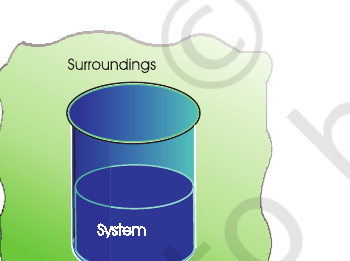
- A system in thermodynamics refers to that part of the universe in which observations are made, and the remaining universe constitutes the surroundings. The system and the surroundings together constitute the universe: the universe = the system + the surroundings.
- For all practical purposes, the surroundings are that portion of the remaining universe which can interact with the system. Usually the region of space in the neighbourhood of the system constitutes its surroundings.
- Example: for the reaction between two substances A and B kept in a beaker, the beaker containing the reaction mixture is the system and the room where the beaker is kept is the surroundings (NCERT Fig. 5.1).
- The system may be defined by physical boundaries, like a beaker or test tube, or by a set of Cartesian coordinates specifying a particular volume in space. The wall that separates the system from the surroundings is called the boundary. It may be real or imaginary, and it is designed to allow us to control and keep track of all movements of matter and energy in or out of the system.
Suggest an edit
Types of system: open, closed and isolated
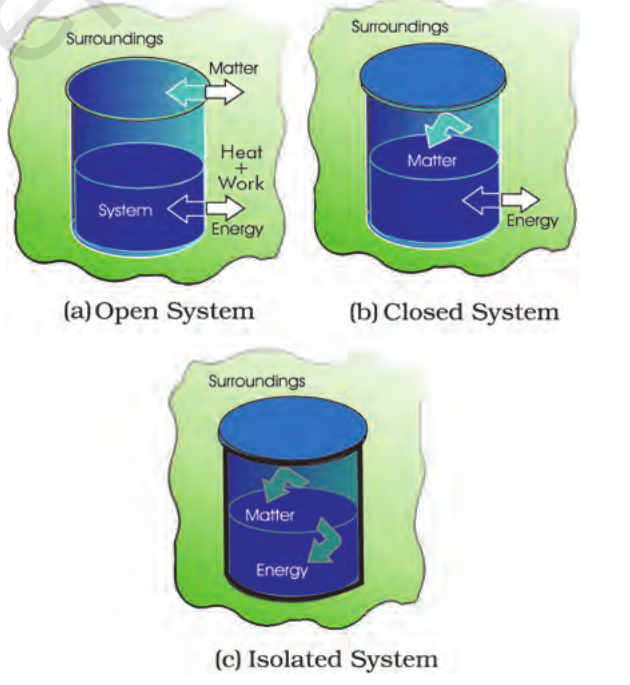
- Open system: there is exchange of energy and matter between system and surroundings [Fig. 5.2 (a)]. The presence of reactants in an open beaker is an example of an open system. Here the boundary is an imaginary surface enclosing the beaker and reactants.
- Closed system: there is no exchange of matter, but exchange of energy is possible between system and the surroundings [Fig. 5.2 (b)]. The presence of reactants in a closed vessel made of conducting material, for example copper or steel, is an example of a closed system.
- Isolated system: there is no exchange of energy or matter between the system and the surroundings [Fig. 5.2 (c)]. The presence of reactants in a thermos flask or any other closed insulated vessel is an example of an isolated system.
- NEET check: ask what crosses the boundary. Matter and energy cross in an open system, energy only in a closed system, and nothing in an isolated system.
- We could have chosen only the reactants as system then walls of the beakers will act as boundary.
Suggest an edit
Practice1 question
Try it now. A wrong answer costs nothing here, try again until you get it.
Which of the following is an example of an isolated system?
NCERT 5.1.2: an isolated system exchanges neither energy nor matter with the surroundings, and reactants in a thermos flask are the example given.
State of the system and state functions
- The system must be described by specifying quantitatively each of the properties such as its pressure (p), volume (V), and temperature (T) as well as the composition of the system. The state of a thermodynamic system is described by its measurable or macroscopic (bulk) properties.
- Variables like p, V and T are called state variables or state functions because their values depend only on the state of the system and not on how it is reached.
- It is not necessary to define all the properties of the system: only a certain number of properties can be varied independently. Once these minimum number of macroscopic properties are fixed, others automatically have definite values.
- The state of the surroundings can never be completely specified, but fortunately it is not necessary to do so.
- Laws of thermodynamics apply only when a system is in equilibrium or moves from one equilibrium state to another equilibrium state. Macroscopic properties like pressure and temperature do not change with time for a system in equilibrium state.
Suggest an edit
Internal energy as a state function
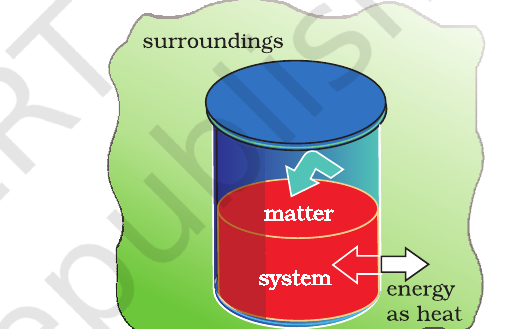
- Internal energy, U, is the total energy of the system: chemical, electrical, mechanical or any other type of energy, the sum of all these is the energy of the system.
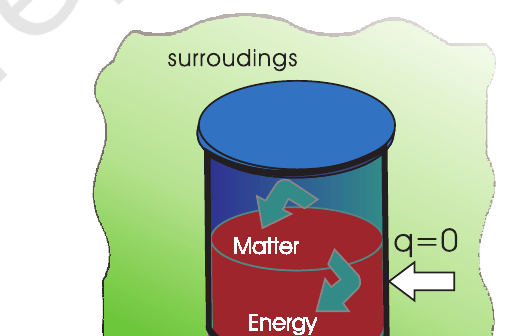
- A system which does not permit the transfer of heat through its boundary is called an adiabatic system (NCERT Fig. 5.3). It may change when heat passes into or out of the system, work is done on or by the system, or matter enters or leaves the system.
- One way: Doing 1 kJ of mechanical work by churning water with paddles gave a temperature change.
- Second way: Doing 1 kJ of electrical work with an immersion rod gave the same temperature change.
- Joule (1840-50) showed that a given amount of work done on the system, no matter how it was done, produced the same change of state.
- So U is a state function: the adiabatic work, wad, required to bring about a change of state is equal to the difference between the value of U in one state and that in another, $\Delta U$ = U2 - U1 = wad. wad is positive when work is done on the system and negative when work is done by the system.
- We can specify an unambiguous absolute value for volume of a system in a particular state, but not the absolute value of the internal energy. We can measure only the changes in the internal energy, $\Delta U$, of the system.
- Other familiar state functions are V, p and T. The change in temperature from 25°C to 35°C is +10°C whether we go straight up or cool first and then heat: T is a state function and the change is independent of the route taken.
Suggest an edit
Table: first law and sign conventions
| Quantity | Symbol | Sign is positive when | Sign is negative when |
|---|---|---|---|
| Heat | q | Heat is transferred from the surroundings to the system | Heat is transferred from the system to the surroundings |
| Work | w | Work is done on the system | Work is done by the system |
| Change in internal energy | $\Delta U$ | Internal energy of the system increases | Internal energy of the system decreases |
- First law of thermodynamics: $\Delta U$ = q + w. The energy of an isolated system is constant. It is commonly stated as the law of conservation of energy: energy can neither be created nor be destroyed.
- For a given change in state, q and w can vary depending on how the change is carried out. However, q + w = $\Delta U$ will depend only on initial and final state. It will be independent of the way the change is carried out. So q and w are path-dependent, while $\Delta U$ is a state function.
- If there is no transfer of energy as heat or as work (isolated system), that is, if w = 0 and q = 0, then $\Delta U$ = 0.
- Caution: in physics books the sign convention for work is the opposite (work done by the system is positive). NCERT follows the IUPAC convention in chemical thermodynamics. In an adiabatic process there is no transfer of heat between the system and surroundings, and the wall separating them is called the adiabatic wall.
- By conventions of IUPAC in chemical thermodynamics. The q is positive, when heat is transferred from the surroundings to the system and the internal energy of the system increases and q is negative when heat is transferred from system to the surroundings resulting in decrease of the internal energy of the system.
Suggest an edit
Practice1 question
Try it now. A wrong answer costs nothing here, try again until you get it.
In a process, 701 J of heat is absorbed by a system and 394 J of work is done by the system. What is the change in internal energy?
NCERT 5.1.4 and Exercise 5.7: $\Delta U$ = q + w. Heat absorbed is +701 J and work done by the system is -394 J, so $\Delta U$ = 701 - 394 = 307 J.
Pressure-volume work
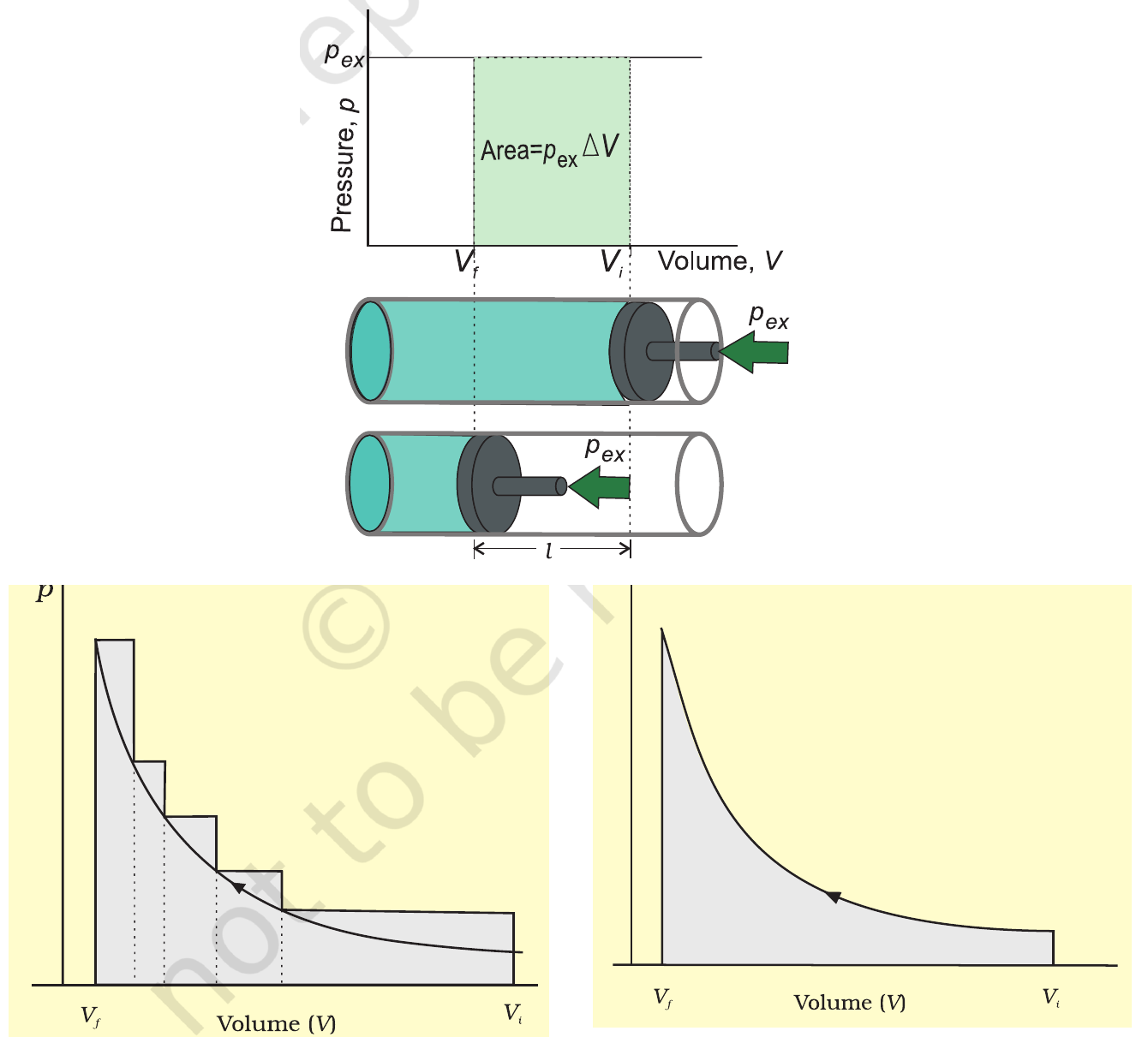
- Only mechanical work, that is, pressure-volume work, is considered here. For a cylinder with one mole of an ideal gas fitted with a frictionless piston, if the external pressure pex is greater than the gas pressure p, the piston moves inward till the pressure inside becomes equal to pex.
- Work done on the system in a single step: w = -pex $\Delta V$ = -pex (Vf - Vi). The negative sign is required so that w is positive for compression, where Vf - Vi is negative.
- If the pressure changes in a number of finite steps, the work done on the gas is summed over all the steps and is equal to -sum p $\Delta V$ [NCERT Fig. 5.5 (b)]. If the pressure changes in infinite steps, w = -integral from Vi to Vf of pex dV.
- A process is reversible if a change is brought out in such a way that the process could, at any moment, be reversed by an infinitesimal change. A reversible process proceeds infinitely slowly by a series of equilibrium states such that system and the surroundings are always in near equilibrium with each other. Processes other than reversible processes are known as irreversible processes.
- Under reversible conditions, wrev = -integral from Vi to Vf of pin dV, where pin is the internal pressure of the system. For n mol of an ideal gas at constant temperature, wrev = -2.303 nRT log(Vf/Vi).
- Free expansion: Expansion of a gas in vacuum (pex = 0) is called free expansion. No work is done during free expansion of an ideal gas whether the process is reversible or irreversible.
Suggest an edit
Table: work in isothermal, adiabatic and free expansion
| Process | w | q | $\Delta U$ |
|---|---|---|---|
| Isothermal irreversible expansion | w = -pex (Vf - Vi) | q = -w = pex (Vf - Vi) | $\Delta U$ = 0 |
| Isothermal reversible expansion | w = -2.303 nRT log(Vf/Vi) | q = -w = 2.303 nRT log(Vf/Vi) | $\Delta U$ = 0 |
| Adiabatic change | w = wad | q = 0 | $\Delta U$ = wad |
| Isothermal (or adiabatic) free expansion of an ideal gas into vacuum | w = 0 (pex = 0) | q = 0 | $\Delta U$ = 0 |
| Constant volume | w = 0 ($\Delta V$ = 0) | q = qV | $\Delta U$ = qV |
- Worked numbers from NCERT: 2 litres of an ideal gas at 10 atm expands isothermally at 25°C into a vacuum until its volume is 10 litres: no work is done and no heat is absorbed (Problem 5.2). The same expansion against a constant external pressure of 1 atm gives q = -w = 8 litre-atm (Problem 5.3). The same expansion of 1 mol conducted reversibly gives q = -w = 39.366 L atm (Problem 5.4).
- At constant volume, $\Delta V$ = 0, so $\Delta U$ = qV, where the subscript V denotes that heat is supplied at constant volume.
Suggest an edit
Enthalpy H
- Most chemical reactions are carried out not at constant volume, but in flasks or test tubes under constant atmospheric pressure. Heat absorbed at constant volume equals the change in internal energy, $\Delta U$ = qV, so a new state function is needed for constant pressure.
- Enthalpy H [Greek word enthalpien, to warm or heat content] is defined as H = U + pV. At constant pressure, qp = (U2 + pV2) - (U1 + pV1) = $H_2$ - H1 = $\Delta H$. Although q is a path dependent function, H is a state function because it depends on U, p and V, all of which are state functions. Therefore $\Delta H$ is independent of path, and qp is also independent of path.
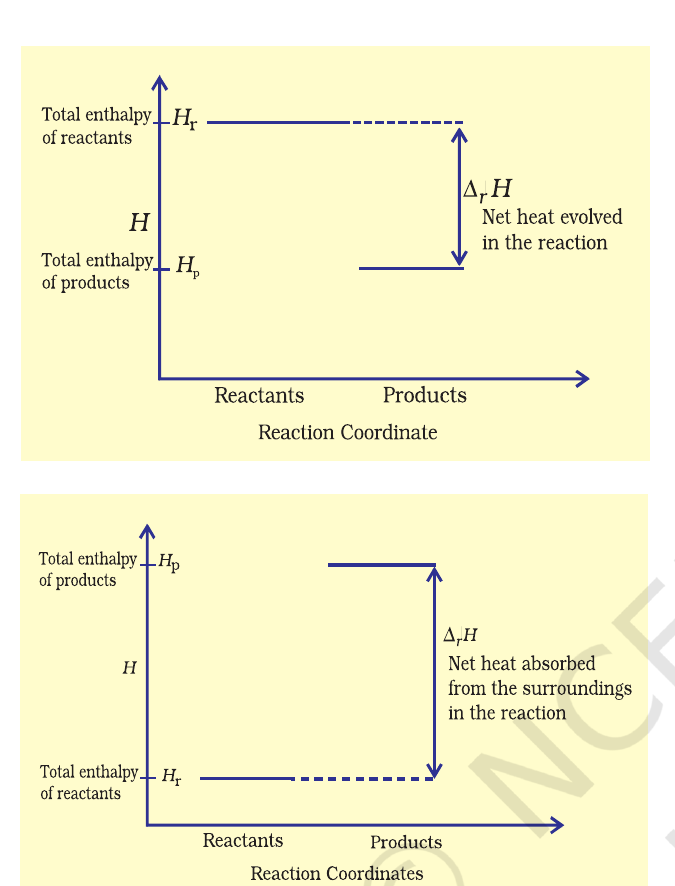
- For finite changes at constant pressure, $\Delta H$ = $\Delta U$ + p$\Delta V$. $\Delta H$ is negative for exothermic reactions, which evolve heat during the reaction, and $\Delta H$ is positive for endothermic reactions, which absorb heat from the surroundings.
- The difference between $\Delta H$ and $\Delta U$ is not usually significant for systems consisting of only solids and liquids. It becomes significant when gases are involved. Using the ideal gas law, p$\Delta V$ = ΔngRT, where Δng is the number of moles of gaseous products minus the number of moles of gaseous reactants. So $\Delta H$ = $\Delta U$ + ΔngRT, and $\Delta H$ is obtained from $\Delta U$ and vice versa.
- Worked example (Problem 5.5): molar enthalpy change for vaporisation of 1 mol of water at 1 bar and 100°C is 41 kJ mol-1. $\Delta U$ = $\Delta H$ - ΔngRT = 41.00 - 1 x 8.3 x 373/1000 = 37.904 kJ mol-1.
Suggest an edit
Practice1 question
Try it now. A wrong answer costs nothing here, try again until you get it.
For the combustion $CH_4$(g) + 2O2(g) -> $CO_2$(g) + 2H2O(l) at 298 K, how does $\Delta H$ compare with $\Delta U$?
NCERT 5.2.2: $\Delta H$ = $\Delta U$ + ΔngRT. For $CH_4$(g) + 2O2(g) -> $CO_2$(g) + 2H2O(l), Δng = 1 - 3 = -2, so $\Delta H$ = $\Delta U$ - 2RT and $\Delta H$ is less than $\Delta U$.
Extensive and intensive properties; heat capacity; Cp - Cv = R
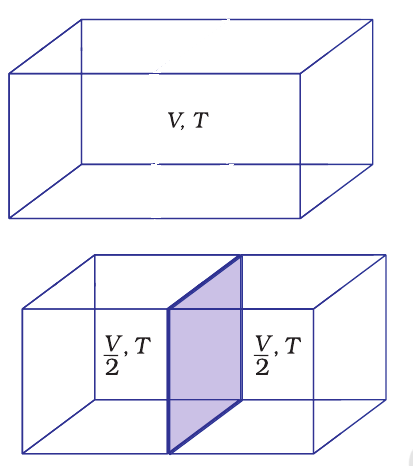
- An extensive property is a property whose value depends on the quantity or size of matter present in the system. Examples: mass, volume, internal energy, enthalpy, heat capacity.
- An intensive property does not depend on the quantity or size of matter present. Examples: temperature, density, pressure. A molar property is the value of an extensive property for 1 mol of the substance, and it is independent of the amount of matter. Examples: molar volume Vm and molar heat capacity Cm.
- NCERT test: a gas in a container of volume V at temperature T is split by a partition so each part has volume V/2, but the temperature stays T. Volume is extensive and temperature is intensive.
- Heat capacity: the increase of temperature is proportional to the heat transferred, q = C $\Delta T$. C is called the heat capacity. When C is large, a given amount of heat results in only a small temperature rise. Water has a large heat capacity.
- The molar heat capacity Cm is the heat capacity for one mole of the substance. Specific heat is the quantity of heat required to raise the temperature of one unit mass of a substance by one degree celsius (or one kelvin): q = c x m x $\Delta T$ = C $\Delta T$.
- At constant volume, qV = Cv $\Delta T$ = $\Delta U$; at constant pressure, qp = Cp $\Delta T$ = $\Delta H$. For one mole of an ideal gas, $\Delta H$ = $\Delta U$ + R$\Delta T$, so Cp $\Delta T$ = Cv $\Delta T$ + R$\Delta T$, giving Cp - Cv = R.
Suggest an edit
Calorimetry: measuring $\Delta U$ and $\Delta H$
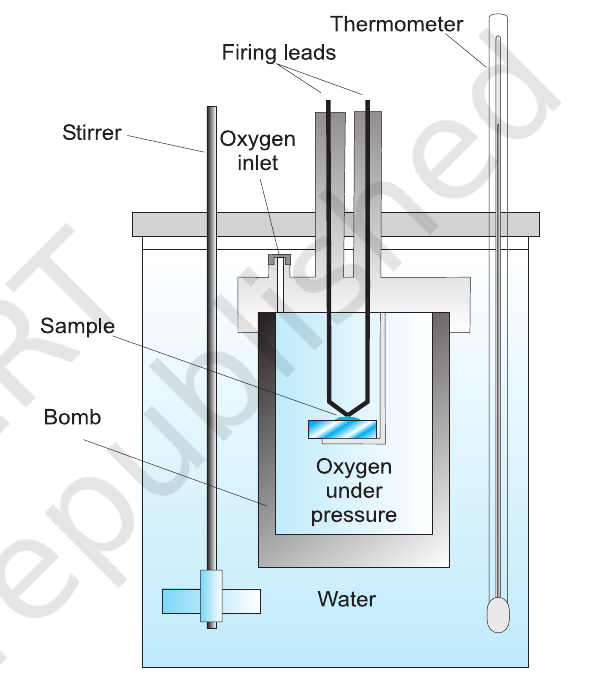
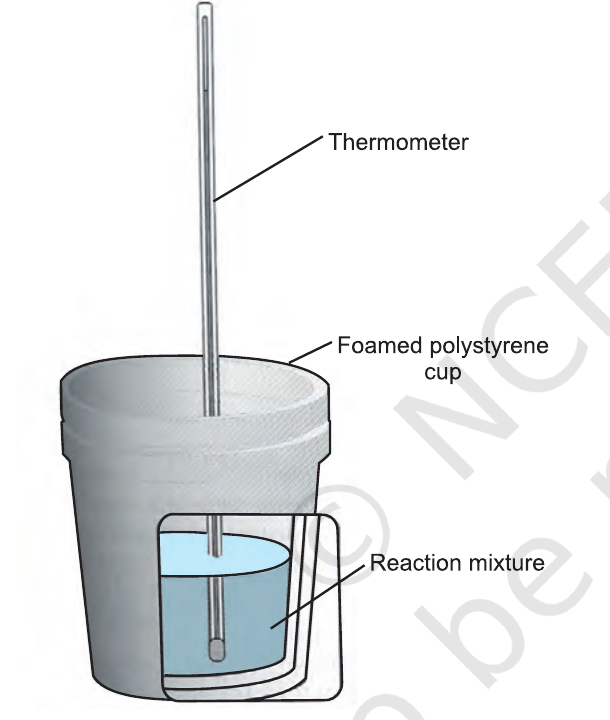
- Energy changes are measured by calorimetry: the process is carried out in a vessel called a calorimeter, immersed in a known volume of a liquid. Knowing the heat capacity of the liquid and of the calorimeter, the heat evolved is found by measuring temperature changes. Measurements are made under two conditions: at constant volume, qV, and at constant pressure, qp.
- $\Delta U$ measurements: heat absorbed at constant volume is measured in a bomb calorimeter (NCERT Fig. 5.7). A steel vessel (the bomb) is immersed in a water bath. The substance is burnt in pure dioxygen in the sealed bomb, so its volume does not change and no work is done, even for reactions involving gases. The temperature change is converted to qV using the known heat capacity of the calorimeter.
- $\Delta H$ measurements: heat change at constant pressure is measured in a calorimeter open to the atmosphere (NCERT Fig. 5.8). $\Delta H$ = qp, and heat absorbed or evolved at constant pressure is also called the heat of reaction or enthalpy of reaction, ΔrH.
- In an exothermic reaction heat is evolved, qp is negative and ΔrH is negative. In an endothermic reaction heat is absorbed, qp is positive and ΔrH is positive.
- Worked example (Problem 5.6): 1 g of graphite burnt in a bomb calorimeter at 298 K raises the temperature from 298 K to 299 K with a calorimeter heat capacity of 20.7 kJ/K. q = -20.7 kJ for 1 g, so for 1 mol (12.0 g) $\Delta U$ = -2.48 x $10^{2}$ kJ mol-1. Since Δng = 0, $\Delta H$ = $\Delta U$ = -2.48 x $10^{2}$ kJ mol-1.
Suggest an edit
Reaction enthalpy and standard states
- In a chemical reaction, reactants are converted into products. The enthalpy change accompanying a reaction is called the reaction enthalpy, ΔrH = (sum of enthalpies of products) - (sum of enthalpies of reactants).
- Example: $CH_4$(g) + 2O2(g) -> $CO_2$(g) + 2H2O(l), where Hm is the molar enthalpy: ΔrH = [Hm($CO_2$, g) + 2Hm($H_2O$, l)] - [Hm($CH_4$, g) + 2Hm($O_2$, g)].
- Enthalpy of a reaction depends on the conditions, so standard conditions are specified. The standard enthalpy of reaction is the enthalpy change for a reaction when all the participating substances are in their standard states.
- The standard state of a substance at a specified temperature is its pure form at 1 bar. For example, the standard state of liquid ethanol at 298 K is pure liquid ethanol at 1 bar, and the standard state of solid iron at 500 K is pure iron at 1 bar. Usually data are taken at 298 K. Standard conditions are shown by adding the superscript 0 to the symbol $\Delta H$, for example $\Delta H$0.
Suggest an edit
Table: enthalpies of phase change, formation and combustion
- The enthalpy change that accompanies melting of one mole of a solid substance in standard state is called standard enthalpy of fusion or molar enthalpy of fusion, ΔfusH0. Melting of a solid is endothermic, so all enthalpies of fusion are positive.
- Amount of heat required to vaporize one mole of a liquid at constant temperature and under standard pressure (1 bar) is called its standard enthalpy of vaporization or molar enthalpy of vaporization, ΔvapH0.
- Standard enthalpy of sublimation, ΔsubH0, is the change in enthalpy when one mole of a solid substance sublimes at a constant temperature and under standard pressure (1 bar). For example, dry ice sublimes at 195 K with ΔsubH0 = 25.2 kJ mol-1, and naphthalene sublimes slowly with ΔsubH0 = 73.0 kJ mol-1.
- The magnitude of the enthalpy change depends on the strength of the intermolecular interactions in the substance undergoing the phase transformations. For example, the strong hydrogen bonds between water molecules hold them tightly in liquid phase. For an organic liquid, such as acetone, the intermolecular dipole-dipole interactions are significantly weaker. Thus, it requires less heat to vaporise 1 mol of acetone than it does to vaporize 1 mol of water.
Table 5.1: Standard Enthalpy Changes of Fusion and Vaporisation:
| Substance | Tf/K | ΔfusH0/(kJ mol-1) | Tb/K | ΔvapH0/(kJ mol-1) |
|---|---|---|---|---|
| $N_2$ | 63.15 | 0.72 | 77.35 | 5.59 |
| $NH_3$ | 195.40 | 5.65 | 239.73 | 23.35 |
| $HCl$ | 159.0 | 1.992 | 188.0 | 16.15 |
| $CO$ | 68.0 | 6.836 | 82.0 | 6.04 |
| $CH_3COCH_3$ | 177.8 | 5.72 | 329.4 | 29.1 |
| $CCl_4$ | 250.16 | 2.5 | 349.69 | 30.0 |
| $H_2O$ | 273.15 | 6.01 | 373.15 | 40.79 |
| $NaCl$ | 1081.0 | 28.8 | 1665.0 | 170.0 |
| $C_6H_6$ | 278.65 | 9.83 | 353.25 | 30.8 |
(Tf and Tb are melting and boiling points, respectively)
At 298 K, ΔvapH0 of water is 44.01 kJ mol-1, so ΔvapU = 44.01 - 2.48 = 41.53 kJ mol-1.
Table 5.2: Standard Molar Enthalpies of Formation (ΔfH0) at 298 K of a Few Selected Substances:
| Substance | ΔfH0/(kJ mol-1) | Substance | ΔfH0/(kJ mol-1) |
|---|---|---|---|
| $Al_2O_3$(s) | -1675.7 | $HI$(g) | +26.48 |
| $BaCO_3$(s) | -1216.3 | $KCl$(s) | -436.75 |
| $Br_2$(l) | 0 | $KBr$(s) | -393.8 |
| $Br_2$(g) | +30.91 | $MgO$(s) | -601.70 |
| $CaCO_3$(s) | -1206.92 | $Mg(OH)_2$(s) | -924.54 |
| C (diamond) | +1.89 | $NaF$(s) | -573.65 |
| C (graphite) | 0 | $NaCl$(s) | -411.15 |
| $CaO$(s) | -635.09 | $NaBr$(s) | -361.06 |
| $CH_4$(g) | -74.81 | $NaI$(s) | -287.78 |
| $C_2H_4$(g) | 52.26 | $NH_3$(g) | -46.11 |
| $CH_3OH$(l) | -238.86 | $NO$(g) | +90.25 |
| $C_2H_5OH$(l) | -277.69 | $NO_2$(g) | +33.18 |
| $C_6H_6$(l) | +49.0 | $PCl_3$(l) | -319.70 |
| $CO$(g) | -110.53 | $PCl_5$(s) | -443.5 |
| $CO_2$(g) | -393.51 | $SiO_2$(s) (quartz) | -910.94 |
| $C_2H_6$(g) | -84.68 | $SnCl_2$(s) | -325.1 |
| $Cl_2$(g) | 0 | $SnCl_4$(l) | -511.3 |
| $C_3H_8$(g) | -103.85 | $SO_2$(g) | -296.83 |
| n-$C_4H_{10}$(g) | -126.15 | $SO_3$(g) | -395.72 |
| $HgS$(s) red | -58.2 | $SiH_4$(g) | +34 |
| $H_2$(g) | 0 | $SiCl_4$(g) | -657.0 |
| $H_2O$(g) | -241.82 | $C$(g) | +716.68 |
| $H_2O$(l) | -285.83 | $H$(g) | +217.97 |
| $HF$(g) | -271.1 | $Cl$(g) | +121.68 |
| $HCl$(g) | -92.31 | $Fe_2O_3$(s) | -824.2 |
| $HBr$(g) | -36.40 |
Table 5.3(a): Some Mean Single Bond Enthalpies in kJ mol-1 at 298 K:
| H | C | N | O | F | Si | P | S | Cl | Br | I | |
|---|---|---|---|---|---|---|---|---|---|---|---|
| H | 435.8 | 414 | 389 | 464 | 569 | 293 | 318 | 339 | 431 | 368 | 297 |
| C | 347 | 293 | 351 | 439 | 289 | 264 | 259 | 330 | 276 | 238 | |
| N | 159 | 201 | 272 | - | 209 | - | 201 | 243 | - | ||
| O | 138 | 184 | 368 | 351 | - | 205 | - | 201 | |||
| F | 155 | 540 | 490 | 327 | 255 | 197 | - | ||||
| Si | 176 | 213 | 226 | 360 | 289 | 213 | |||||
| P | 213 | 230 | 331 | 272 | 213 | ||||||
| S | 213 | 251 | 213 | - | |||||||
| Cl | 243 | 218 | 209 | ||||||||
| Br | 192 | 180 | |||||||||
| I | 151 |
Table 5.3(b): Some Mean Multiple Bond Enthalpies in kJ mol-1 at 298 K:
| Bond | Value (kJ mol-1) | Bond | Value (kJ mol-1) | Bond | Value (kJ mol-1) |
|---|---|---|---|---|---|
| $N=N$ | 418 | $C=C$ | 611 | $O=O$ | 498 |
| $N\equiv N$ | 946 | $C\equiv C$ | 837 | ||
| $C=N$ | 615 | $C=O$ | 741 | ||
| $C\equiv N$ | 891 | $C\equiv O$ | 1070 |
Note that symbol used for bond dissociation enthalpy and mean bond enthalpy is the same.
If we use enthalpy of bond formation (ΔfH0 of a bond), which is the enthalpy change when one mole of a particular type of bond is formed from gaseous atom, then ΔrH0 = Σ ΔfH0 of bonds of products - Σ ΔfH0 of bonds of reactants.
- Standard molar enthalpy of formation, ΔfH0, is the standard enthalpy change for the formation of one mole of a compound from its elements in their most stable states of aggregation. The reference state of an element is its most stable state of aggregation at 25°C and 1 bar: $H_2$ gas, $O_2$ gas, C graphite and S rhombic.
- By convention, the standard enthalpy of formation of an element in its reference state is taken as zero.
- Combustion enthalpies (all exothermic): butane $C_4H_{10}$(g) + 13/2 $O_2$(g) -> 4CO2(g) + 5H2O(l), ΔcH0 = -2658.0 kJ mol-1; ethanol $C_2H_5OH$(l) + 3O2(g) -> 2CO2(g) + 3H2O(l), ΔrH0 = -1367 kJ mol-1; glucose $C_6H_{12}O_6$(s) + 6O2(g) -> 6CO2(g) + 6H2O(l), ΔcH0 = -2802.0 kJ mol-1; benzene $C_6H_6$(l) + 15/2 $O_2$(g) -> 6CO2(g) + 3H2O(l), ΔcH0 = -3267 kJ mol-1.
- Enthalpy of reaction from formation enthalpies: ΔrH0 = sum ai ΔfH0(products) - sum bi ΔfH0(reactants). Example: $CaCO_3$(s) -> $CaO$(s) + $CO_2$(g) gives ΔrH0 = (-635.1) + (-393.5) - (-1206.9) = +178.3 kJ mol-1, so the decomposition is endothermic.
Suggest an edit
Hess's law of constant heat summation
- Enthalpy is a state function, so the change in enthalpy is independent of the path between initial state (reactants) and final state (products). Hess's law: if a reaction takes place in several steps then its standard reaction enthalpy is the sum of the standard enthalpies of the intermediate reactions into which the overall reaction may be divided at the same temperature.
- Worked example: C(graphite, s) + $O_2$(g) -> $CO_2$(g) has ΔrH0 = -393.5 kJ mol-1, and $CO$(g) + 1/2 $O_2$(g) -> $CO_2$(g) has ΔrH0 = -283.0 kJ mol-1. Reversing the second reaction changes the sign of ΔrH0 to +283.0 kJ mol-1. Adding gives C(graphite, s) + 1/2 $O_2$(g) -> $CO$(g) with ΔrH0 = -393.5 + 283.0 = -110.5 kJ mol-1.
- A balanced chemical equation together with the value of its ΔrH is called a thermochemical equation. The physical state (along with allotropic state) of the substance is specified in the equation.
- Conventions for thermochemical equations: (1) the coefficients refer to the number of moles (never molecules) of reactants and products; (2) the numerical value of ΔrH0 refers to the number of moles of substances specified by the equation, with units kJ mol-1, which means per mole of reaction; (3) when a chemical equation is reversed, the value of ΔrH0 is reversed in sign, for example $N_2$(g) + 3H2(g) -> 2NH3(g) has ΔrH0 = -91.8 kJ mol-1, so the reverse has +91.8 kJ mol-1.
- Enthalpy is an extensive quantity: halving the equation for $Fe_2O_3$(s) + 3H2(g) -> 2Fe(s) + 3H2O(l) halves ΔrH0 from -33.3 kJ mol-1 to -16.6 kJ mol-1.
Suggest an edit
Practice1 question
Try it now. A wrong answer costs nothing here, try again until you get it.
What is ΔrH0 for C(graphite, s) + 1/2 $O_2$(g) -> $CO$(g)?
NCERT 5.4: C(graphite) + $O_2$ -> $CO_2$ has ΔrH0 = -393.5 kJ mol-1 and $CO$ + 1/2 $O_2$ -> $CO_2$ has ΔrH0 = -283.0 kJ mol-1. Reversing the second gives +283.0, and -393.5 + 283.0 = -110.5 kJ mol-1.
Ladder: enthalpy traps
- Formation is not any reaction: $CaO$(s) + $CO_2$(g) -> $CaCO_3$(s) has ΔrH0 = -178.3 kJ mol-1, but it is not an enthalpy of formation of calcium carbonate, since calcium carbonate has been formed from other compounds and not from its constituent elements. Formation needs the elements in their most stable states.
- One mole of product only: $H_2$(g) + $Br_2$(l) -> 2HBr(g) makes two moles of product, so its ΔrH0 is twice ΔfH0 of $HBr$(g), which is -36.4 kJ mol-1. Divide the coefficients by 2 to write the formation reaction: 1/2 $H_2$(g) + 1/2 $Br_2$(l) -> $HBr$(g).
- Elements are zero: the standard enthalpy of formation of an element in its reference state is zero, so ΔfH0($H_2$, g) = 0, ΔfH0($O_2$, g) = 0, ΔfH0(Fe, s) = 0 and ΔfH0(C, graphite) = 0.
- $\Delta H$ equals $\Delta U$ only when Δng = 0: graphite combustion has Δng = 0, so $\Delta H$ = $\Delta U$ = -2.48 x $10^{2}$ kJ mol-1. When gases are involved with Δng not zero, use $\Delta H$ = $\Delta U$ + ΔngRT.
- Bond enthalpy is a gas-phase idea: the relation ΔrH0 = sum of bond enthalpies of reactants - sum of bond enthalpies of products is valid when all substances (reactants and products) in the reaction are in gaseous state. Diatomic Molecules: Bond dissociation enthalpy and mean bond enthalpy are the same for diatomic molecules: for $H_2$, both are 435.0 kJ mol-1. Polyatomic Molecules: For polyatomic molecules they differ: the four C-H bonds in $CH_4$ break in steps of 427, 439, 452 and 347 kJ mol-1, and the mean bond enthalpy of C-H bond is 416 kJ mol-1.
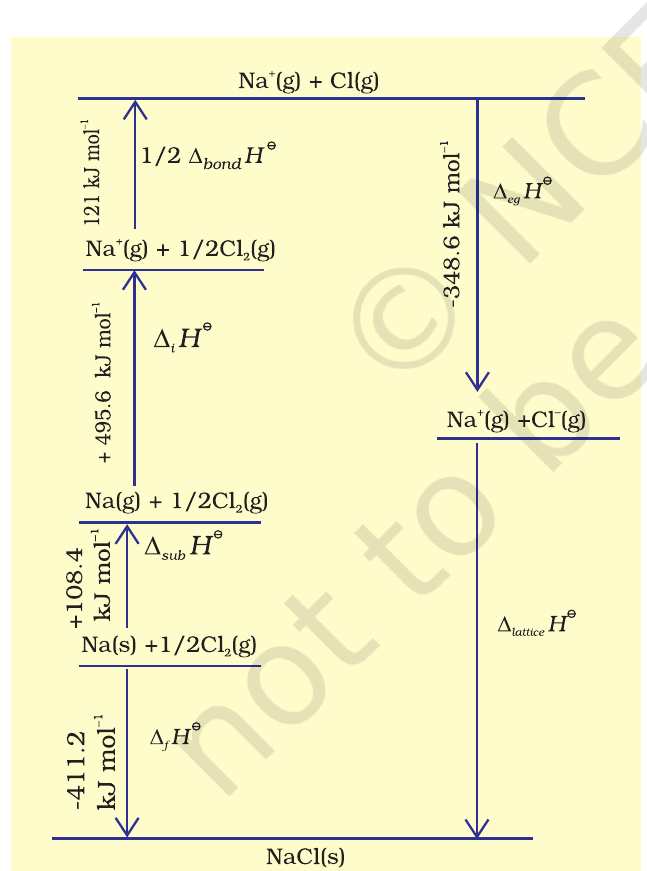
- Lattice enthalpy cannot be measured directly: the lattice enthalpy of $NaCl$ is +788 kJ mol-1, found by the Born-Haber Cycle from sublimation of sodium (108.4), half the Cl-Cl bond enthalpy (121), ionisation of sodium (496), electron gain by chlorine (-348.6) and standard enthalpy of formation of $NaCl$ (-411.2 kJ mol-1). Internal energy for the same change is smaller by 2RT and equals +783 kJ mol-1.
- Enthalpy of solution: ΔsolH0 = ΔlatticeH0 + ΔhydH0. For $NaCl$, +788 + (-784) = +4 kJ mol-1. For most ionic compounds ΔsolH0 is positive and the dissociation is endothermic, so solubility of most salts in water increases with rise of temperature.
Suggest an edit
Spontaneity and entropy
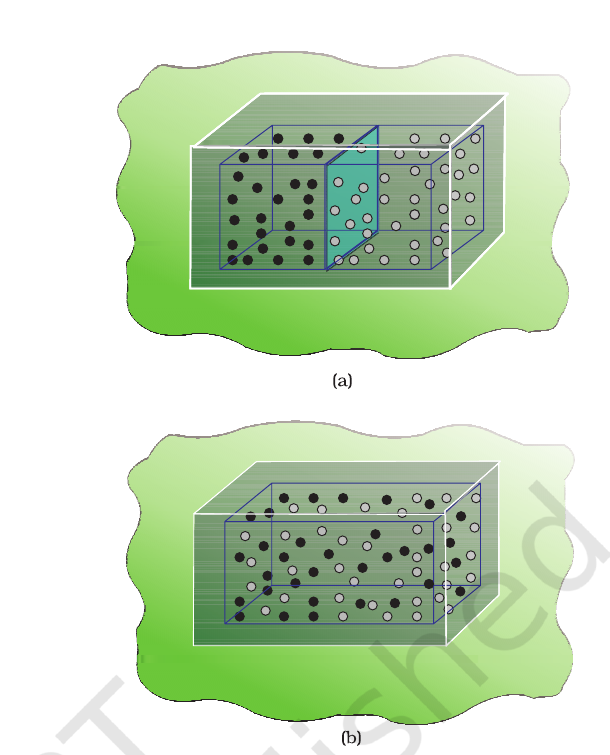
- The first law tells us about the relationship between the heat absorbed and the work performed on or by a system, but it puts no restrictions on the direction of heat flow. All naturally occurring processes tend to proceed spontaneously in one direction only: a gas expands to fill the available volume, and carbon burns in dioxygen to give carbon dioxide.
- A spontaneous process is an irreversible process and may only be reversed by some external agency. Spontaneity means having the potential to proceed without the assistance of external agency. It does not tell about the rate of the reaction: hydrogen and oxygen mixed at room temperature may be left for years without perceptible change, yet the reaction is spontaneous.
- A fall in enthalpy is not a safe test, although the idea that a fall in energy drives a reaction sounds 'reasonable': exothermic reactions such as 1/2 $N_2$(g) + 3/2 $H_2$(g) -> $NH_3$(g) with ΔrH0 = -46.1 kJ mol-1 and $H_2$(g) + 1/2 $O_2$(g) -> $H_2O$(l) with ΔrH0 = -285.8 kJ mol-1 are spontaneous, but so are endothermic reactions such as 1/2 $N_2$(g) + $O_2$(g) -> $NO_2$(g) with ΔrH0 = +33.2 kJ mol-1 and C(graphite, s) + 2S(l) -> $CS_2$(l) with ΔrH0 = +128.5 kJ mol-1.
- Entropy S is a measure of the degree of randomness or disorder in the system. The greater the disorder in an isolated system, the higher is the entropy. For a given substance, the crystalline solid state is the state of lowest entropy (most ordered) and the gaseous state is state of highest entropy.
- Whenever heat is added to the system, it increases molecular motions, causing increased randomness: heat (q) has randomising influence on the system. A system at higher temperature has greater randomness than one at lower temperature: temperature is the measure of average chaotic motion of particles in the system.
- Entropy change for a reversible process: $\Delta S$ = qrev/T. Entropy, like internal energy U and enthalpy H, is a state function and $\Delta S$ is independent of path.
- The total entropy change for the system and surroundings of a spontaneous process is $\Delta S$total = $\Delta S$system + $\Delta S$surr > 0. When a system is in equilibrium, the entropy is maximum and the change in entropy is zero. For an isolated system, $\Delta U$ = 0 and $\Delta S$ > 0, so entropy change distinguishes a spontaneous change while energy change does not.
- Worked check (Problem 5.11): for 4Fe(s) + 3O2(g) -> 2Fe2O3(s), the entropy change of the system is -549.4 J K-1 mol-1 at 298 K, but the surroundings gain -ΔrH0/T = 5530 J K-1 mol-1, so the total entropy change is -549.4 + 5530 = 4980.6 J K-1 mol-1, positive, and the reaction is spontaneous.
- Prediction drill (Problem 5.10): entropy decreases when a liquid crystallises into a solid; entropy increases when a crystalline solid is warmed from 0 K to 115 K, when 2NaHCO3(s) gives $Na_2CO_3$(s) + $CO_2$(g) + $H_2O$(g), and when $H_2$(g) gives 2H(g).
Suggest an edit
Gibbs energy change and equilibrium
- Neither decrease in enthalpy nor increase in entropy alone can determine the direction of spontaneous change for closed or open systems. Gibbs energy, or Gibbs function, G, is defined as G = H - TS. It is an extensive property and a state function.
- At constant temperature, $\Delta G$ = $\Delta H$ - T$\Delta S$. This is the Gibbs equation, one of the most important equations in chemistry. $\Delta G$ is the net energy available to do useful work and is a measure of the free energy, so it is also known as the free energy of the reaction.
- $\Delta G$ gives a criterion for spontaneity at constant pressure and temperature: if $\Delta G$ is negative (< 0), the process is spontaneous; if $\Delta G$ is positive (> 0), the process is non-spontaneous. At equilibrium, $\Delta G$ = 0.
- If a reaction has a positive enthalpy change and positive entropy change, it can be spontaneous when T$\Delta S$ is large enough to outweigh $\Delta H$. That can happen when the positive entropy change is small and T is large, or when the positive entropy change is large and T is small. This is why reactions are often carried out at high temperature.
Table 5.4: Effect of Temperature on Spontaneity of Reactions:
| ΔrH0 | ΔrS0 | ΔrG0 | Description |
|---|---|---|---|
| $-$ | $+$ | $-$ | Reaction spontaneous at all temperatures |
| $-$ | $-$ | $-$ (at low T) | Reaction spontaneous at low temperature |
| $-$ | $-$ | $+$ (at high T) | Reaction nonspontaneous at high temperature |
| $+$ | $+$ | $+$ (at low T) | Reaction nonspontaneous at low temperature |
| $+$ | $+$ | $-$ (at high T) | Reaction spontaneous at high temperature |
| $+$ | $-$ | $+$ (at all T) | Reaction nonspontaneous at all temperatures |
The term low temperature and high temperature are relative. For a particular reaction, high temperature could even mean room temperature.
- Second law of thermodynamics: in an isolated system there is always a tendency for the energy to become more disordered, and increase in entropy is the natural direction of a spontaneous change. In exothermic reactions, heat released increases the disorder of the surroundings and the overall entropy change is positive.
- The entropy of any pure crystalline substance approaches zero as the temperature approaches absolute zero. This is called third law of thermodynamics. There is perfect order in a crystal at absolute zero. It permits the calculation of absolute values of entropy of pure substances from thermal data alone, by summing qrev/T increments from 0 K to 298 K.
- Gibbs energy and equilibrium: at equilibrium the free energy of the system is minimum, so ΔrG = 0. For a reaction with all reactants and products in standard state, ΔrG0 = -RT ln K = -2.303 RT log K. For strongly endothermic reactions K is much smaller than 1; for strongly exothermic reactions K is much larger than 1.
- Worked numbers: oxygen to ozone, 3/2 $O_2$(g) -> $O_3$(g) at 298 K with Kp = 2.47 x $10^{-29}$, gives ΔrG0 = 163 kJ mol-1 (Problem 5.12). A reaction with ΔrG0 = -13.6 kJ mol-1 at 298 K has K = 2.4 x $10^{2}$ (Problem 5.13).
Suggest an edit
Practice1 question
Try it now. A wrong answer costs nothing here, try again until you get it.
For 2A + B -> C, $\Delta H$ = 400 kJ mol-1 and $\Delta S$ = 0.2 kJ K-1 mol-1. Above what temperature does the reaction become spontaneous?
NCERT 5.7 and Exercise 5.17: the reaction turns spontaneous when T$\Delta S$ outweighs $\Delta H$, that is at T = $\Delta H$/$\Delta S$ = 400/0.2 = 2000 K.
Trap pairs: the confusions NEET tests
- State function vs path function: U, H, G, S, p, V and T depend only on the state, while q and w depend on the path. $\Delta U$ is fixed for a change of state, but q and w are not.
- Sign of w: in the IUPAC convention used by NCERT, w is positive when work is done on the system. Compression gives positive w; expansion gives negative w. Physics books use the opposite sign for work.
- $\Delta H$ vs $\Delta U$: $\Delta H$ = qp and $\Delta U$ = qV. They are equal only when Δng = 0 or when no gases are involved. For water vaporisation, $\Delta H$ = 41 kJ mol-1 but $\Delta U$ = 37.904 kJ mol-1.
- Spontaneity test: a fall in enthalpy does not prove spontaneity. Endothermic reactions with ΔrH0 = +33.2 kJ mol-1 ($NO_2$ formation) and +128.5 kJ mol-1 ($CS_2$ formation) are spontaneous. Only $\Delta G$ < 0, or $\Delta S$total > 0, decides.
- $\Delta G$ = 0 means equilibrium, not a dead reaction: away from equilibrium the net reaction proceeds in the direction that decreases free energy; at equilibrium the free energy is minimum and forward and reverse rates are equal.
- Reversible vs spontaneous: a reversible process is infinitely slow and stays in near equilibrium, while a spontaneous process is irreversible and has $\Delta S$total > 0. Isothermal irreversible expansion of an ideal gas has $\Delta U$ = 0 but $\Delta S$total not zero.
- Formation vs combustion vs reaction enthalpy: ΔfH0 is for one mole formed from elements in their reference states, ΔcH0 is for one mole burnt in dioxygen, and ΔrH0 is for the reaction exactly as written, per mole of reaction.
Suggest an edit
Trap Boxes
Is work positive when the system expands?
Wrong idea: Work is positive whenever the system does work, so expansion gives positive w.
NCERT uses the IUPAC convention: w is positive when work is done on the system, so compression gives positive w. Physics books use the opposite sign, with work done by the system positive.
NCERT XI, Ch 5, 5.1.4
Heat and work are state functions?
Wrong idea: q and w are fixed for a given change of state, just like $\Delta U$.
q and w depend on the path, but $\Delta U$ = q + w depends only on the initial and final states. U, H, G, S, p, V and T are state functions; q and w are not.
NCERT XI, Ch 5, 5.1.4
$\Delta H$ always equals $\Delta U$?
Wrong idea: Enthalpy change and internal energy change are the same thing, so $\Delta H$ = $\Delta U$ for every reaction.
$\Delta H$ = $\Delta U$ + ΔngRT, so $\Delta H$ equals $\Delta U$ only when Δng = 0. Graphite combustion has Δng = 0, so $\Delta H$ = $\Delta U$ = -2.48 x $10^{2}$ kJ mol-1. For water vaporisation $\Delta H$ = 41 kJ mol-1 but $\Delta U$ = 37.904 kJ mol-1.
NCERT XI, Ch 5, 5.2.2
Only exothermic reactions are spontaneous?
Wrong idea: A reaction is spontaneous only if its enthalpy falls, so an endothermic reaction can never be spontaneous.
Only $\Delta G$ < 0 (or ΔStotal > 0) decides spontaneity. Endothermic reactions can be spontaneous: $NO_2$ formation has ΔrH0 = +33.2 kJ mol-1 and $CS_2$ formation has ΔrH0 = +128.5 kJ mol-1, and both are spontaneous because T$\Delta S$ outweighs $\Delta H$.
NCERT XI, Ch 5, 5.6
Every reaction enthalpy is an enthalpy of formation?
Wrong idea: The enthalpy change of any reaction that makes a compound is its standard enthalpy of formation.
ΔfH0 is defined for one mole of a compound formed from its elements in their most stable states. $CaO$ + $CO_2$ -> $CaCO_3$ is not a formation reaction, and $H_2$ + $Br_2$ -> 2HBr makes two moles, so its ΔrH0 is twice ΔfH0 of $HBr$. The ΔfH0 of an element in its reference state is zero.
NCERT XI, Ch 5, 5.4
Chapter test
5 NEET PYQs. +4 for a correct answer, -1 for a wrong answer, exactly like NEET. Finish the test to earn a medal.
Q1: NEET (UG) 2023, Code F1, Q86
Which amongst the following options is the correct relation between change in enthalpy and change in internal energy?
NCERT gives $\Delta H$ = $\Delta U$ + ΔngRT, where Δng is the number of moles of gaseous products minus the number of moles of gaseous reactants.
Q2: NEET (UG) 2021, Code P3, Q86
For irreversible expansion of an ideal gas under isothermal condition, the correct option is:
Isothermal means $\Delta T$ = 0, and the internal energy of an ideal gas depends only on temperature, so $\Delta U$ = 0. An irreversible process is spontaneous, and for a spontaneous process $\Delta S$total > 0, so $\Delta S$total is not zero.
Q3: NEET (UG) 2021, Code P3, Q55
Which one among the following is the correct option for right relationship between CP and CV for one mole of ideal gas?
NCERT derives Cp = Cv + R for one mole of an ideal gas from $\Delta H$ = $\Delta U$ + R$\Delta T$ with qV = Cv$\Delta T$ = $\Delta U$ and qp = Cp$\Delta T$ = $\Delta H$.
Q4: NEET (UG) 2021, Code P3, Q66
The correct sequence of bond enthalpy of 'C-X' bond is :
Bond enthalpy falls down a group as the bond gets longer and weaker: C-F is strongest and C-I weakest, so $CH_3$-F > $CH_3$-Cl > $CH_3$-Br > $CH_3$-I.
Q5: NEET (UG) 2020, Code G5, Q107
The correct option for free expansion of an ideal gas under adiabatic condition is:
Free expansion means pex = 0, so w = -pex$\Delta V$ = 0. Adiabatic means q = 0. Then $\Delta U$ = q + w = 0, and the internal energy of an ideal gas depends only on temperature, so $\Delta T$ = 0.
Score: 0 · Answered 0 of 5
Flashcards
Tap a card to flip it over and see the answer. Tap it again to flip it back.
State the first law of thermodynamics and the IUPAC sign convention for q and w.
Tap to flip$\Delta U$ = q + w. q is positive when heat is transferred from the surroundings to the system, and w is positive when work is done on the system. For an isolated system q = 0 and w = 0, so $\Delta U$ = 0.
Tap to flip backWrite the expressions for pressure-volume work at constant external pressure and for reversible isothermal work.
Tap to flipw = -pex $\Delta V$ for expansion or compression at constant external pressure. For a reversible isothermal change of an ideal gas, wrev = -2.303 nRT log(Vf/Vi).
Tap to flip backRelate $\Delta H$ to $\Delta U$, and Cp to Cv for one mole of an ideal gas.
Tap to flip$\Delta H$ = $\Delta U$ + ΔngRT, where Δng is moles of gaseous products minus moles of gaseous reactants. For one mole of an ideal gas, Cp - Cv = R.
Tap to flip backWrite the Gibbs equation, the spontaneity conditions, and the relation between ΔrG0 and K.
Tap to flip$\Delta G$ = $\Delta H$ - T$\Delta S$. $\Delta G$ < 0 means the process is spontaneous, ΔG > 0 means it is non-spontaneous, and $\Delta G$ = 0 at equilibrium. Standard Gibbs energy is tied to the equilibrium constant by ΔrG0 = -2.303 RT log K.
Tap to flip backGive the standard enthalpies of fusion and vaporisation of water and the enthalpies of sublimation of dry ice and naphthalene.
Tap to flipWater: ΔfusH0 = 6.00 kJ mol-1 and ΔvapH0 = 40.79 kJ mol-1 at its boiling point (44.01 kJ mol-1 at 298 K). Solid carbon dioxide sublimes with ΔsubH0 = 25.2 kJ mol-1 and naphthalene with ΔsubH0 = 73.0 kJ mol-1. All enthalpies of fusion and vaporisation are positive.
Tap to flip backGive the lattice enthalpy, hydration enthalpy and enthalpy of solution of $NaCl$.
Tap to flip$NaCl$: lattice enthalpy +788 kJ mol-1, enthalpy of hydration -784 kJ mol-1, so enthalpy of solution is +4 kJ mol-1. Dissolving $NaCl$ gives out almost no heat.
Tap to flip backFor each combination of signs of ΔrH0 and ΔrS0, state when the reaction is spontaneous.
Tap to flip$\Delta H$ negative and $\Delta S$ positive: spontaneous at all temperatures. $\Delta H$ negative and $\Delta S$ negative: spontaneous at low temperature only. $\Delta H$ positive and $\Delta S$ positive: spontaneous at high temperature only. $\Delta H$ positive and $\Delta S$ negative: non-spontaneous at all temperatu
Tap to flip backGive the standard molar enthalpies of formation of water, methane, ethanol, calcium carbonate, calcium oxide and carbon dioxide.
Tap to flip$H_2O$(l) -285.8, $CH_4$(g) -74.81, $C_2H_5OH$(l) -277.7, $CaCO_3$(s) -1206.9, $CaO$(s) -635.1, $CO_2$(g) -393.5 kJ mol-1. By convention the standard enthalpy of formation of an element in its reference state is zero.
Tap to flip backWhy is the enthalpy change of $CaO$ + $CO_2$ -> $CaCO_3$ not a standard enthalpy of formation, and what is ΔfH0 of $HBr$(g)?
Tap to flip$CaO$(s) + $CO_2$(g) -> $CaCO_3$(s) has ΔrH0 = -178.3 kJ mol-1, but this is not an enthalpy of formation, because calcium carbonate is formed from other compounds and not from its elements. $H_2$(g) + $Br_2$(l) -> 2HBr(g) makes two moles of product, so its ΔrH0 is twice ΔfH0 of $HBr$(g), which is -36.4 kJ mol-1.
Tap to flip backName the three types of thermodynamic system and give the NCERT example of each.
Tap to flipOpen system: exchange of matter and energy (reactants in an open beaker). Closed system: exchange of energy only, no matter (reactants in a closed vessel of conducting material such as copper or steel). Isolated system: exchange of neither matter nor energy (reactants in a thermos flask).
Tap to flip backUse Hess's law to find ΔrH0 for C(graphite) + 1/2 $O_2$ -> $CO$ from the two given combustion enthalpies.
Tap to flipC(graphite, s) + $O_2$(g) -> $CO_2$(g), ΔrH0 = -393.5 kJ mol-1. $CO$(g) + 1/2 $O_2$(g) -> $CO_2$(g), ΔrH0 = -283.0 kJ mol-1. Reversing the second step and adding gives C(graphite, s) + 1/2 $O_2$(g) -> $CO$(g), ΔrH0 = -110.5 kJ mol-1.
Tap to flip backHow is the mean C-H bond enthalpy in methane worked out, and what are the H-H, Cl-Cl and O=O bond enthalpies?
Tap to flip$CH_4$(g) -> C(g) + 4H(g) has ΔaH0 = 1665 kJ mol-1. The four C-H bonds break in steps of 427, 439, 452 and 347 kJ mol-1, so the mean C-H bond enthalpy is 1665/4 = 416 kJ mol-1. H-H is 435.0, Cl-Cl is 242 and O=O is 428 kJ mol-1.
Tap to flip back