 NEET Notes
Home > Chemistry > Organic > Organic Chemistry — Some Basic Principles and Techniques
Organic Chemistry — Some Basic Principles and Techniques
On this page · 18 sections
- 01Syllabus map
- 02General introduction: organic chemistry and carbon
- 03Tetravalence, hybridisation and pi bonds
- 04Structural and three-dimensional representation
- 05Classification of organic compounds
- 06Table: functional groups and IUPAC prefixes and suffixes
- 07IUPAC nomenclature of alkanes
- 08Nomenclature with functional groups and substituted benzenes
- 09Ladder: nomenclature traps
- 10Structural isomerism
- 11Stereoisomerism
- 12Fission of a covalent bond
- 13Substrate, reagent, nucleophiles and electrophiles
- 14Table: electron displacement effects
- 15Types of organic reactions
- 16Purification and chromatography
- 17Table: qualitative and quantitative analysis
- 18Trap pairs: the confusions NEET tests
Carbon compounds: tetravalence and hybridisation, structural formulas and IUPAC names, isomerism, bond fission and electron displacement effects, purification, chromatography and elemental analysis.
Syllabus map
- NMC Unit: CHEM-U14, Some Basic Principles of Organic Chemistry.
- Subtopics in this chapter (NCERT XI, Ch 8): general introduction (8.1); tetravalence of carbon and shapes of organic compounds (8.2); structural representations of organic compounds (8.3); classification of organic compounds (8.4); nomenclature of organic compounds (8.5); isomerism (8.6); fundamental concepts in organic reaction mechanism (8.7); methods of purification of organic compounds (8.8); qualitative analysis of organic compounds (8.9); quantitative analysis (8.10).
- Subtopic checklist: (1) catenation and tetravalence of carbon; (2) sp3, sp2 and sp hybridisation and pi bonds; (3) complete, condensed and bond-line formulas, wedge-dash representation; (4) acyclic, alicyclic, aromatic and heterocyclic compounds; (5) functional groups, homologous series and trivial names; (6) IUPAC naming of alkanes, functional groups and substituted benzenes; (7) structural and stereoisomerism; (8) homolytic and heterolytic fission, carbocations, carbanions and free radicals; (9) substrate, reagent, nucleophiles and electrophiles; (10) inductive, electromeric, resonance and hyperconjugation effects; (11) substitution, addition, elimination and rearrangement reactions; (12) sublimation, crystallisation, distillation, differential extraction and chromatography; (13) Lassaigne's test; (14) Dumas, Kjeldahl and Carius methods.
- Extra information (beyond NCERT): none. Everything in this chapter is NCERT Chapter 8.
- Excluded topics: hydrocarbons (Class 11 Ch 9), haloalkanes and haloarenes (Class 12), aldehydes, ketones and carboxylic acids (Class 12). Do not import their facts into this chapter.
- Estimated revision time: 12 minutes. Jump links: Syllabus map, General introduction: organic chemistry and carbon, Tetravalence, hybridisation and pi bonds, Structural and three-dimensional representation, Classification of organic compounds, Table: functional groups and IUPAC prefixes and suffixes, IUPAC nomenclature of alkanes, Nomenclature with functional groups and substituted benzenes, Ladder: nomenclature traps, Structural isomerism, Stereoisomerism, Fission of a covalent bond, Substrate, reagent, nucleophiles and electrophiles, Table: electron displacement effects, Types of organic reactions, Purification and chromatography, Table: qualitative and quantitative analysis, Trap pairs: the confusions NEET tests.
Suggest an edit
General introduction: organic chemistry and carbon
- Organic chemistry deals with the study of carbon compounds. Carbon forms a very large number of compounds because of catenation, the self-linking of carbon atoms, and its tetravalence.
- In 1828 Wohler synthesised urea from ammonium cyanate in the laboratory. This disproved the 'vital force' theory, which held that organic compounds could only be made inside living organisms.
- Carbon compounds are the basis of life: DNA, proteins and other molecules of living systems are organic compounds.
- The tetravalence of carbon and the formation of covalent bonds by it are explained by the electronic configuration of carbon and the hybridisation of s and p orbitals.
Suggest an edit
Tetravalence, hybridisation and pi bonds
- Methane ($CH_4$), ethene ($C_2H_4$) and ethyne ($C_2H_2$) are explained by sp3, sp2 and sp hybrid orbitals of carbon. Methane is tetrahedral, ethene is trigonal planar and ethyne is linear.
- Hybridisation changes the bond length and bond enthalpy (strength). The sp hybrid orbital has more s character and is closer to the nucleus, so it forms shorter and stronger bonds than the sp3 hybrid orbital. The sp2 hybrid orbital is intermediate in s character between sp and sp3, and so are the length and enthalpy of the bonds it forms.
- The change in hybridisation also changes the electronegativity of carbon. The greater the s character of the hybrid orbitals, the greater the electronegativity. A carbon atom with sp hybrid orbitals (50% s character) is more electronegative than one with sp2 or sp3 hybrid orbitals.
- In a pi bond, parallel p orbitals on adjacent atoms overlap sideways. The electron charge cloud of the pi bond lies above and below the plane of the bonding atoms, so the electrons are easily available to attacking reagents. In general, pi bonds provide the most reactive centres in molecules with multiple bonds.
- In ethene all atoms must lie in the same plane, and rotation of one $CH_2$ fragment with respect to the other is restricted because it would disturb the maximum overlap of the p orbitals.
- Worked counts (Problem 8.1): $HC\equiv CCH=CHCH_3$ has sigma C-C : 4, sigma C-H : 6, pi C=C : 1 and pi C triple bond C : 2. $CH_2$=C=$CHCH_3$ has sigma C-C : 3, sigma C-H : 6 and pi C=C : 2.
- Worked shapes (Problem 8.3): $H_2C$=O has sp2 hybridised carbon and is trigonal planar; $CH_3F$ has sp3 hybridised carbon and is tetrahedral; $HC\equiv N$ has sp hybridised carbon and is linear.
Suggest an edit
Practice1 question
Try it now. A wrong answer costs nothing here, try again until you get it.
How many sigma C-C bonds and pi bonds are present in $CH_2$=C=$CHCH_3$?
NCERT 8.2.1, Problem 8.1(b): $CH_2$=C=$CHCH_3$ has sigma C-C : 3, sigma C-H : 6 and pi C=C : 2.
Structural and three-dimensional representation
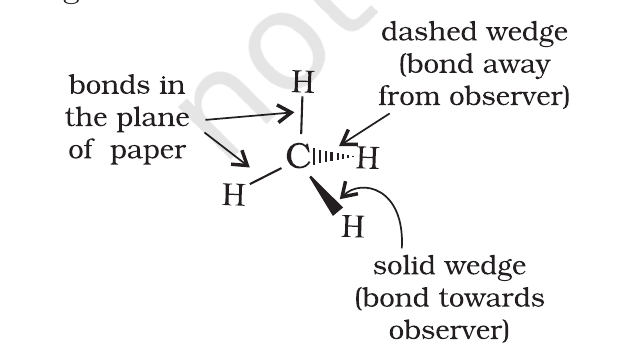
- Complete structural formula: all bonds are shown. Condensed structural formula: some bonds are omitted, for example $CH_3CH_2CH_2CH_2CH_2CH_2CH_2CH_3$ for octane. Bond-line structural formula: carbon and hydrogen atoms are not shown; lines represent bonds, and the ends and junctions of lines are carbon atoms.
- The three-dimensional structure of an organic molecule can be shown on paper with wedge-dash formula. A solid wedge is used for a bond projecting out of the plane of paper towards the observer, a dashed wedge for a bond projecting out of the plane away from the observer, and a normal line for a bond lying in the plane of the paper. The wedge is drawn so that its broad end is towards the observer. NCERT Fig. 8.1 shows the wedge-dash representation of $CH_4$.
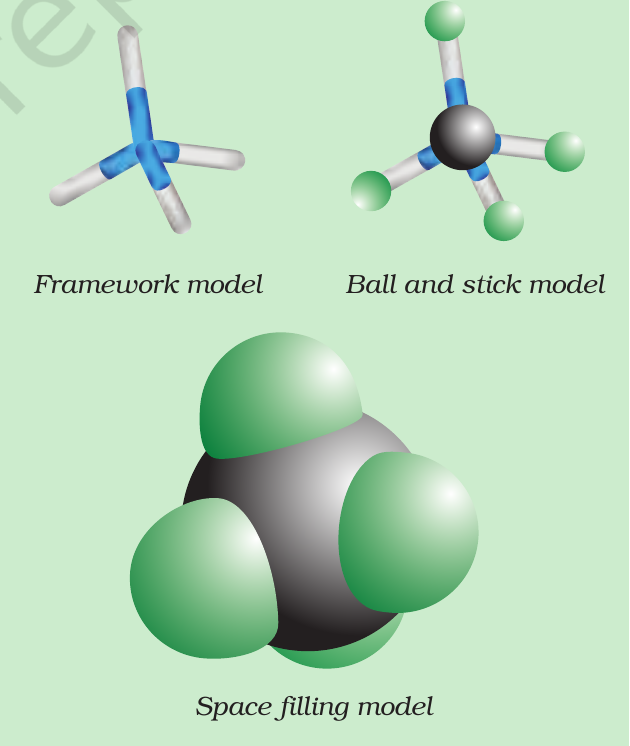
- Molecular models are physical devices used for a better view of three-dimensional shapes. Three types are used: (1) framework model, in which only the bonds connecting the atoms are shown; (2) ball-and-stick model, in which both atoms and bonds are shown, with balls for atoms and sticks for bonds; (3) space-filling model, which shows the relative size of each atom based on its van der Waals radius, with no bonds shown. NCERT Fig. 8.2 shows the three models for methane.
- Compounds with C=C can be shown with springs in place of sticks; these are called ball-and-spring models.
Suggest an edit
Classification of organic compounds
- Organic compounds are classified by the carbon skeleton. Acyclic or open chain compounds are also called aliphatic compounds. Cyclic or closed chain (ring) compounds are of two types: alicyclic compounds (for example cyclopropane and cyclohexane) and aromatic compounds.
- Aromatic compounds are benzenoid (benzene and its homologues such as toluene and naphthalene) or non-benzenoid. Heterocyclic aromatic compounds contain a heteroatom in the ring: furan, thiophene and pyridine are the examples given.
- Organic compounds can also be classified by functional groups into families or homologous series. The functional group is an atom or a group of atoms joined to the carbon chain which is responsible for the characteristic chemical properties of the organic compounds. Examples are the hydroxyl group (-OH), the aldehyde group (-CHO) and the carboxylic acid group (-COOH).
- A homologous series is a group of organic compounds each containing a characteristic functional group, whose members can be represented by a general molecular formula, and whose successive members differ from each other in molecular formula by a -CH2 unit. Examples are alkanes, alkenes, alkynes, haloalkanes, alkanols, alkanals, alkanones, alkanoic acids and amines.
- A compound can contain two or more identical or different functional groups. This gives rise to polyfunctional compounds.
- Trivial or common names come from the origin or a property of the compound: citric acid is named so because it is found in citrus fruits, and formic acid because the Latin word for ant is formica. Buckminsterfullerene is the common name of the C60 cluster, named for its likeness to the geodesic domes of architect R. Buckminster Fuller.
Suggest an edit
Table: functional groups and IUPAC prefixes and suffixes
| Class of compounds | Functional group | IUPAC group prefix | IUPAC group suffix | Example |
|---|---|---|---|---|
| Alkanes | - | - | -ane | Butane, $CH_3$($CH_2$)2CH3 |
| Alkenes | >C=C< | - | -ene | But-1-ene, $CH_2$=$CHCH_2CH_3$ |
| Alkynes | $-C\equiv C-$ | - | -yne | But-1-yne, $CH\equiv CCH_2CH_3$ |
| Arenes | - | - | - | Benzene |
| Halides | -X (X=F, Cl, Br, I) | halo- | - | 1-Bromobutane, $CH_3$($CH_2$)2CH2Br |
| Alcohols | -OH | hydroxy- | -ol | Butan-2-ol, $CH_3CH_2CHOHCH_3$ |
| Aldehydes | -CHO | formyl or oxo | -al | Butanal, $CH_3$($CH_2$)2CHO |
| Ketones | >C=O | oxo- | -one | Butan-2-one, $CH_3CH_2COCH_3$ |
| Nitriles | $-C\equiv N$ | cyano | nitrile | Pentanenitrile, $CH_3CH_2CH_2CH_2CN$ |
| Ethers | R-O-R' | alkoxy- | - | Ethoxyethane, $CH_3CH_2OCH_2CH_3$ |
| Carboxylic acids | -COOH | carboxy | -oic acid | Butanoic acid, $CH_3$($CH_2$)2CO2H |
| Carboxylate ions | -COO- | - | -oate | Sodium butanoate, $CH_3$($CH_2$)2CO2- $Na^+$ |
| Esters | -COOR | alkoxycarbonyl | -oate | Methyl propanoate, $CH_3CH_2COOCH_3$ |
| Acyl halides | -COX (X=F, Cl, Br, I) | halocarbonyl | -oyl halide | Butanoyl chloride, $CH_3$($CH_2$)2COCl |
| Amines | -NH2, >NH, >$N-$ | amino- | -amine | Butan-2-amine, $CH_3CHNH_2CH_2CH_3$ |
| Amides | -CONH2, -CONHR, -CONR2 | -carbamoyl | -amide | Butanamide, $CH_3$($CH_2$)2CONH2 |
| Nitro compounds | -NO2 | nitro | - | 1-Nitrobutane, $CH_3$($CH_2$)3NO2 |
| Sulphonic acids | -SO3H | sulpho | sulphonic acid | Methylsulphonic acid, $CH_3SO_3H$ |
- Table 8.4: Some Functional Groups and Classes of Organic Compounds.
| Compound | Common name |
|---|---|
| $CH_4$ | Methane |
| $H_3CCH_2CH_2CH_3$ | n-Butane |
| ($H_3C$)2CHCH3 | Isobutane |
| ($H_3C$)4C | Neopentane |
| $H_3CCH_2CH_2OH$ | n-Propyl alcohol |
| HCHO | Formaldehyde |
| ($H_3C$)2CO | Acetone |
| $CHCl_3$ | Chloroform |
| $CH_3COOH$ | Acetic acid |
| $C_6H_6$ | Benzene |
| $C_6H_5OCH_3$ | Anisole |
| $C_6H_5NH_2$ | Aniline |
| $C_6H_5COCH_3$ | Acetophenone |
| $CH_3OCH_2CH_3$ | Ethyl methyl ether |
- Table 8.1: Common or Trivial Names of Some Organic Compounds.
- The principal functional group takes the suffix; all other groups present are named as prefixes.
Suggest an edit
Practice1 question
Try it now. A wrong answer costs nothing here, try again until you get it.
Which IUPAC suffix is used for a compound containing the -COOH group?
NCERT Table 8.4: the carboxylic acid group -COOH takes the suffix -oic acid, as in butanoic acid.
IUPAC nomenclature of alkanes
- The IUPAC (International Union of Pure and Applied Chemistry) system derives a systematic name by identifying the parent hydrocarbon and the functional group or groups attached to it, so that the structure can be deduced from the name.
- Hydrocarbons with only carbon-carbon single bonds are saturated, and their IUPAC name is alkane, ending with the suffix -ane. The names from $CH_4$ to $C_4H_{10}$ use prefixes from trivial names; beyond that the prefix gives the number of carbon atoms.
Straight chain hydrocarbons: Table 8.2, IUPAC Names of Some Unbranched Saturated Hydrocarbons:
| Name | Molecular formula | Name | Molecular formula |
|---|---|---|---|
| Methane | $CH_4$ | Heptane | $C_7H_{16}$ |
| Ethane | $C_2H_6$ | Octane | $C_8H_{18}$ |
| Propane | $C_3H_8$ | Nonane | $C_9H_{20}$ |
| Butane | $C_4H_{10}$ | Decane | $C_{10}H_{22}$ |
| Pentane | $C_5H_{12}$ | Icosane | $C_{20}H_{42}$ |
| Hexane | $C_6H_{14}$ | Triacontane | $C_{30}H_{62}$ |
| Alkane: Molecular formula | Alkane: Name of alkane | Alkyl group: Structural formula | Alkyl group: Name of alkyl group |
|---|---|---|---|
| $CH_4$ | Methane | -$CH_3$ | Methyl |
| $C_2H_6$ | Ethane | -$CH_2CH_3$ | Ethyl |
| $C_3H_8$ | Propane | -$CH_2CH_2CH_3$ | Propyl |
| $C_4H_{10}$ | Butane | -$CH_2CH_2CH_2CH_3$ | Butyl |
| $C_{10}H_{22}$ | Decane | -$CH_2(CH_2)_8CH_3$ | Decyl |
- Table 8.3: Some Alkyl Groups.
- Branched chain hydrocarbons: An alkyl group is derived from a saturated hydrocarbon by removing a hydrogen atom from carbon, and is named by replacing -ane with -yl: $CH_4$ gives -$CH_3$, the methyl group. Abbreviations are used for some alkyl groups: methyl is Me, ethyl is Et, propyl is Pr and butyl is Bu.
- Branched alkyl groups have specific names: isopropyl, sec-butyl, isobutyl and tert-butyl; the structural unit -$CH_2C(CH_3)_3$ is called the neopentyl group.
- Nomenclature of branched chain alkanes: Rules for naming branched chain alkanes: (1) identify the longest carbon chain in the molecule; (2) number it so that the branched carbon atoms get the lowest possible numbers; (3) when two or more branches are at equal positions, the lower number goes to the one coming first in the alphabetical listing; (4) list the substituents in alphabetical order; (5) use di, tri, tetra for two or more identical substituents; (6) in alphabetical order, the prefixes iso- and neo- are counted as part of the fundamental name of the alkyl group, but sec- and tert- are not; (7) the carbon atom of the branch that attaches to the root alkane is numbered 1.
- Cyclic Compounds: Cyclic compounds are named with the prefix cyclo-, for example cyclohexane, and the ring carbons are numbered so that substituents get the lowest numbers.
Suggest an edit
Nomenclature with functional groups and substituted benzenes
- For compounds with a functional group, the longest chain of carbon atoms containing the functional group is numbered so that the functional group is attached at the carbon atom with the lowest possible number in the chain.
- The terminal e of the parent alkane is dropped when the suffix begins with a vowel (propan-1-ol), and it is retained when the suffix begins with a consonant (pentanenitrile).
- When two or more functional groups are present, the one highest in the priority order takes the suffix and the others are named as prefixes. The order of decreasing priority is: -COOH, -SO3H, -COOR, -COCl, -CONH2, -CN, -CHO, >C=O, -OH, -NH2, >C=C<, $-C\equiv C-$.
- Substituted benzene compounds are named with the positions 1,2- as ortho (o-), 1,3- as meta (m-) and 1,4- as para (p-). Worked examples (Problem 8.10): o-ethylanisole, p-nitroaniline, 2,3-dibromo-1-phenylpentane and 4-ethyl-1-fluoro-2-nitrobenzene.
- When the benzene ring carries a functional group that becomes the principal group, the ring is named as a phenyl substituent, for example 1-phenylpentane.
Suggest an edit
Ladder: nomenclature traps
- Number from the end that gives the principal functional group the lowest locant, not from the end that gives the first branch the lowest locant. The functional group outranks branches.
- When two numberings give the same locant for the functional group, compare the locant sets number by number; the set with the lower number at the first point of difference wins.
- Alphabetical order ignores the multiplicative prefixes di, tri and tetra, but it counts iso- and neo- as part of the name. Sec- and tert- are not counted: tert-butyl is listed under b for butyl.
- The terminal e of the parent alkane is dropped before a vowel suffix (butan-2-ol, not butane-2-ol) and kept before a consonant suffix (pentanenitrile, not pentannitrile).
- The e is dropped before the vowel of -oic acid too: butane gives butanoic acid, not butaneoic acid.
- Halo groups are prefixes (chloro, bromo), never suffixes. For monosubstituted benzenes, common names such as phenol, toluene, aniline and anisole are retained as IUPAC base names.
Suggest an edit
Structural isomerism
- Isomerism is the phenomenon of the existence of two or more compounds possessing the same molecular formula but different properties. Such compounds are called isomers.
- Structural isomers have the same molecular formula but different structures (manners in which atoms are linked). Four types are given.
- (i) Chain isomerism: compounds have a similar molecular formula but different carbon skeletons. $C_5H_{12}$ represents three compounds: pentane ($CH_3CH_2CH_2CH_2CH_3$), isopentane (2-methylbutane) and neopentane (2,2-dimethylpropane).
- (ii) Position isomerism: compounds differ in the position of a substituent atom or functional group on the carbon skeleton. $C_3H_8O$ represents two alcohols: propan-1-ol ($CH_3CH_2CH_2OH$) and propan-2-ol ($CH_3CH$(OH)$CH_3$).
- (iii) Functional group isomerism: compounds have the same molecular formula but different functional groups. $C_3H_6O$ represents an aldehyde (propanal, $CH_3CH_2CHO$) and a ketone (propanone, $CH_3COCH_3$).
- (iv) Metamerism: compounds differ in the alkyl chains on either side of the functional group. $C_4H_{10}O$ represents methoxypropane ($CH_3OC_3H_7$) and ethoxyethane ($C_2H_5OC_2H_5$).
Suggest an edit
Practice1 question
Try it now. A wrong answer costs nothing here, try again until you get it.
Which pair of compounds shows functional group isomerism?
NCERT 8.6.1: $C_3H_6O$ represents both an aldehyde (propanal) and a ketone (propanone), so they are functional group isomers. Propan-1-ol and propan-2-ol are position isomers.
Stereoisomerism
- Stereoisomers are compounds that have the same constitution and sequence of covalent bonds but differ in the relative positions of their atoms or groups in space.
- This special type of isomerism is called stereoisomerism and can be classified as geometrical and optical isomerism.
Suggest an edit
Fission of a covalent bond
- A covalent bond can be cleaved by heterolytic cleavage or by homolytic cleavage. In heterolytic cleavage the shared pair of electrons remains with one of the fragments. In homolytic cleavage one electron of the shared pair goes with each fragment.
- After heterolysis, one atom has a sextet and a positive charge and the other has a valence octet with at least one lone pair and a negative charge. Heterolytic cleavage of bromomethane gives $CH_3^+$ and $Br^-$.
- A species with a carbon atom possessing a sextet of electrons and a positive charge is called a carbocation (earlier called carbonium ion). The $CH_3^+$ ion is the methyl cation or methyl carbonium ion. Carbocations are classified as primary, secondary or tertiary, depending on whether one, two or three carbons are directly attached to the positively charged carbon. Examples: $CH_3CH_2^+$ is a primary carbocation, ($CH_3$)2CH+ is secondary and ($CH_3$)3C+ is tertiary.
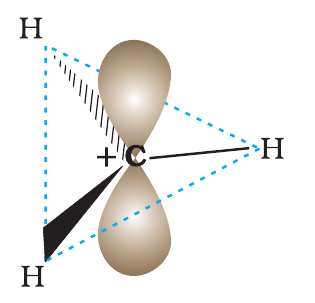
- Carbocations are highly unstable and reactive. Alkyl groups directly attached to the positively charged carbon stabilise them by inductive and hyperconjugation effects. The observed order of carbocation stability is: $CH_3^+$ < $CH_3CH_2^+$ < ($CH_3$)2CH+ < ($CH_3$)3C+. Carbocations have a trigonal planar shape, with the positively charged carbon sp2 hybridised. NCERT Fig. 8.3(a) shows the shape of the methyl carbocation.
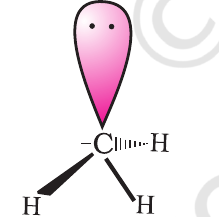
- When the group Z attached to carbon leaves with the shared pair, the methyl anion ($H_3C^-$) is formed. A carbon species carrying a negative charge on a carbon atom is called a carbanion. Carbon in a carbanion is generally sp3 hybridised and its structure is a distorted tetrahedron, as shown in NCERT Fig. 8.3(b).
- In homolytic cleavage, the movement of a single electron takes place instead of an electron pair, shown by half-headed (fish-hook) curved arrows. Such cleavage gives neutral species containing an unpaired electron, called free radicals. Alkyl radicals are classified as primary, secondary or tertiary, and their stability increases from primary to tertiary: $CH_3$ dot < $CH_2CH_3$ dot < CH($CH_3$)2 dot < C($CH_3$)3 dot.
- Organic reactions through homolytic fission are called free radical or homopolar or nonpolar reactions. Reactions through heterolytic fission are called ionic or heteropolar or polar reactions.
Suggest an edit
Substrate, reagent, nucleophiles and electrophiles
- In an organic reaction, the organic molecule reacts with an attacking reagent and gives one or more intermediates and finally products. The reactant which supplies carbon to the new bond is the substrate, and the other reactant is the reagent. If both reactants supply carbon to the new bond, the choice is arbitrary.
- A sequential account of each step, describing details of electron movement, energetics during bond cleavage and bond formation, and the rates of transformation of reactants into products (kinetics) is referred to as a reaction mechanism.
- Reagents attack the reactive site of the substrate. A reagent that brings an electron pair is called a nucleophile (Nu:) (nucleus seeking) and the reaction is nucleophilic. A reagent that takes away an electron pair is called an electrophile ($E^+$) (electron seeking) and the reaction is electrophilic.
- Nucleophiles are electron-rich: negatively charged ions such as $OH^-$, $CN^-$ and carbanions, and neutral molecules with a lone pair such as $NH_3$, $H_2O$ and ROH.
- Electrophiles are electron-deficient: positively charged species such as $H^+$ and carbocations, and neutral molecules with an incomplete octet or a polar multiple bond, such as $BF_3$, $AlCl_3$ and the carbon of a carbonyl group.
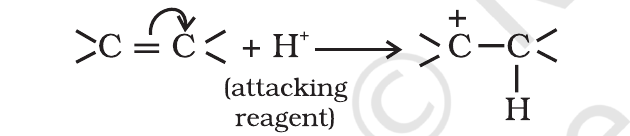
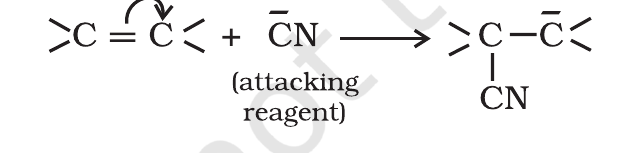
- Electron movement is shown with curved arrows. A full curved arrow shows the movement of an electron pair: it starts from the point where the pair is shifted and ends where the pair may move. A half-headed (fish-hook) arrow shows the movement of a single electron.
- Three patterns of electron-pair shift are shown: (i) from a pi bond to an adjacent bond position, (ii) from a pi bond to an adjacent atom, (iii) from an atom to an adjacent bond position.
Suggest an edit
Table: electron displacement effects
| Effect | Nature | What happens | Key facts |
|---|---|---|---|
| Inductive effect | Permanent, in the ground state, through sigma bonds | Polarisation of a sigma bond by an adjacent polar bond; the effect falls off fast and becomes vanishingly small after three bonds | Electron-withdrawing groups relative to hydrogen: halogens, -NO2, -CN, -COOH, -COOR, -OAr (for example -OC6H5). Electron-donating groups: alkyl groups such as -CH3 and -CH2CH3. Shown by an arrow from delta+ to delta- |
| Electromeric effect | Temporary, only when a reagent attacks | Complete transfer of a shared pair of pi electrons to one of the atoms joined by a multiple bond | Positive (+E): pi electrons move to the atom to which the attacking reagent gets attached; Negative (-E): pi electrons move to the atom to which the attacking reagent does not get attached |
| Resonance effect | Permanent, by delocalisation of pi electrons or a lone pair | Canonical (resonance) structures are hypothetical and do not represent any real molecule; the real structure is a resonance hybrid | +R groups: -halogen, -OH, -OR, -OCOR, -NH2, -NHR, -NR2, -NHCOR. -R groups: -COOH, -CHO, >C=O, -CN, -NO2. The two N-O bonds of nitromethane are of the same length, between a single and a double bond, proving the hybrid |
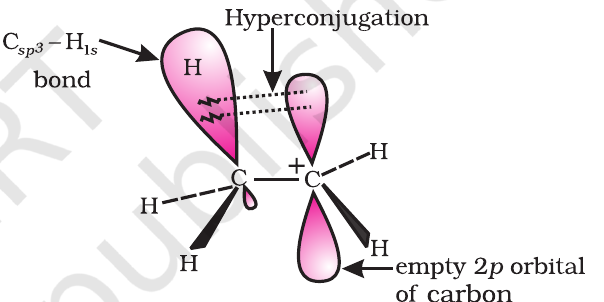
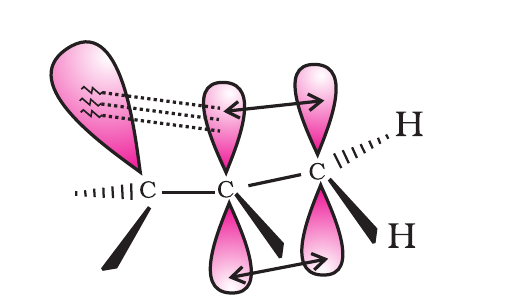
| Hyperconjugation | Permanent, overlap of a C-H sigma bond with an adjacent vacant p orbital or pi system | Delocalisation without a bond shift; also called no-bond resonance | Alpha-H counts: ($CH_3$)3C+ 9, ($CH_3$)2CH+ 6, $CH_3CH_2^+$ 3, $CH_3^+$ 0. Stability order: ($CH_3$)3C+ > ($CH_3$)2CH+ > $CH_3CH_2^+$ > $CH_3^+$. Also possible in alkenes and alkylarenes. NCERT Fig. 8.4(a) shows hyperconjugation in ethyl cation and NCERT Fig. 8.4(b) shows hyperconjugation in propene |
- Resonance energy (resonance stabilisation energy) is the difference in energy between the actual structure and the lowest-energy canonical structure.
- The electron displacement in a molecule may be permanent (inductive and resonance effects, from an atom or substituent in the ground state) or temporary (electromeric effect, when a reagent approaches to attack).
Suggest an edit
Practice1 question
Try it now. A wrong answer costs nothing here, try again until you get it.
Which carbocation has the largest number of alpha-H atoms?
NCERT 8.7.9: the tert-butyl cation ($CH_3$)3C+ has 9 alpha-H atoms, the isopropyl cation ($CH_3$)2CH+ has 6, the ethyl cation $CH_3CH_2^+$ has 3 and the methyl cation $CH_3^+$ has none, so ($CH_3$)3C+ has the most hyperconjugation.
Types of organic reactions
- Organic reactions can be classified into four categories: (i) substitution reactions, (ii) addition reactions, (iii) elimination reactions and (iv) rearrangement reactions.
- In a substitution reaction, an atom or group in the substrate is replaced by another atom or group. In an addition reaction, two reactants add to form a single product across a multiple bond. In an elimination reaction, atoms or groups are removed from the substrate to form a multiple bond. In a rearrangement reaction, the carbon skeleton of the substrate is reorganised to give an isomeric product.
- These reaction types are studied in detail in Unit 9 and later in Class XII.
Suggest an edit
Purification and chromatography
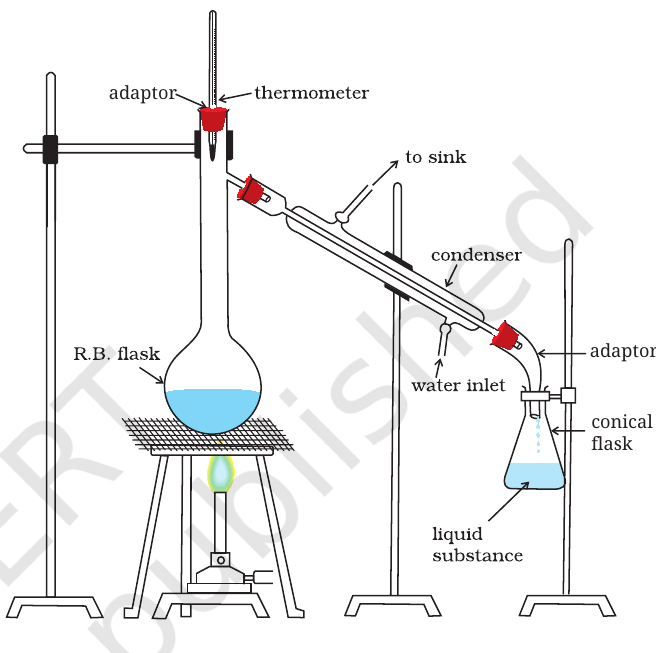
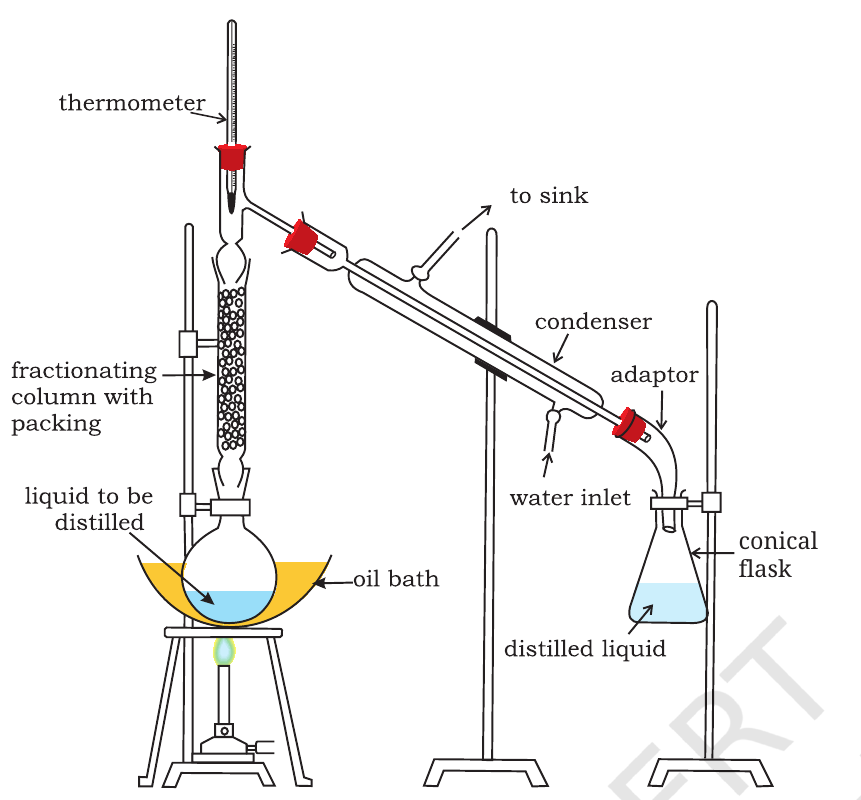
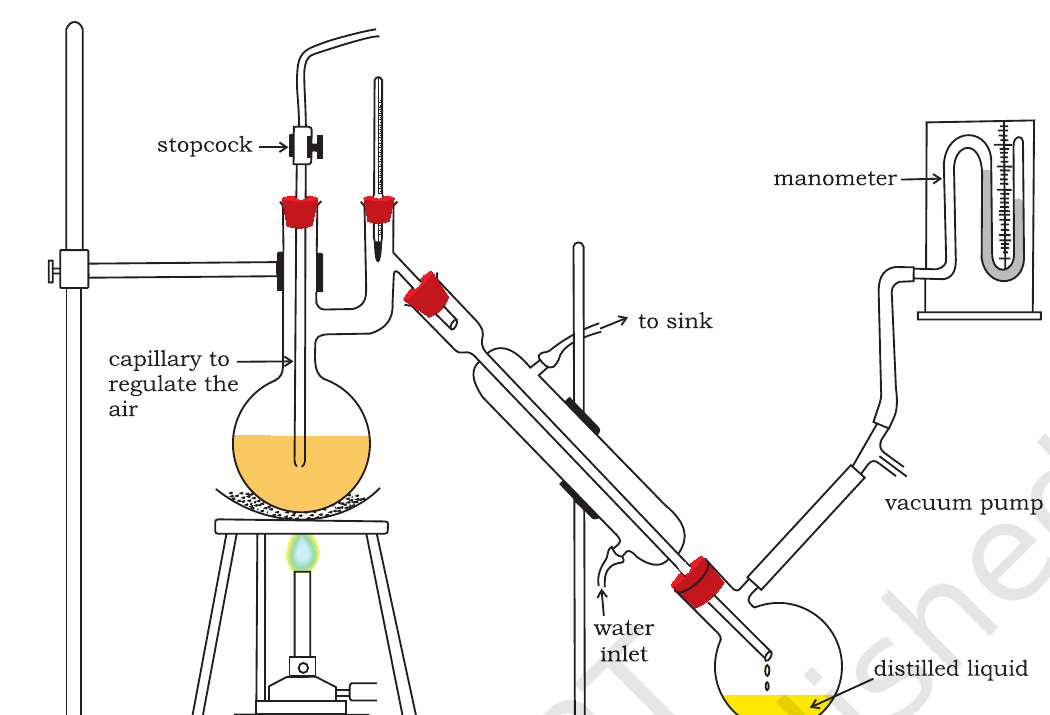
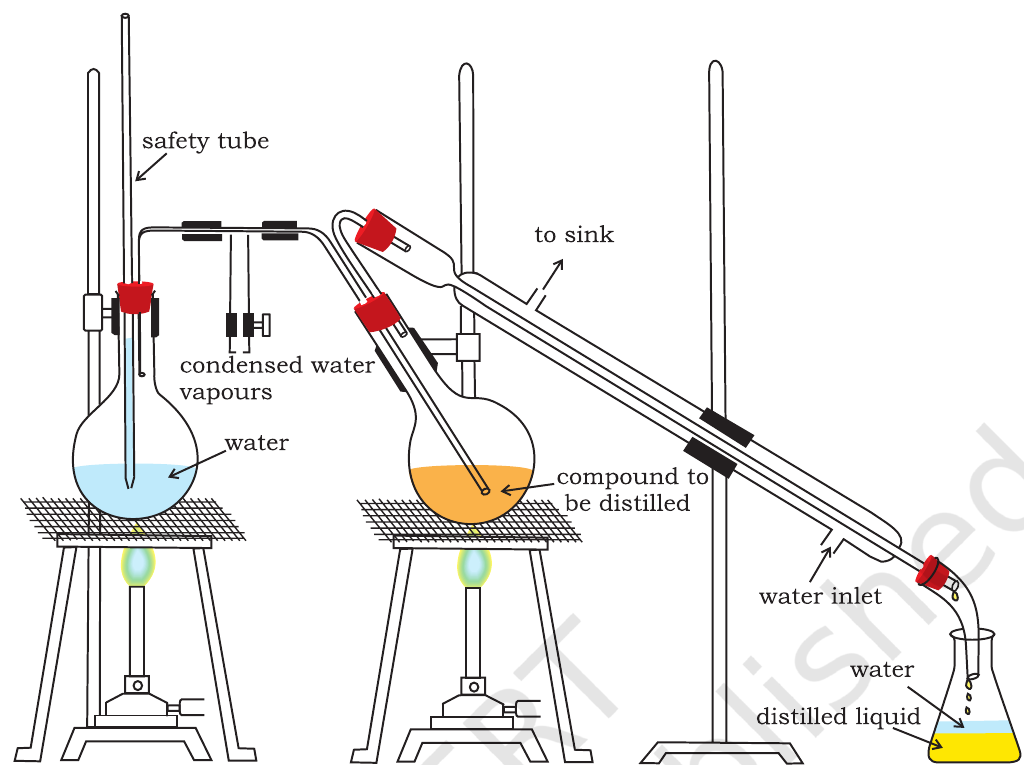
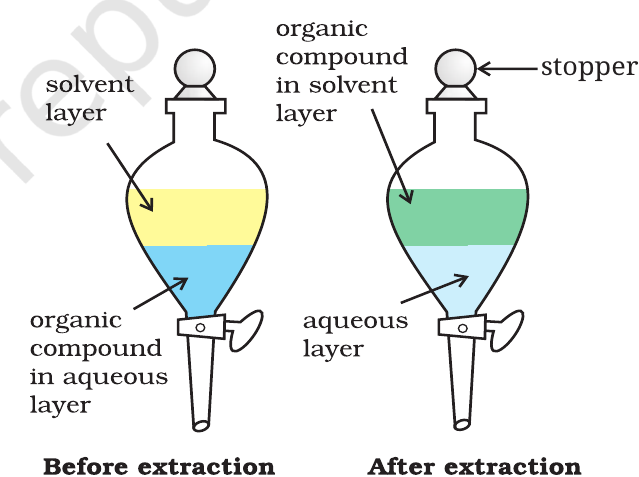
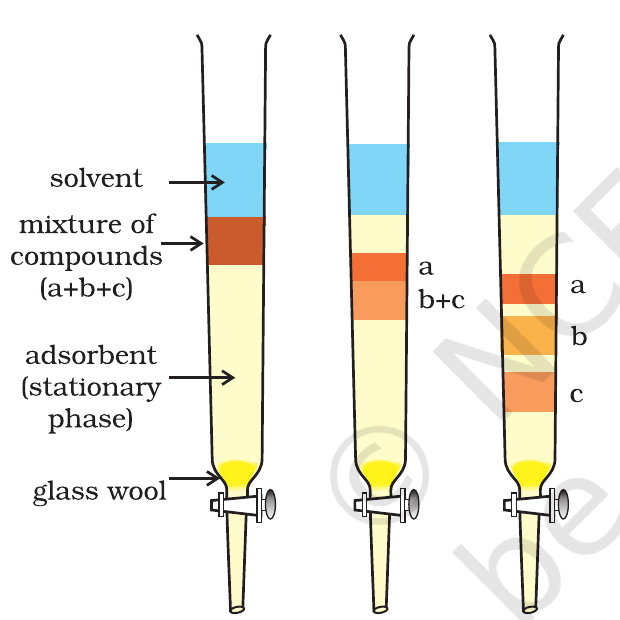
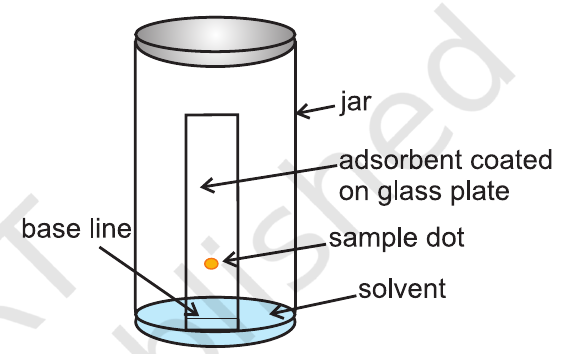
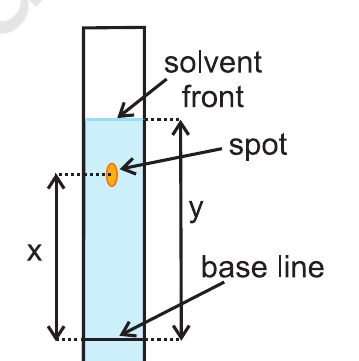
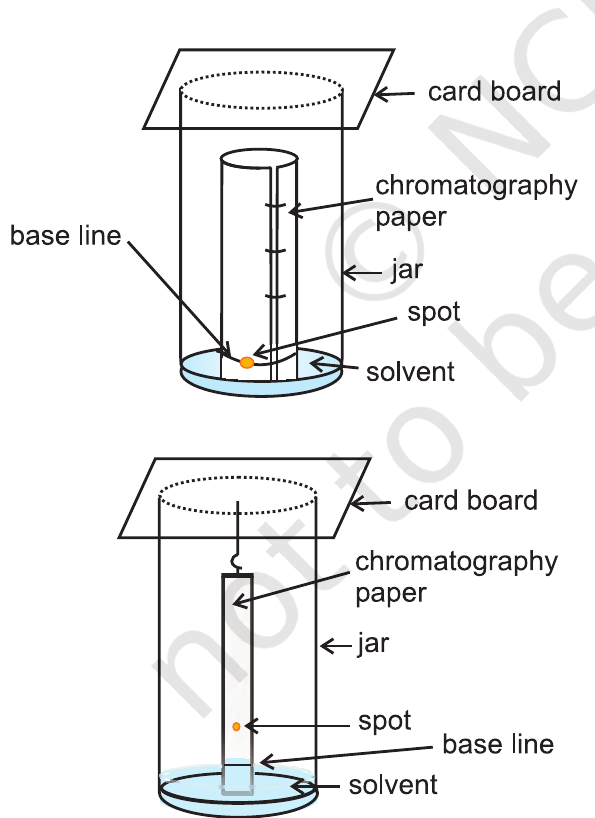
- Once an organic compound is extracted from a natural source or synthesised in the laboratory, it must be purified. The common techniques are: (i) sublimation, (ii) crystallisation, (iii) distillation, (iv) differential extraction and (v) chromatography. The purity of a compound is checked by its melting or boiling point: pure compounds have sharp melting and boiling points.
- Sublimation: used for solids that change directly from solid to vapour on heating, such as camphor and naphthalene.
- Crystallisation: based on the difference in solubilities of the compound and the impurities in a solvent. The impure compound is dissolved in a hot solvent, the solution is filtered, and the pure compound crystallises on cooling. Activated charcoal is used to remove coloured impurities.
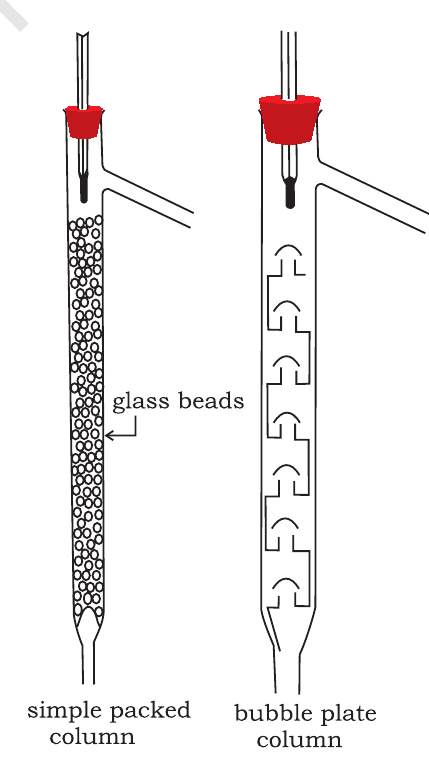
- Distillation: simple distillation separates volatile liquids whose boiling points differ widely. Fractional Distillation: separates liquids whose boiling points differ only slightly, using a fractionating column with theoretical plates; crude oil is fractionated this way in the petroleum industry. Distillation under reduced pressure: purifies liquids that decompose at or below their boiling points, for example glycerol separated from spent-lye in the soap industry. Steam Distillation: separates substances that are steam volatile and immiscible with water, for example aniline.
- Differential extraction: the compound is shaken with two immiscible solvents in a separatory funnel, and it distributes itself between them according to its solubility in each.
- Chromatography separates the components of a mixture by their different rates of movement through a stationary phase and a mobile phase. Column Chromatography and Thin Layer Chromatography (TLC) are adsorption chromatography. Partition Chromatography: paper chromatography is partition chromatography: water trapped in the chromatography paper is the stationary phase and the solvent rising by capillary action is the mobile phase.
- Rf value (retardation factor) = distance moved by the substance from the base line / distance moved by the solvent from the base line. Colourless spots are seen under ultraviolet light or by spraying a suitable reagent.
Suggest an edit
Table: qualitative and quantitative analysis
| Test or method | What is done | Observation or formula |
|---|---|---|
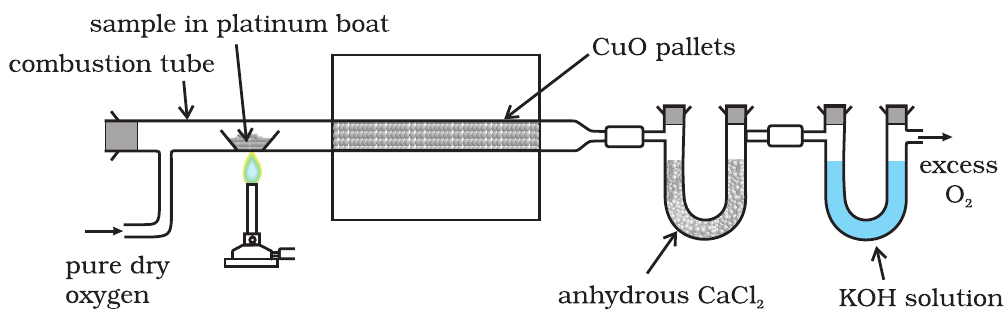
| Detection of C and H (8.9.1) | Heat the compound with copper(II) oxide CuO | C + 2CuO -> 2Cu + $CO_2$; $CO_2$ turns lime water turbid. $H_2$ + CuO -> Cu + $H_2O$; water turns white anhydrous $CuSO_4$ blue ($CuSO_4$.5H2O) |
| Lassaigne's test, N (8.9.2) | Fuse with sodium metal, extract with water (sodium fusion extract) | Boil with iron(II) sulphate and acidify: Prussian blue Fe4[Fe(CN)6]3.xH2O |
| Lassaigne's test, S (8.9.2) | Sodium fusion extract acidified with acetic acid + lead acetate, and sodium fusion extract + sodium nitroprusside | Black precipitate of PbS; violet colour |
| Lassaigne's test, N + S (8.9.2) | Sodium fusion extract + $Fe^{3+}$ | Blood-red [Fe(SCN)]2+ |
| Lassaigne's test, halogens (8.9.2) | Sodium fusion extract + $HNO_3$ + $AgNO_3$ | AgCl white ppt, soluble in $NH_4OH$; AgBr pale yellow ppt, sparingly soluble; AgI yellow ppt, insoluble |
| Test for P (8.9.2) | Heat compound with sodium peroxide (oxidising agent) to form phosphate, boil with $HNO_3$, add ammonium molybdate | Yellow colouration or ppt of ammonium phosphomolybdate, ($NH_4$)3PO4.12MoO3 |
| Carbon and hydrogen (8.10.1) | Combustion; weigh $CO_2$ and $H_2O$ formed | Percentage of C = 12 x m1 x 100 / (44 x m); percentage of H = 2 x m2 x 100 / (18 x m) |
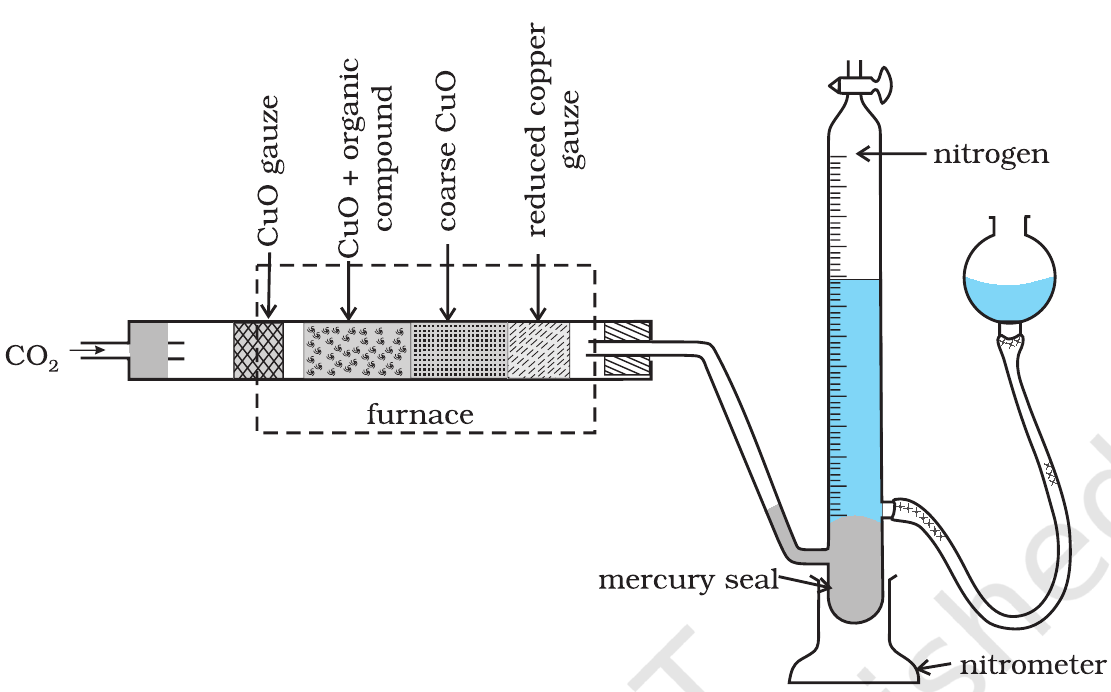
| Nitrogen, Dumas method (8.10.2) | Heat with CuO in $CO_2$, measure $N_2$ over $KOH$ | Percentage of N = 28 x V x 100 / (22400 x m), V in mL at STP |
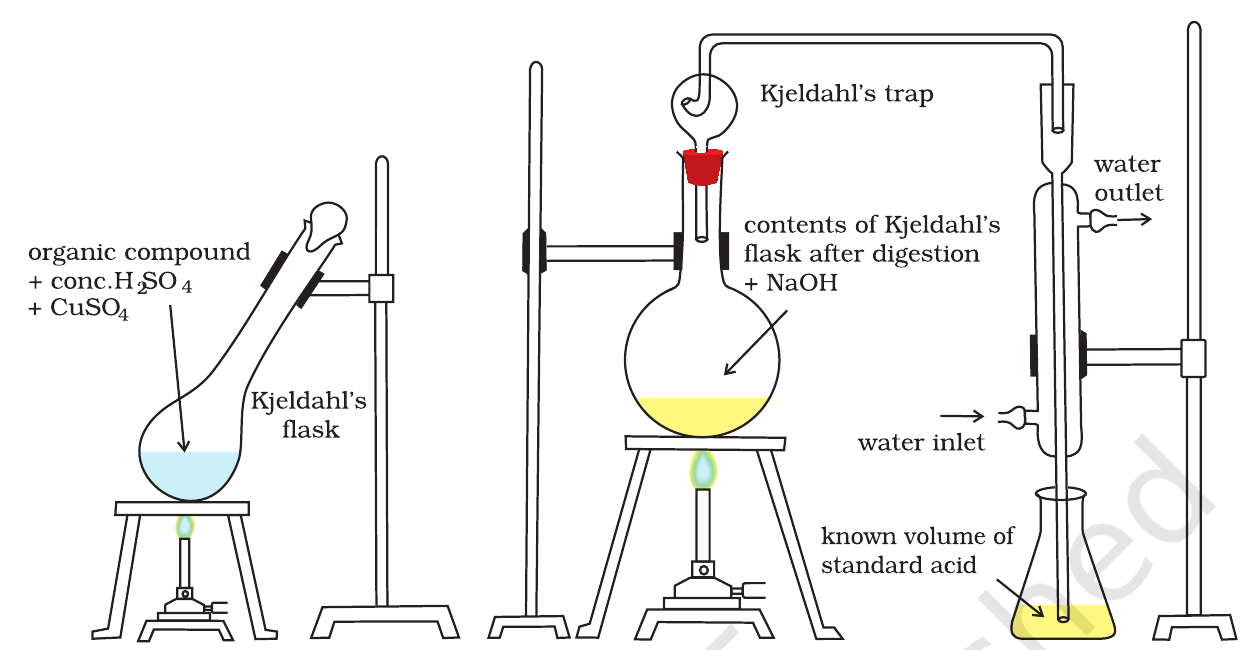
| Nitrogen, Kjeldahl's method (8.10.2) | Digest with conc. $H_2SO_4$, distil $NH_3$ into standard acid, back-titrate | Percentage of N = 1.4 x M x 2(V - V1/2) / m. Not applicable to nitro, azo or ring nitrogen |
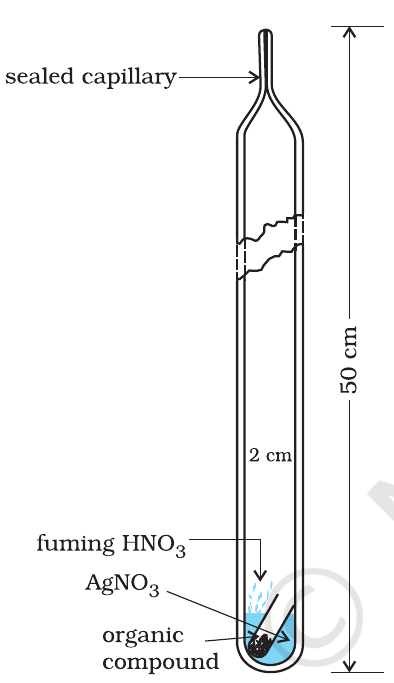
| Halogens, Carius method (8.10.3) | Heat with fuming $HNO_3$ and $AgNO_3$ in a sealed Carius tube, weigh AgX | Percentage of X = atomic mass of X x m1 x 100 / (molecular mass of AgX x m) |
| Sulphur, Carius method (8.10.4) | Oxidise to $H_2SO_4$, precipitate as $BaSO_4$ and weigh | Percentage of S = 32 x m1 x 100 / (233 x m) |
| Phosphorus (8.10.5) | Precipitate as ammonium phosphomolybdate or as $Mg_2P_2O_7$ | Percentage of P = 31 x m1 x 100 / (1877 x m), or percentage of P = 62 x m1 x 100 / (222 x m) |
| Oxygen (8.10.6) | By difference | Percentage of O = 100 - sum of the percentages of all other elements |
- In the percentage formulae above, m1 is the mass of $CO_2$ formed, m2 is the mass of $H_2O$ formed and m is the mass of the compound taken.
- Lassaigne fusion reactions: Na + C + N -> NaCN; 2Na + S -> $Na_2S$; Na + X -> NaX (X = Cl, Br or I). The elements are converted from covalent form to ionic form by fusing with sodium metal.
- Worked value (Problem 8.22): in Kjeldahl's estimation, ammonia from 0.5 g of compound neutralised 10 mL of 1 M $H_2SO_4$; the percentage of nitrogen is 56.0%.
Suggest an edit
Practice1 question
Try it now. A wrong answer costs nothing here, try again until you get it.
Which is the correct Kjeldahl formula for the percentage of nitrogen?
NCERT 8.10.2: percentage of N = 1.4 x M x 2(V - V1/2) / m in Kjeldahl's method.
Trap pairs: the confusions NEET tests
- Homolytic vs heterolytic: homolytic cleavage gives two free radicals with one unpaired electron each (fish-hook arrows); heterolytic cleavage gives a carbocation and an anion, or a carbanion and a cation (full curved arrows).
- Carbocation vs carbanion vs free radical: the carbocation carbon is sp2 and trigonal planar with a sextet; the carbanion carbon is sp3 and a distorted tetrahedron with an octet; a free radical is a neutral reactive species carrying an unpaired electron.
- Inductive vs electromeric vs resonance: inductive is permanent, through sigma bonds, and dies after three bonds; electromeric is temporary and moves pi electrons only when a reagent attacks; resonance is permanent delocalisation, and the canonical structures are hypothetical while the hybrid is real.
- Hyperconjugation needs alpha-H: the methyl cation has no alpha-H, so it has no hyperconjugative stability and is the least stable carbocation.
- Paper vs column chromatography: paper chromatography is partition (water in the paper is the stationary phase); column and thin layer chromatography are adsorption.
- Kjeldahl vs Dumas: Dumas measures nitrogen gas directly and works for all nitrogen compounds; Kjeldahl fails for nitro, azo and ring nitrogen.
- Lassaigne colours: nitrogen alone is Prussian blue; nitrogen with sulphur is blood red; sulphur alone is violet with sodium nitroprusside. Do not read blood red as nitrogen alone.
- Priority vs numbering: the principal functional group takes the lowest locant and the suffix; branches and other groups are prefixes listed alphabetically.
Suggest an edit
Trap Boxes
Tertiary carbocations are less stable than primary ones?
Wrong idea: More alkyl groups push the positive charge away, so a tertiary carbocation is the least stable.
Stability rises with the number of alkyl groups: ($CH_3$)3C+ > ($CH_3$)2CH+ > $CH_3CH_2^+$ > $CH_3^+$, because alkyl groups stabilise the positive carbon by inductive and hyperconjugation effects. The tert-butyl cation has 9 alpha-H atoms and the methyl cation has none.
NCERT XI, Ch 8, 8.7.1 and 8.7.9
Paper chromatography is adsorption chromatography?
Wrong idea: Paper chromatography separates by adsorption on the paper, like column chromatography.
Paper chromatography is partition chromatography: water trapped in the chromatography paper is the stationary phase. Column chromatography and thin layer chromatography are adsorption chromatography.
NCERT XI, Ch 8, 8.8.5
Blood-red colour in Lassaigne's test means nitrogen only?
Wrong idea: A blood-red colour with $Fe^{3+}$ proves that nitrogen is present.
Blood-red [Fe(SCN)]2+ with $Fe^{3+}$ forms only when both nitrogen and sulphur are present in the compound. Nitrogen alone gives Prussian blue, Fe4[Fe(CN)6]3.xH2O.
NCERT XI, Ch 8, 8.9.2
Kjeldahl's method works for every nitrogen compound?
Wrong idea: Kjeldahl's method can estimate the nitrogen in nitrobenzene and in pyridine.
Kjeldahl's method is not applicable to compounds with nitrogen in nitro and azo groups and to nitrogen present in the ring (for example pyridine), because that nitrogen does not change to ammonium sulphate under the digestion conditions.
NCERT XI, Ch 8, 8.10.2
Homolytic cleavage gives ions?
Wrong idea: Breaking a bond so that each atom keeps one electron gives a carbocation and an anion.
Homolytic cleavage gives two free radicals, one unpaired electron on each fragment, shown with half-headed fish-hook arrows. Heterolytic cleavage gives a carbocation and an anion (or a carbanion and a cation), shown with full curved arrows.
NCERT XI, Ch 8, 8.7.1
Chapter test
5 NEET PYQs. +4 for a correct answer, -1 for a wrong answer, exactly like NEET. Finish the test to earn a medal.
Q1: NEET (UG) 2023, Code F1, Q55
In Lassaigne's extract of an organic compound, both nitrogen and sulphur are present, which gives blood red colour with $Fe^{3+}$ due to the formation of
When both nitrogen and sulphur are present, Lassaigne's extract contains NaSCN, which reacts with $Fe^{3+}$ to give the blood-red complex [Fe(SCN)]2+.
Q2: NEET (UG) 2021, Code P3, Q82
An organic compound contains 78% (by wt.) carbon and remaining percentage of hydrogen. The right option for the empirical formula of this compound is: [Atomic wt. of C is 12, H is 1]
78% carbon is 78/12 = 6.5 mol and 22% hydrogen is 22/1 = 22 mol. Dividing by 6.5 gives C : H = 1 : 3.4, nearest whole numbers 1 : 3, so the empirical formula is $CH_3$.
Q3: NEET (UG) 2020, Code G5, Q134
Paper chromatography is an example of
Paper chromatography is a type of partition chromatography: water trapped in the chromatography paper is the stationary phase and the solvent rising by capillary action is the mobile phase.
Q4: NEET (UG) 2020, Code G5, Q119
A tertiary butyl carbocation is more stable than a secondary butyl carbocation because of which of the following ?
The tert-butyl cation ($CH_3$)3C+ has 9 alpha-H atoms and the sec-butyl cation $CH_3CH$+$CH_2CH_3$ has 5. More alpha-H atoms mean more hyperconjugation, so the tertiary carbocation is more stable.
Q5: NEET (UG) 2019, Code Q2, Q105
The number of sigma (σ) and pi (π) bonds in pent-2-en-4-yne is
Pent-2-en-4-yne is $CH_3$-CH=CH-C≡CH. It has 4 C-C sigma bonds and 6 C-H sigma bonds, 10 sigma in all, plus 1 pi bond in the double bond and 2 pi bonds in the triple bond, 3 pi in all.
Score: 0 · Answered 0 of 5
Flashcards
Tap a card to flip it over and see the answer. Tap it again to flip it back.
Write the formulae for the percentage of carbon and hydrogen from the masses of $CO_2$ and $H_2O$ formed on combustion.
Tap to flipPercentage of C = 12 x m1 x 100 / (44 x m), where m1 is the mass of $CO_2$ formed and m is the mass of the compound. Percentage of H = 2 x m2 x 100 / (18 x m), where m2 is the mass of $H_2O$ formed.
Tap to flip backWrite the Kjeldahl formula for the percentage of nitrogen.
Tap to flipPercentage of N = 1.4 x M x 2(V - V1/2) / m, where M is the molarity of $H_2SO_4$, V is its volume in mL taken, V1 is the volume in mL of $NaOH$ of molarity M used for titration of excess acid, and m is the mass of the compound in g.
Tap to flip backDefine the retardation factor Rf used in chromatography.
Tap to flipRf = distance moved by the substance from the base line / distance moved by the solvent from the base line.
Tap to flip backGive the observed order of carbocation stability.
Tap to flip($CH_3$)3C+ > ($CH_3$)2CH+ > $CH_3CH_2^+$ > $CH_3^+$, that is tertiary > secondary > primary > methyl. Alkyl groups stabilise the carbocation by inductive and hyperconjugation effects.
Tap to flip backGive the order of stability of alkyl free radicals.
Tap to flip$CH_3$ dot < $CH_2CH_3$ dot < CH($CH_3$)2 dot < C($CH_3$)3 dot, that is methyl < ethyl < isopropyl < tert-butyl free radical.
Tap to flip backGive the order of decreasing priority of functional groups for IUPAC naming.
Tap to flip-COOH > -SO3H > -COOR > -COCl > -CONH2 > -CN > -CHO > >C=O > -OH > -NH2 > >C=C< > -C triple bond $C^-$. The group highest in this order is the principal group and takes the suffix.
Tap to flip backHow many alpha-H atoms do the tert-butyl, isopropyl, ethyl and methyl carbocations have?
Tap to flipTert-butyl cation ($CH_3$)3C+ has 9 alpha-H atoms, isopropyl cation ($CH_3$)2CH+ has 6, ethyl cation $CH_3CH_2^+$ has 3, and methyl cation $CH_3^+$ has none, so it lacks hyperconjugative stability.
Tap to flip backWhat colours and formulae identify nitrogen, sulphur, and nitrogen with sulphur in Lassaigne's test?
Tap to flipNitrogen alone gives Prussian blue, Fe4[Fe(CN)6]3.xH2O. Nitrogen and sulphur together give blood-red [Fe(SCN)]2+ with $Fe^{3+}$. Sulphur alone gives a violet colour with sodium nitroprusside.
Tap to flip backShow the heterolytic cleavage of bromomethane and name the products.
Tap to flip$H_3C$-Br -> $H_3C^+$ + $Br^-$. The shared pair stays with bromine, so carbon keeps a sextet and a positive charge (a carbocation) and bromine gets the octet and a negative charge.
Tap to flip backShow homolytic cleavage of R-X and state what it gives.
Tap to flipR-X -> R dot + X dot, in heat or light. One electron of the shared pair goes with each fragment, giving two neutral free radicals, shown with half-headed (fish-hook) arrows.
Tap to flip backName the types of isomerism and the two kinds under each head.
Tap to flipStructural isomerism: chain, position, functional group and metamerism. Stereoisomerism: geometrical and optical isomerism. Structural isomers differ in how atoms are linked; stereoisomers have the same constitution but differ in the relative positions of atoms or groups in space.
Tap to flip backFor which nitrogen compounds does Kjeldahl's method fail, and why?
Tap to flipKjeldahl's method is not applicable to compounds containing nitrogen in nitro and azo groups and nitrogen present in the ring (for example pyridine), because the nitrogen of these compounds does not change to ammonium sulphate under the digestion conditions.
Tap to flip back