 NEET Notes
Home > Chemistry > Physical > Electrochemistry
Electrochemistry
On this page · 18 sections
- 01Syllabus map
- 02Electrochemical cells: galvanic and electrolytic
- 03Daniell cell, half-cells and cell notation
- 04Electrode potential and the standard hydrogen electrode
- 05Table: standard electrode potentials at 298 K
- 06Ladder: oxidising and reducing strength down Table 2.1
- 07Nernst equation
- 08Table: Nernst equation forms at 298 K
- 09Equilibrium constant from the Nernst equation
- 10Gibbs energy and cell emf
- 11Conductance: resistance, resistivity and conductivity
- 12Table: conductivity and molar conductivity of $KCl$ solutions
- 13Measurement of conductivity and the cell constant
- 14Variation of molar conductivity with concentration
- 15Kohlrausch law and its applications
- 16Electrolysis and Faraday laws
- 17Ladder: products of electrolysis
- 18Batteries, fuel cells and corrosion
Galvanic and electrolytic cells, SHE and standard potentials, Nernst equation, conductance and Kohlrausch law, Faraday laws, batteries, fuel cells and corrosion.
Syllabus map
- NMC Unit: CHEM-U07, Redox Reactions and Electrochemistry.
- Subtopics in this chapter (NCERT XII, Ch 2): electrochemical cells (2.1); galvanic cells (2.2), measurement of electrode potential (2.2.1); Nernst equation (2.3), equilibrium constant from Nernst equation (2.3.1), electrochemical cell and Gibbs energy of the reaction (2.3.2); conductance of electrolytic solutions (2.4), measurement of conductivity of ionic solutions (2.4.1), variation of conductivity and molar conductivity with concentration (2.4.2); electrolytic cells and electrolysis (2.5), products of electrolysis (2.5.1); batteries (2.6), primary batteries (2.6.1), secondary batteries (2.6.2); fuel cells (2.7); corrosion (2.8).
- Subtopic checklist: (1) galvanic vs electrolytic cells; (2) Daniell cell and cell notation; (3) standard hydrogen electrode and standard electrode potentials; (4) reading Table 2.1; (5) Nernst equation at 298 K; (6) equilibrium constant and Gibbs energy from Ecell; (7) resistivity, conductivity and molar conductivity; (8) cell constant and its measurement; (9) strong vs weak electrolyte plots; (10) Kohlrausch law; (11) Faraday laws of electrolysis; (12) products of electrolysis; (13) dry cell, mercury cell, lead storage battery and nickel-cadmium cell; (14) hydrogen-oxygen fuel cell; (15) rusting of iron and its prevention.
- Extra information (beyond NCERT): none. Everything in this chapter is NCERT Chapter 2.
- Excluded topics: oxidation numbers and balancing of redox reactions, which belong to Class 11 Chapter 7 (Redox Reactions); here only the cell reactions as written in this chapter are used. Do not import their facts into this chapter.
- Estimated revision time: 12 minutes. Jump links: Syllabus map, Electrochemical cells: galvanic and electrolytic, Daniell cell, half-cells and cell notation, Electrode potential and the standard hydrogen electrode, Table: standard electrode potentials at 298 K, Ladder: oxidising and reducing strength down Table 2.1, Nernst equation, Table: Nernst equation forms at 298 K, Equilibrium constant from the Nernst equation, Gibbs energy and cell emf, Conductance: resistance, resistivity and conductivity, Table: conductivity and molar conductivity of $KCl$ solutions, Measurement of conductivity and the cell constant, Variation of molar conductivity with concentration, Kohlrausch law and its applications, Electrolysis and Faraday laws, Ladder: products of electrolysis, Batteries, fuel cells and corrosion.
Suggest an edit
Electrochemical cells: galvanic and electrolytic
- Electrochemistry is the study of production of electricity from energy released during spontaneous chemical reactions and the use of electrical energy to bring about non-spontaneous chemical transformations.
- A galvanic cell (voltaic cell) converts the chemical energy of a spontaneous redox reaction into electrical energy. An electrolytic cell uses electrical energy to carry out a non-spontaneous chemical reaction.
- The Daniell cell converts the chemical energy of Zn(s) + $Cu^{2+}$(aq) -> $Zn^{2+}$(aq) + Cu(s) into electrical energy and has an electrical potential of 1.1 V when the concentrations of $Zn^{2+}$ and $Cu^{2+}$ ions are both unity (1 mol dm-3).
- If an external opposing potential Eext is applied to the galvanic cell and raised slowly: while Eext < 1.1 V the reaction goes on as a galvanic cell; when Eext = 1.1 V the reaction stops altogether and no current flows; when Eext > 1.1 V the reaction starts again in the opposite direction and the cell works as an electrolytic cell, with zinc deposited at the zinc electrode and copper dissolved at the copper electrode.
Suggest an edit
Daniell cell, half-cells and cell notation
- The Daniell cell reaction is a combination of two half reactions: reduction $Cu^{2+}$ + 2e- -> Cu(s) at the copper electrode and oxidation Zn(s) -> $Zn^{2+}$ + 2e- at the zinc electrode. Each portion of the cell is a half-cell or redox couple.
- The two half-cells are connected by a metallic wire through a voltmeter and a switch outside, and the electrolytes of the two half-cells are connected inside through a salt bridge. When both electrodes dip in the same electrolyte solution, no salt bridge is needed.
- At each electrode-electrolyte interface a potential difference develops between the electrode and the electrolyte, called the electrode potential. When the concentrations of all the species in a half-cell are unity, it is the standard electrode potential.
- In a galvanic cell the half-cell where oxidation takes place is the anode and it has a negative potential with respect to the solution; the half-cell where reduction takes place is the cathode and it has a positive potential. Electrons flow from the negative electrode to the positive electrode, and the direction of current flow is opposite to that of electron flow.
- The potential difference between the two electrodes is the cell potential, measured in volts. It is called the cell electromotive force (emf) when no current is drawn through the cell.
- Convention: the anode is kept on the left and the cathode on the right. A vertical line is put between metal and electrolyte solution and a double vertical line between the two electrolytes joined by a salt bridge. The emf is positive and Ecell = Eright - Eleft.
- Example: Cu(s) + 2Ag+(aq) -> $Cu^{2+}$(aq) + 2Ag(s) is written as Cu(s)|$Cu^{2+}$(aq)||$Ag^+$(aq)|Ag(s), with Ecell = Eright - Eleft = EAg+|Ag - ECu2+|Cu.
Suggest an edit
Practice1 question
Try it now. A wrong answer costs nothing here, try again until you get it.
In the Daniell cell, which electrode is the anode and what is its sign?
NCERT 2.2: oxidation takes place at the zinc electrode, so zinc is the anode, and the anode of a galvanic cell is negative.
Electrode potential and the standard hydrogen electrode
- The potential of an individual half-cell cannot be measured. Only the difference between the two half-cell potentials, the emf of the cell, can be measured, so the potential of one electrode is fixed by convention and the other is found against it.
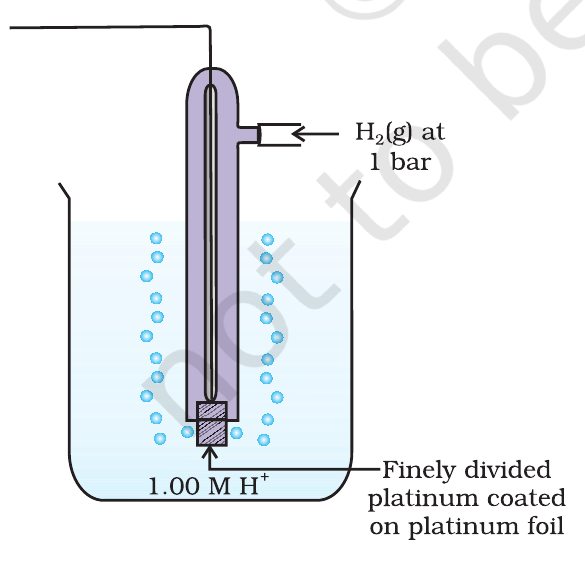
- The standard hydrogen electrode (SHE), shown in Fig. 2.3, is assigned a zero potential at all temperatures, for the reaction $H^+$(aq) + e- -> 1/2 $H_2$(g). It is written as Pt(s)|$H_2$(g)|$H^+$(aq).
- SHE consists of a platinum electrode coated with platinum black, dipped in an acidic solution, with pure hydrogen gas bubbled through it. The pressure of hydrogen gas is one bar and the concentration of hydrogen ion in the solution is one molar.
- A cell built with SHE as anode (reference half-cell) and the other half-cell as cathode gives the reduction potential of the other half-cell. If the concentrations of the oxidised and reduced forms in the right hand half-cell are unity, the cell potential equals the standard electrode potential E° of that half-cell.
- Pt(s)|$H_2$(g, 1 bar)|$H^+$(aq, 1 M)||$Cu^{2+}$(aq, 1 M)|Cu has emf 0.34 V, so E°($Cu^{2+}$/Cu) = 0.34 V. Pt(s)|$H_2$(g, 1 bar)|$H^+$(aq, 1 M)||$Zn^{2+}$(aq, 1 M)|Zn has emf -0.76 V, so E°($Zn^{2+}$/Zn) = -0.76 V.
- A positive E° means the ion is reduced more easily than $H^+$; Cu does not dissolve in $HCl$, and in nitric acid it is oxidised by the nitrate ion, not by hydrogen ion. A negative E° means hydrogen ions can oxidise the metal, so zinc can reduce hydrogen ions.
- For the Daniell cell: E°cell = E°R - E°L = 0.34 V - (-0.76 V) = 1.10 V.
- Platinum or gold are used as inert electrodes. They do not take part in the reaction but provide a surface for oxidation or reduction and for conduction of electrons. Examples: hydrogen electrode Pt(s)|$H_2$(g)|$H^+$(aq) with $H^+$(aq) + e- -> 1/2 $H_2$(g), and bromine electrode Pt(s)|$Br_2$(aq)|$Br^-$(aq) with 1/2 $Br_2$(aq) + e- -> $Br^-$(aq).
Suggest an edit
Table: standard electrode potentials at 298 K
- Selected values from NCERT Table 2.1. Ions are present as aqueous species and $H_2O$ as liquid; gases and solids are shown by g and s.
| Half-cell reaction | E°/V |
|---|---|
| $F_2$(g) + 2e- -> 2F- | 2.87 |
| $MnO_4^-$ + 8H+ + 5e- -> $Mn^{2+}$ + 4H2O | 1.51 |
| $Cl_2$(g) + 2e- -> 2Cl- | 1.36 |
| $O_2$(g) + 4H+ + 4e- -> 2H2O | 1.23 |
| $Br_2$ + 2e- -> 2Br- | 1.09 |
| $Ag^+$ + e- -> Ag(s) | 0.80 |
| $Fe^{3+}$ + e- -> $Fe^{2+}$ | 0.77 |
| $I_2$ + 2e- -> 2I- | 0.54 |
| $Cu^{2+}$ + 2e- -> Cu(s) | 0.34 |
| 2H+ + 2e- -> $H_2$(g) | 0.00 |
| $Pb^{2+}$ + 2e- -> Pb(s) | -0.13 |
| $Ni^{2+}$ + 2e- -> Ni(s) | -0.25 |
| $Fe^{2+}$ + 2e- -> Fe(s) | -0.44 |
| $Zn^{2+}$ + 2e- -> Zn(s) | -0.76 |
| $Al^{3+}$ + 3e- -> Al(s) | -1.66 |
| $Mg^{2+}$ + 2e- -> Mg(s) | -2.36 |
| $Na^+$ + e- -> Na(s) | -2.71 |
| $K^+$ + e- -> K(s) | -2.93 |
| $Li^+$ + e- -> Li(s) | -3.05 |
- Other values in Table 2.1: $Co^{3+}$ + e- -> $Co^{2+}$ 1.81 V; $H_2O_2$ + 2H+ + 2e- -> 2H2O 1.78 V; $Au^{3+}$ + 3e- -> Au(s) 1.40 V; $Cr_2O_7$ 2- + 14H+ + 6e- -> 2Cr3+ + 7H2O 1.33 V; $MnO_2$(s) + 4H+ + 2e- -> $Mn^{2+}$ + 2H2O 1.23 V; $NO_3^-$ + 4H+ + 3e- -> $NO$(g) + 2H2O 0.97 V; 2Hg2+ + 2e- -> Hg2 2+ 0.92 V; $O_2$(g) + 2H+ + 2e- -> $H_2O_2$ 0.68 V; $Cu^+$ + e- -> Cu(s) 0.52 V; AgCl(s) + e- -> Ag(s) + $Cl^-$ 0.22 V; AgBr(s) + e- -> Ag(s) + $Br^-$ 0.10 V; $Sn^{2+}$ + 2e- -> Sn(s) -0.14 V; $Cr^{3+}$ + 3e- -> Cr(s) -0.74 V; 2H2O + 2e- -> $H_2$(g) + 2OH-(aq) -0.83 V; $Ca^{2+}$ + 2e- -> Ca(s) -2.87 V.
Suggest an edit
Ladder: oxidising and reducing strength down Table 2.1
- As we go from top to bottom in Table 2.1 the standard electrode potential falls, the oxidising power of the species on the left falls, and the reducing power of the species on the right hand side rises.
- Strongest oxidising agent: $F_2$ (E° = 2.87 V). Fluorine gas has the maximum tendency to be reduced to fluoride ions, so fluoride ion is the weakest reducing agent.
- Strongest reducing agent: Li (E° = -3.05 V). Lithium metal is the most powerful reducing agent in aqueous solution, so lithium ion is the weakest oxidising agent.
- A negative E° means the redox couple is a stronger reducing agent than the $H^+$/$H_2$ couple. A positive E° means the redox couple is a weaker reducing agent than the $H^+$/$H_2$ couple.
- A metal displaces a metal below it in reducing power: zinc (-0.76 V) and iron (-0.44 V) displace copper (0.34 V) from $CuSO_4$ solution, but silver (0.80 V) cannot displace copper because $Ag^+$ is the stronger oxidising agent.
- Copper does not dissolve in $HCl$ because hydrogen ions cannot oxidise copper; zinc is oxidised by hydrogen ions.
- Electrochemical cells are used for determining the $\mathrm{pH}$ of solutions, solubility product, equilibrium constant and other thermodynamic properties, and for potentiometric titrations.
Suggest an edit
Practice1 question
Try it now. A wrong answer costs nothing here, try again until you get it.
Which of these metals can displace copper from $CuSO_4$ solution?
NCERT 2.2.1 and Table 2.1: $Fe^{2+}$/Fe is -0.44 V, below $Cu^{2+}$/Cu at 0.34 V, so iron is the stronger reducing agent and displaces copper. Silver (0.80 V) and gold cannot.
Nernst equation
- For the electrode reaction $Mn^+$(aq) + ne- -> M(s), the electrode potential at any concentration, measured against the standard hydrogen electrode, is E = E° - (RT/nF) ln (1/[$Mn^+$]). The concentration of solid M is taken as unity. R is the gas constant (8.314 J K-1 mol-1), F is the Faraday constant (96487 C mol-1) and T is temperature in kelvin.
- For the Daniell cell: E(cell) = E°cell - (RT/2F) ln ([$Zn^{2+}$]/[$Cu^{2+}$]). E(cell) rises with a rise in the concentration of $Cu^{2+}$ ions and a fall in the concentration of $Zn^{2+}$ ions.
- Changing the natural logarithm to base 10 at T = 298 K gives E(cell) = E°cell - (0.059/2) log ([$Zn^{2+}$]/[$Cu^{2+}$]).
- For a general cell reaction aA + bB -> cC + dD: E(cell) = E°cell - (RT/nF) ln Q = E°cell - (RT/nF) ln ([C]^c[D]^d/[A]^a[B]^b). Use the same number of electrons n for both electrodes; for Ni(s)|$Ni^{2+}$(aq)||$Ag^+$(aq)|Ag the cell reaction is Ni(s) + 2Ag+(aq) -> $Ni^{2+}$(aq) + 2Ag(s) and n = 2.
- Worked example 2.1: Mg(s) + 2Ag+(0.0001 M) -> $Mg^{2+}$(0.130 M) + 2Ag(s) with E°cell = 3.17 V. E(cell) = 3.17 V - (0.059/2) log (0.130/(0.0001)^2) = 3.17 V - 0.21 V = 2.96 V.
- Intext question 2.5 answer: Ni(s) + 2Ag+(0.002 M) -> $Ni^{2+}$(0.160 M) + 2Ag(s) with E°cell = 1.05 V gives E(cell) = 0.91 V.
Suggest an edit
Table: Nernst equation forms at 298 K
- At 298 K, 2.303 RT/F = 0.059 V. n is the number of electrons in the balanced cell reaction.
| Form | Equation |
|---|---|
| Single electrode $Mn^+$/M | E = E° - (0.059/n) log (1/[$Mn^+$]) |
| Daniell cell | E(cell) = E°cell - (0.059/2) log ([$Zn^{2+}$]/[$Cu^{2+}$]) |
| General cell | E(cell) = E°cell - (0.059/n) log Q |
| Equilibrium (E(cell) = 0) | E°cell = (0.059/n) log Kc |
| Gibbs energy | ΔrG = -nFE(cell); ΔrG° = -nFE°cell |
| Gibbs energy and K | ΔrG° = -RT ln K |
- General Nernst form at any T: E(cell) = E°cell - (RT/nF) ln Q, with Q = [C]^c[D]^d/[A]^a[B]^b for aA + bB -> cC + dD.
- E(cell) is an intensive parameter but ΔrG is an extensive thermodynamic property and its value depends on n: doubling the cell reaction doubles ΔrG but E(cell) stays the same.
Suggest an edit
Equilibrium constant from the Nernst equation
- If the Daniell cell circuit is closed, $Zn^{2+}$ keeps rising and $Cu^{2+}$ keeps falling, and the voltmeter reading keeps falling. After some time there is no change in the ion concentrations and the voltmeter reads zero: equilibrium has been reached.
- At equilibrium E(cell) = 0, so E°cell = (2.303 RT/nF) log Kc, where Kc is the equilibrium constant of the cell reaction.
- At T = 298 K: E°cell = (0.059/n) log Kc.
- Daniell cell: E°cell = 1.1 V and n = 2, so log Kc = (1.1 V x 2)/0.059 V = 37.288 and Kc = 2 x $10^{37}$ at 298 K.
- Worked example 2.2: Cu(s) + 2Ag+(aq) -> $Cu^{2+}$(aq) + 2Ag(s) with E°cell = 0.46 V. log Kc = (0.46 V x 2)/0.059 V = 15.6 and Kc = 3.92 x $10^{15}$.
- Equilibrium constants of reactions that are hard to measure otherwise can be calculated from the matching E° value of the cell.
Suggest an edit
Practice1 question
Try it now. A wrong answer costs nothing here, try again until you get it.
For the Daniell cell at 298 K, E°cell = 1.1 V. What is log Kc?
NCERT 2.3.1: log Kc = (1.1 x 2)/0.059 = 37.288, so Kc = 2 x $10^{37}$.
Gibbs energy and cell emf
- Electrical work done in one second is electrical potential multiplied by total charge passed. To get maximum work from a galvanic cell the charge has to be passed reversibly, and the reversible work done by a galvanic cell equals the fall in its Gibbs energy.
- ΔrG = -nFE(cell), where E is the emf of the cell and nF is the amount of charge passed.
- For Zn(s) + $Cu^{2+}$(aq) -> $Zn^{2+}$(aq) + Cu(s), ΔrG = -2FE(cell); for the doubled reaction 2Zn(s) + 2Cu2+(aq) -> 2Zn2+(aq) + 2Cu(s), ΔrG = -4FE(cell). E(cell) is intensive but ΔrG is extensive and depends on n.
- When the concentration of all reacting species is unity, E(cell) = E°cell and ΔrG° = -nFE°cell. From ΔrG° the equilibrium constant follows by ΔrG° = -RT ln K.
- Worked example 2.3: the Daniell cell has E°cell = 1.1 V, n = 2 and F = 96487 C mol-1. ΔrG° = -2 x 1.1 V x 96487 C mol-1 = -212271 J mol-1 = -212.27 kJ mol-1.
- Intext question 2.6 answer: the cell 2Fe3+(aq) + 2I-(aq) -> 2Fe2+(aq) + $I_2$(s) has E°cell = 0.236 V at 298 K, giving ΔrG° = -45.54 kJ mol-1 and Kc = 9.62 x $10^{7}$.
Suggest an edit
Conductance: resistance, resistivity and conductivity
- Electrical resistance R is measured in ohm. For any object R is directly proportional to its length l and inversely proportional to its area of cross section A: R = ρl/A.
- ρ (rho) is resistivity (specific resistance). Its SI unit is ohm metre, and 1 ohm m = 100 ohm cm. Physically, the resistivity of a substance is its resistance when it is one metre long and its area of cross section is one m2. IUPAC recommends the term resistivity over specific resistance.
- The inverse of resistance is conductance G: G = 1/R = A/(ρl) = κA/l. The SI unit of conductance is siemens, symbol S, equal to ohm-1 (also known as mho).
- The inverse of resistivity is conductivity κ (kappa, specific conductance). Its SI units are S m-1, but κ is often expressed in S cm-1, and 1 S cm-1 = 100 S m-1. The conductivity of a material in S m-1 is its conductance when it is 1 m long and its area of cross section is 1 m2.
- Molar conductivity Λm = κ/c. If κ is in S m-1 and c in mol m-3, Λm is in S m2 mol-1. In laboratory units: Λm (S cm2 mol-1) = κ (S cm-1) x 1000 / molarity (mol L-1). 1 S m2 mol-1 = $10^{4}$ S cm2 mol-1, and 1 S cm2 mol-1 = $10^{-4}$ S m2 mol-1.
- Electronic (metallic) conductance is due to the movement of electrons and depends on (i) the nature and structure of the metal, (ii) the number of valence electrons per atom, (iii) temperature (it falls with a rise in temperature). The composition of the metallic conductor stays unchanged.
- Ionic (electrolytic) conductance is conductance by ions in solution and depends on (i) the nature of the electrolyte added, (ii) size of the ions produced and their solvation, (iii) the nature of the solvent and its viscosity, (iv) concentration of the electrolyte, (v) temperature (it rises with a rise in temperature).
- Even very pure water has small amounts of hydrogen and hydroxyl ions (about $10^{-7}$ M) and a very low conductivity of 3.5 x $10^{-5}$ S m-1. Materials are classed as conductors, insulators and semiconductors by the size of their conductivity; superconductors have zero resistivity or infinite conductivity.
Suggest an edit
Table: conductivity and molar conductivity of $KCl$ solutions
- NCERT Table 2.3: conductivity and molar conductivity of $KCl$ solutions at 298.15 K.
| Concentration (mol L-1) | Conductivity (S cm-1) | Conductivity (S m-1) | Molar conductivity (S cm2 mol-1) |
|---|---|---|---|
| 1.000 | 0.1113 | 11.13 | 111.3 |
| 0.100 | 0.0129 | 1.29 | 129.0 |
| 0.010 | 0.00141 | 0.141 | 141.0 |
- NCERT Table 2.2, aqueous solutions at 298.15 K (conductivity in S m-1): pure water 3.5 x $10^{-5}$; 0.1 M $HCl$ 3.91; 0.01 M $KCl$ 0.14; 0.01 M $NaCl$ 0.12; 0.1 M HAc 0.047; 0.01 M HAc 0.016.
- NCERT Table 2.2, other materials (conductivity in S m-1): insulators glass 1.0 x $10^{-16}$ and Teflon 1.0 x $10^{-18}$; semiconductors CuO 1 x $10^{-7}$, Si 1.5 x $10^{-2}$ and Ge 2.0.
- Pattern to learn from Table 2.3: as the $KCl$ solution is diluted, its conductivity falls (0.1113 to 0.00141 S cm-1) while its molar conductivity rises (111.3 to 141.0 S cm2 mol-1).
Suggest an edit
Measurement of conductivity and the cell constant
- Measuring the resistance of an ionic solution has two problems: passing direct current (DC) changes the composition of the solution, and a solution cannot be connected to the bridge like a metallic wire. The first is fixed by using an alternating current (AC) source and the second by using a specially designed vessel called a conductivity cell.
- A conductivity cell has two platinum electrodes coated with platinum black (finely divided metallic Pt deposited electrochemically), of area of cross section A and separated by distance l. The resistance of the solution column is R = ρl/A = l/(κA).
- The quantity l/A is the cell constant, denoted G. It depends on the distance between the electrodes and their area of cross section, has the dimension of length-1, and is usually found by measuring the resistance of a cell filled with a $KCl$ solution whose conductivity is already known (Table 2.3): G = l/A = Rκ.
- The measurement set-up is a Wheatstone bridge fed by an oscillator O, a source of AC power in the audio frequency range 550 to 5000 cycles per second, with a detector P. At balance no current passes through the detector and the unknown resistance R2 = R1 R4/R3, where R3 and R4 are fixed resistances and R1 is variable.
- Once the cell constant and the resistance are known, the conductivity is κ = G*/R. Inexpensive conductivity meters now read conductance or resistance directly.
- Worked example 2.4: a cell filled with 0.1 mol L-1 $KCl$ has resistance 100 ohm and the conductivity of 0.1 mol L-1 $KCl$ is 1.29 S m-1, so the cell constant G* = 1.29 x 100 = 129 m-1 = 1.29 cm-1. The same cell filled with 0.02 mol L-1 $KCl$ has resistance 520 ohm, so κ = 129/520 = 0.248 S m-1 and Λm = 124 x $10^{-4}$ S m2 mol-1 = 124 S cm2 mol-1.
- Worked example 2.5: a column of 0.05 mol L-1 $NaOH$ solution of diameter 1 cm and length 50 cm has resistance 5.55 x $10^{3}$ ohm. Resistivity ρ = 87.135 ohm cm, conductivity κ = 0.01148 S cm-1 and molar conductivity Λm = 229.6 S cm2 mol-1.
Suggest an edit
Variation of molar conductivity with concentration
- Conductivity always falls with a fall in concentration, for both weak and strong electrolytes, because the number of ions per unit volume that carry the current in a solution falls on dilution.
- Molar conductivity rises with a fall in concentration. Molar conductivity at a given concentration is the conductance of the volume V of solution containing one mole of electrolyte, so Λm = κV; the fall in κ on dilution is more than made up for by the rise in V.
- When concentration approaches zero, the molar conductivity is known as limiting molar conductivity and is written Λ°m.
- Strong electrolytes: Λm rises slowly with dilution and follows Λm = Λ°m - A c^1/2. A plot of Λm against c^1/2 is a straight line with intercept Λ°m and slope -A. The constant A for a given solvent and temperature depends on the type of electrolyte, that is, the charges on the cation and anion: $NaCl$, $CaCl_2$ and $MgSO_4$ are 1-1, 2-1 and 2-2 electrolytes.
- Worked example 2.6: for $KCl$ solutions, the plot of Λm against c^1/2 is nearly a straight line with Λ°m = 150.0 S cm2 mol-1 and A = 87.46 S cm2 mol-1 (mol L-1)^-1/2.
- Weak electrolytes: Λm rises steeply on dilution, mainly near lower concentrations, because the degree of dissociation rises and so does the number of ions in the volume holding one mole of electrolyte. Λ°m cannot be found by extrapolating Λm to zero concentration, because at such low concentrations the conductivity is too low to measure accurately.
- At any concentration c, the degree of dissociation α = Λm/Λ°m. For acetic acid, Ka = cα^2/(1-α) = cΛm^2/[Λ°m(Λ°m - Λm)].
- Worked example 2.9: the conductivity of 0.001028 mol L-1 acetic acid is 4.95 x $10^{-5}$ S cm-1, giving Λm = 48.15 S cm2 mol-1. With Λ°m = 390.5 S cm2 mol-1, α = 0.1233 and Ka = 1.78 x $10^{-5}$ mol L-1.
Suggest an edit
Practice1 question
Try it now. A wrong answer costs nothing here, try again until you get it.
On diluting an electrolyte solution, what happens to conductivity and molar conductivity?
NCERT 2.4.2: conductivity always falls with dilution, while molar conductivity rises with dilution for both weak and strong electrolytes.
Kohlrausch law and its applications
- Kohlrausch noted that the difference in Λ°m of the electrolytes NaX and KX for any X is nearly constant. At 298 K: Λ°m($KCl$) - Λ°m($NaCl$) = Λ°m(KBr) - Λ°m(NaBr) = Λ°m(KI) - Λ°m(NaI) = 23.4 S cm2 mol-1, and Λ°m(NaBr) - Λ°m($NaCl$) = Λ°m(KBr) - Λ°m($KCl$) = 1.8 S cm2 mol-1.
- Kohlrausch law of independent migration of ions: the limiting molar conductivity of an electrolyte is the sum of the individual contributions of the anion and the cation of the electrolyte.
- If an electrolyte gives n+ cations and n- anions on dissociation, Λ°m = n+ λ°+ + n- λ°-, where λ°+ and λ°- are the limiting molar conductivities of the cation and anion. For $NaCl$: Λ°m($NaCl$) = λ°$Na^+$ + λ°$Cl^-$.
- Limiting ionic conductivities at 298 K (S cm2 mol-1, Table 2.4): $H^+$ 349.6, $Na^+$ 50.1, $K^+$ 73.5, $Ca^{2+}$ 119.0, $Mg^{2+}$ 106.0, $OH^-$ 199.1, $Cl^-$ 76.3, $Br^-$ 78.1, $CH_3COO^-$ 40.9, $SO_4$ 2- 160.0.
- Worked example 2.7: Λ°m($CaCl_2$) = λ°$Ca^{2+}$ + 2λ°$Cl^-$ = 119.0 + 2(76.3) = 271.6 S cm2 mol-1; Λ°m($MgSO_4$) = λ°$Mg^{2+}$ + λ°$SO_4$ 2- = 106.0 + 160.0 = 266 S cm2 mol-1.
- Worked example 2.8: Λ°m(HAc) = Λ°m($HCl$) + Λ°m(NaAc) - Λ°m($NaCl$) = 425.9 + 91.0 - 126.4 = 390.5 S cm2 mol-1. This is how Λ°m of a weak electrolyte is found, since it cannot be found by extrapolation.
- Uses of Kohlrausch law: calculate Λ°m for any electrolyte from the λ° of its ions, and find the dissociation constant of a weak electrolyte such as acetic acid from Λm and Λ°m at a given concentration c.
- Intext question 2.9 answer: the molar conductivity of 0.025 mol L-1 methanoic acid is 46.1 S cm2 mol-1, with λ°($H^+$) = 349.6 and λ°($HCOO^-$) = 54.6 S cm2 mol-1, giving degree of dissociation 0.114 and dissociation constant 3.67 x $10^{-4}$ mol L-1.
Suggest an edit
Electrolysis and Faraday laws
- In an electrolytic cell an external source of voltage is used to bring about a chemical reaction. In the simplest cell, two copper strips dip in an aqueous solution of copper sulphate: $Cu^{2+}$(aq) + 2e- -> Cu(s) at the cathode and Cu(s) -> $Cu^{2+}$(aq) + 2e- at the anode. Copper is dissolved (oxidised) at the anode and deposited (reduced) at the cathode.
- This is the basis of refining impure copper: the impure copper is made the anode, it dissolves on passing current, and pure copper is deposited at the cathode. Sodium and magnesium are produced by electrolysis of their fused chlorides, and aluminium by electrolysis of aluminium oxide in the presence of cryolite.
- Faraday first law: the amount of chemical reaction at any electrode during electrolysis is proportional to the quantity of electricity passed through the electrolyte. Second law: the amounts of different substances liberated by the same quantity of electricity are proportional to their chemical equivalent weights (atomic mass of metal divided by the number of electrons needed to reduce the cation).
- The quantity of electricity Q passed is Q = It, with Q in coulombs when I is in amperes and t in seconds.
- The charge on one mole of electrons is 96487 C mol-1 and is called one Faraday, F. For approximate calculations 1 F = 96500 C mol-1. One mole of $Ag^+$ needs 1 mol of electrons (1 F), one mole of $Mg^{2+}$ needs 2 F and one mole of $Al^{3+}$ needs 3 F. In commercial production of metals, currents as high as 50,000 A are used, about 0.518 F per second.
- Worked example 2.10: a solution of $CuSO_4$ is electrolysed for 10 minutes with a current of 1.5 A. Charge = 1.5 x 600 = 900 C. 2 F (2 x 96487 C) deposits 1 mol (63 g) of Cu, so 900 C deposits (63 x 900)/(2 x 96487) = 0.2938 g of Cu.
- Intext question 2.12: $Cr_2O_7$ 2- + 14H+ + 6e- -> 2Cr3+ + 7H2O needs 6 mol of electrons per mol of $Cr_2O_7$ 2-, so the charge needed is 6 F.
Suggest an edit
Ladder: products of electrolysis
- Products of electrolysis depend on the nature of the material electrolysed and the type of electrode. An inert electrode (platinum or gold) does not take part in the chemical reaction and acts only as a source or sink for electrons; a reactive electrode takes part in the electrode reaction.
- Products also depend on the oxidising and reducing species present and their standard electrode potentials. Some processes, though feasible, are so slow kinetically that at lower voltages they do not seem to take place and extra potential (called overpotential) has to be applied.
- Case 1, molten $NaCl$: only $Na^+$ and $Cl^-$ are present. Cathode: $Na^+$ + e- -> Na. Anode: $Cl^-$ -> 1/2 $Cl_2$ + e-. Products: sodium metal and $Cl_2$ gas.
- Case 2, aqueous $NaCl$: cathode competition is $Na^+$(aq) + e- -> Na(s) (E° = -2.71 V) against $H^+$(aq) + e- -> 1/2 $H_2$(g) (E° = 0.00 V). The reaction with the higher E° is preferred, so $H_2$ is formed; the net cathode reaction is $H_2O$(l) + e- -> 1/2 $H_2$(g) + $OH^-$(aq). Anode competition is $Cl^-$(aq) -> 1/2 $Cl_2$(g) + e- (E° = 1.36 V) against 2H2O(l) -> $O_2$(g) + 4H+(aq) + 4e- (E° = 1.23 V). The reaction with the lower E° should be preferred, but on account of overpotential of oxygen the chloride reaction is preferred. Net reaction: $NaCl$(aq) + $H_2O$(l) -> $Na^+$(aq) + $OH^-$(aq) + 1/2 $H_2$(g) + 1/2 $Cl_2$(g). Products: $NaOH$, $Cl_2$ and $H_2$.
- Case 3, dilute sulphuric acid with platinum electrodes: at the anode 2H2O(l) -> $O_2$(g) + 4H+(aq) + 4e- (E° = 1.23 V) is preferred, so oxygen gas is the anode product.
- Case 4, concentrated sulphuric acid: at the anode 2SO4 2-(aq) -> $S_2O_8$ 2-(aq) + 2e- (E° = 1.96 V) is preferred, so peroxodisulphate is formed.
- Case 5, aqueous $CuSO_4$ with copper electrodes: copper dissolves at the anode and deposits at the cathode, which is how impure copper is refined.
- From these cases: at the cathode the reduction with the higher E° is preferred, and at the anode the oxidation with the lower E° is preferred, unless overpotential blocks it.
Suggest an edit
Practice1 question
Try it now. A wrong answer costs nothing here, try again until you get it.
What is the product at the anode when dilute sulphuric acid is electrolysed with platinum electrodes?
NCERT 2.5.1: for dilute sulphuric acid the anode reaction is 2H2O -> $O_2$ + 4H+ + 4e-, so oxygen gas is given off. NEET 2020 asked this.
Batteries, fuel cells and corrosion
- A battery is a galvanic cell used as a source of electrical energy. For practical use it should be reasonably light, compact and its voltage should not vary appreciably during use. In a primary battery the reaction occurs only once and the battery cannot be reused; a secondary cell can be recharged by passing current through it in the opposite direction.
- Dry cell (Leclanche cell), about 1.5 V: the zinc container is the anode and the cathode is a carbon (graphite) rod surrounded by powdered manganese dioxide and carbon, with a moist paste of ammonium chloride ($NH_4Cl$) and zinc chloride ($ZnCl_2$) between the electrodes. Anode: Zn(s) -> $Zn^{2+}$ + 2e-. Cathode: $MnO_2$ + $NH_4^+$ + e- -> MnO(OH) + $NH_3$; manganese is reduced from the +4 state to the +3 state, and the ammonia forms [Zn($NH_3$)4]2+ with $Zn^{2+}$.
- Mercury cell, about 1.35 V, for low current devices like hearing aids and watches: zinc-mercury amalgam anode and a paste of HgO and carbon as cathode, with a paste of $KOH$ and ZnO as electrolyte. Anode: Zn(Hg) + 2OH- -> ZnO(s) + $H_2O$ + 2e-. Cathode: HgO + $H_2O$ + 2e- -> Hg(l) + 2OH-. Overall: Zn(Hg) + HgO(s) -> ZnO(s) + Hg(l). The cell potential stays constant during its life because the overall reaction involves no ion in solution whose concentration can change.
- Lead storage battery, used in automobiles and invertors: lead anode and a grid of lead packed with lead dioxide ($PbO_2$) as cathode, with a 38% solution of sulphuric acid as electrolyte. Anode: Pb(s) + $SO_4$ 2-(aq) -> $PbSO_4$(s) + 2e-. Cathode: $PbO_2$(s) + $SO_4$ 2-(aq) + 4H+(aq) + 2e- -> $PbSO_4$(s) + 2H2O(l). Overall: Pb(s) + $PbO_2$(s) + 2H2SO4(aq) -> 2PbSO4(s) + 2H2O(l). On charging the reaction is reversed and $PbSO_4$ on anode and cathode is converted into Pb and $PbO_2$.
- Nickel-cadmium cell: longer life than the lead storage cell but more expensive to manufacture, in a jelly roll arrangement with a separator soaked in moist sodium or potassium hydroxide. NCERT gives only the overall discharge reaction: Cd(s) + 2Ni(OH)3(s) -> CdO(s) + 2Ni(OH)2(s) + $H_2O$(l).
- Fuel cells are galvanic cells designed to convert the energy of combustion of fuels like hydrogen, methane and methanol directly into electrical energy, with reactants fed continuously to the electrodes and products removed continuously.
- Hydrogen-oxygen fuel cell, used for electrical power in the Apollo space programme: hydrogen and oxygen are bubbled through porous carbon electrodes into concentrated aqueous sodium hydroxide solution, with finely divided platinum or palladium as catalyst. Cathode: $O_2$(g) + 2H2O(l) + 4e- -> 4OH-(aq). Anode: 2H2(g) + 4OH-(aq) -> 4H2O(l) + 4e-. Overall: 2H2(g) + $O_2$(g) -> 2H2O(l). The cell runs continuously as long as the reactants are supplied. Fuel cells produce electricity with an efficiency of about 70% against about 40% for thermal plants, and are pollution free.
- Corrosion is an electrochemical process. Rusting of iron occurs in the presence of water and air. At one spot oxidation takes place and the spot behaves as anode: 2Fe(s) -> 2Fe2+ + 4e-, E°($Fe^{2+}$/Fe) = -0.44 V. Electrons move through the metal to another spot that behaves as cathode: $O_2$(g) + 4H+(aq) + 4e- -> 2H2O(l), E° = 1.23 V. Overall: 2Fe(s) + $O_2$(g) + 4H+(aq) -> 2Fe2+(aq) + 2H2O(l), E°cell = 1.67 V. Ferrous ions are further oxidised by atmospheric oxygen to ferric ions, which come out as rust, hydrated ferric oxide ($Fe_2O_3$.xH2O).
- Prevention of corrosion: cover the surface with paint or chemicals (for example bisphenol) so it does not come in contact with the atmosphere; cover the surface with other metals (Sn, Zn); or provide a sacrificial electrode of another metal (like Mg, Zn) which corrodes itself but saves the object.
Suggest an edit
Trap Boxes
Anode is always positive?
Wrong idea: The anode is the positive electrode in every electrochemical cell.
In a galvanic cell the anode is negative (oxidation takes place there and electrons leave it) and the cathode is positive. In an electrolytic cell the signs are the other way round because the external supply drives the reaction. The anode is where oxidation takes place in both kinds of cell.
NCERT XII, Ch 2, 2.1, 2.2
Ecell is cathode potential plus anode potential?
Wrong idea: Ecell = E cathode + E anode.
Ecell = Eright - Eleft = E cathode - E anode. For the Daniell cell: 0.34 V - (-0.76 V) = 1.10 V. Adding the two potentials would give -0.42 V, which is wrong.
NCERT XII, Ch 2, 2.2
Conductivity rises on dilution?
Wrong idea: Diluting a solution raises its conductivity because there is more water.
Conductivity falls on dilution because the number of ions per unit volume carrying the current falls. It is molar conductivity that rises on dilution, because the volume of solution holding one mole of electrolyte grows.
NCERT XII, Ch 2, 2.4.2
Water is oxidised first in brine electrolysis?
Wrong idea: In aqueous $NaCl$ the anode must give oxygen because water has the lower E° value (1.23 V against 1.36 V for chloride).
By the E° values water should be oxidised first, but the overpotential of oxygen makes that reaction slow, so chloride is oxidised instead and $Cl_2$ gas is given off at the anode.
NCERT XII, Ch 2, 2.5.1
Charging a lead storage battery uses up acid?
Wrong idea: Charging a lead storage battery uses up sulphuric acid just like discharging does.
Discharging turns Pb, $PbO_2$ and $H_2SO_4$ into $PbSO_4$ and water. Charging reverses the reaction, so $PbSO_4$ on both plates turns back into Pb and $PbO_2$ and sulphuric acid is formed again.
NCERT XII, Ch 2, 2.6.2
Chapter test
5 NEET PYQs. +4 for a correct answer, -1 for a wrong answer, exactly like NEET. Finish the test to earn a medal.
Q1: NEET (UG) 2022, Code R1, Q80
At 298 K, the standard electrode potentials of $Cu^{2+}$/Cu, $Zn^{2+}$/Zn, $Fe^{2+}$/Fe and $Ag^+$/Ag are 0.34 V, -0.76 V, -0.44 V and 0.80 V, respectively. On the basis of standard electrode potential, predict which of the following reaction cannot occur?
$Ag^+$/Ag (0.80 V) sits above $Cu^{2+}$/Cu (0.34 V), so silver is the weaker reducing agent and cannot reduce $Cu^{2+}$ to Cu. Zinc (-0.76 V) and iron (-0.44 V) sit below copper, so they can displace it.
Q2: NEET (UG) 2021, Code P3, Q93
The molar conductivity of 0.007 M acetic acid is 20 S cm2 mol-1. What is the dissociation constant of acetic acid? Choose the correct option. The limiting molar conductivity of $H^+$ is 350 S cm2 mol-1 and of $CH_3COO^-$ is 50 S cm2 mol-1.
Limiting molar conductivity of $CH_3COOH$ = 350 + 50 = 400 S cm2 mol-1, so alpha = 20/400 = 0.05. Using the weak-electrolyte approximation (1 - alpha ≈ 1), Ka ≈ c x alpha^2 = 0.007 x 0.0025 = 1.75 x $10^{-5}$ mol L-1 (exact c x alpha^2 / (1 - alpha) gives 1.84 x $10^{-5}$; NTA keys option (4)).
Q3: NEET (UG) 2021, Code P3, Q62
The molar conductance of $NaCl$, $HCl$ and $CH_3COONa$ at infinite dilution are 126.45, 426.16 and 91.0 S cm2 mol-1 respectively. The molar conductance of $CH_3COOH$ at infinite dilution is. Choose the right option for your answer.
By Kohlrausch law: limiting molar conductivity of $CH_3COOH$ = 91.0 + 426.16 - 126.45 = 390.71 S cm2 mol-1, from $CH_3COONa$ + $HCl$ - $NaCl$.
Q4: NEET (UG) 2020, Code G5, Q130
On electrolysis of dil.sulphuric acid using Platinum (Pt) electrode, the product obtained at anode will be :
For dilute sulphuric acid the anode reaction is 2H2O(l) -> $O_2$(g) + 4H+(aq) + 4e-, so oxygen gas is given off. At higher acid concentrations the anode gives peroxodisulphate instead.
Q5: NEET (UG) 2020, Code G5, Q93
The number of Faradays(F) required to produce 20 g of calcium from molten $CaCl_2$ (Atomic mass of Ca=40 g mol-1) is :
$Ca^{2+}$ needs 2 mol of electrons per mol of Ca. 20 g of Ca is 0.5 mol, so 1 mol of electrons (1 F) is needed. The equivalent mass of Ca is 40/2 = 20, and 20 g is 1 equivalent.
Score: 0 · Answered 0 of 5
Flashcards
Tap a card to flip it over and see the answer. Tap it again to flip it back.
Write the Nernst equation for a cell at 298 K in base 10 logs.
Tap to flipE(cell) = E°cell - (0.059/n) log Q, where n is the number of electrons in the balanced cell reaction and Q is the reaction quotient. For a single electrode $Mn^+$/M: E = E° - (0.059/n) log (1/[$Mn^+$]).
Tap to flip backState the relation between standard cell potential, Gibbs energy and equilibrium constant.
Tap to flipΔrG° = -nFE°cell and ΔrG° = -RT ln K, so E°cell = (2.303 RT/nF) log Kc; at 298 K, E°cell = (0.059/n) log Kc.
Tap to flip backDefine molar conductivity and give its units.
Tap to flipMolar conductivity Λm = κ/c. With κ in S m-1 and c in mol m-3, Λm is in S m2 mol-1; with κ in S cm-1, Λm (S cm2 mol-1) = κ x 1000 / molarity.
Tap to flip backState Kohlrausch law of independent migration of ions.
Tap to flipThe limiting molar conductivity of an electrolyte is the sum of the contributions of its ions: Λ°m = n+ λ°+ + n- λ°-. Example: Λ°m($NaCl$) = λ°$Na^+$ + λ°$Cl^-$.
Tap to flip backGive E° for $Cu^{2+}$/Cu and $Zn^{2+}$/Zn and the emf of the Daniell cell.
Tap to flipE°($Cu^{2+}$/Cu) = 0.34 V and E°($Zn^{2+}$/Zn) = -0.76 V, so E°cell = 0.34 - (-0.76) = 1.10 V.
Tap to flip backWhich species is the strongest oxidising agent and which metal is the strongest reducing agent in Table 2.1?
Tap to flip$F_2$ (E° = 2.87 V) is the strongest oxidising agent and $F^-$ is the weakest reducing agent; Li (E° = -3.05 V) is the most powerful reducing agent and $Li^+$ is the weakest oxidising agent.
Tap to flip backGive Kc and ΔrG° for the Daniell cell reaction at 298 K.
Tap to flipE°cell = 1.1 V, log Kc = 37.288, Kc = 2 x $10^{37}$; ΔrG° = -212.27 kJ mol-1.
Tap to flip backArrange Li, K, Zn, Cu and $F_2$ in order of rising standard electrode potential.
Tap to flipLi (-3.05 V) < K (-2.93 V) < Zn (-0.76 V) < Cu (0.34 V) < $F_2$ (2.87 V). E° rises from the strongest reducing agent to the strongest oxidising agent.
Tap to flip backWrite the electrode reactions of the $H_2$-O2 fuel cell.
Tap to flipCathode: $O_2$(g) + 2H2O(l) + 4e- -> 4OH-(aq). Anode: 2H2(g) + 4OH-(aq) -> 4H2O(l) + 4e-. Overall: 2H2(g) + $O_2$(g) -> 2H2O(l).
Tap to flip backWrite the discharge reactions of the lead storage battery.
Tap to flipAnode: Pb(s) + $SO_4$ 2-(aq) -> $PbSO_4$(s) + 2e-. Cathode: $PbO_2$(s) + $SO_4$ 2-(aq) + 4H+(aq) + 2e- -> $PbSO_4$(s) + 2H2O(l). Overall: Pb(s) + $PbO_2$(s) + 2H2SO4(aq) -> 2PbSO4(s) + 2H2O(l).
Tap to flip backWhy is chlorine, not oxygen, given off at the anode during electrolysis of aqueous $NaCl$?
Tap to flipBy E° values water (1.23 V) should be oxidised before chloride (1.36 V), but the overpotential of oxygen makes the oxygen reaction slow, so chloride is oxidised to $Cl_2$ instead.
Tap to flip backGive the cell constant relation and the Wheatstone bridge balance condition.
Tap to flipCell constant G* = l/A = Rκ, and conductivity κ = G*/R. At bridge balance the unknown resistance R2 = R1 R4/R3.
Tap to flip back