 NEET Notes
Home > Chemistry > Inorganic > Coordination Compounds
Coordination Compounds
On this page · 20 sections
- 01Syllabus map
- 02Werner's theory of coordination compounds
- 03Table: Werner's cobalt(III) chloride-ammonia complexes
- 04Coordination entity, central atom and ligands
- 05Table: ligand types by denticity
- 06Coordination number, sphere, polyhedron, oxidation number, homoleptic and heteroleptic
- 07Formulas of mononuclear coordination entities
- 08Naming of mononuclear coordination compounds
- 09Table: worked names and formulas
- 10Geometrical isomerism
- 11Optical isomerism
- 12Structural isomerism: linkage, coordination, ionisation and solvate
- 13Valence bond theory
- 14Table: hybridisation, geometry and magnetic behaviour
- 15Magnetic properties of coordination compounds
- 16Crystal field theory: octahedral splitting and the spectrochemical series
- 17Tetrahedral splitting and colour in coordination compounds
- 18Bonding in metal carbonyls and importance of coordination compounds
- 19Ladder: inner orbital versus outer orbital complexes
- 20Ladder: trap pairs
Werner's theory, ligands and coordination numbers, IUPAC names of mononuclear complexes, isomerism, valence bond and crystal field theories, colour, magnetic properties and uses, from NCERT Class 12 Chemistry Chapter 5.
Syllabus map
- NMC Unit: CHEM-U12, Co-ordination Compounds (NMC spelling, with a hyphen).
- Subtopics in this chapter (NCERT XII, Ch 5): Werner's theory of coordination compounds (5.1); definitions of some important terms pertaining to coordination compounds (5.2); nomenclature of coordination compounds (5.3), formulas of mononuclear coordination entities (5.3.1), naming of mononuclear coordination compounds (5.3.2); isomerism in coordination compounds (5.4), geometrical isomerism (5.4.1), optical isomerism (5.4.2), linkage isomerism (5.4.3), coordination isomerism (5.4.4), ionisation isomerism (5.4.5), solvate isomerism (5.4.6); bonding in coordination compounds (5.5), valence bond theory (5.5.1), magnetic properties (5.5.2), limitations of valence bond theory (5.5.3), crystal field theory (5.5.4), colour in coordination compounds (5.5.5), limitations of crystal field theory (5.5.6); bonding in metal carbonyls (5.6); importance and applications of coordination compounds (5.7).
- Subtopic checklist: (1) Werner's postulates and primary vs secondary valence; (2) coordination entity, central atom, ligand, denticity and chelation; (3) coordination number and coordination polyhedron; (4) oxidation number of the central atom; (5) homoleptic and heteroleptic complexes; (6) formulas of mononuclear entities; (7) IUPAC naming rules; (8) geometrical isomerism; (9) optical isomerism; (10) linkage, coordination, ionisation and solvate isomerism; (11) valence bond theory, inner and outer orbital complexes; (12) magnetic properties; (13) crystal field splitting in octahedral and tetrahedral fields; (14) the spectrochemical series; (15) colour and d-d transitions; (16) bonding in metal carbonyls; (17) importance in analysis, metallurgy, biological systems, industry and medicine.
- Extra information (beyond NCERT): none. Everything in this chapter is NCERT Chapter 5.
- Excluded topics: advanced crystal field theory derivations, ligand field theory and molecular orbital theory, which NCERT states are beyond the scope of the present study; polynuclear complexes, since the NMC syllabus covers IUPAC nomenclature of mononuclear coordination compounds only. Do not import their facts into this chapter.
- Estimated revision time: 12 minutes. Jump links: Syllabus map, Werner's theory of coordination compounds, Table: Werner's cobalt(III) chloride-ammonia complexes, Coordination entity, central atom and ligands, Table: ligand types by denticity, Coordination number, sphere, polyhedron, oxidation number, homoleptic and heteroleptic, Formulas of mononuclear coordination entities, Naming of mononuclear coordination compounds, Table: worked names and formulas, Geometrical isomerism, Optical isomerism, Structural isomerism: linkage, coordination, ionisation and solvate, Valence bond theory, Table: hybridisation, geometry and magnetic behaviour, Magnetic properties of coordination compounds, Crystal field theory: octahedral splitting and the spectrochemical series, Tetrahedral splitting and colour in coordination compounds, Bonding in metal carbonyls and importance of coordination compounds, Ladder: inner orbital versus outer orbital complexes, Ladder: trap pairs.
Suggest an edit
Werner's theory of coordination compounds
- Alfred Werner (1866-1919), a Swiss chemist, was the first to formulate his ideas about the structures of coordination compounds. He won the Nobel Prize in 1913 for his work on the linkage of atoms and the coordination theory.
- Werner proposed the concept of a primary valence and a secondary valence for a metal ion. Binary compounds such as $CrCl_3$, $CoCl_2$ or $PdCl_2$ have primary valence of 3, 2 and 2 respectively.
- In a series of compounds of cobalt(III) chloride with ammonia, some chloride ions could be precipitated as AgCl on adding excess silver nitrate solution in cold, but some remained in solution. Together with conductivity measurements, this is explained if six groups in all, either chloride ions or ammonia molecules or both, remain bonded to the cobalt ion, and the atoms within the square brackets form a single entity which does not dissociate.
- The main postulates of Werner's theory (1898): (1) In coordination compounds metals show two types of linkages (valences), primary and secondary. (2) The primary valences are normally ionisable and are satisfied by negative ions. (3) The secondary valences are non ionisable. These are satisfied by neutral molecules or negative ions. The secondary valence is equal to the coordination number and is fixed for a metal. (4) The ions/groups bound by the secondary linkages to the metal have characteristic spatial arrangements corresponding to different coordination numbers.
- In modern formulations, such spatial arrangements are called coordination polyhedra. The species within the square bracket are coordination entities or complexes and the ions outside the square bracket are called counter ions.
- Werner postulated that octahedral, tetrahedral and square planar geometrical shapes are more common in coordination compounds of transition metals. Thus, [Co($NH_3$)6]3+, [CoCl($NH_3$)5]2+ and [$CoCl_2$($NH_3$)4]+ are octahedral entities, while [Ni($CO$)4] and [$PtCl_4$]2- are tetrahedral and square planar, respectively.
- Double salt versus complex: both are formed by the combination of two or more stable compounds in stoichiometric ratio. Double salts such as carnallite, $KCl$.$MgCl_2$.6H2O, Mohr's salt, $FeSO_4$.($NH_4$)2SO4.6H2O, and potash alum, KAl($SO_4$)2.12H2O, dissociate into simple ions completely when dissolved in water. Complex ions such as [Fe(CN)6]4- of K4[Fe(CN)6] do not dissociate into Fe and CN ions.
- Coordination compounds are the backbone of modern inorganic and bio-inorganic chemistry and chemical industry. Chlorophyll, haemoglobin and vitamin B12 are coordination compounds of magnesium, iron and cobalt respectively.
Suggest an edit
Table: Werner's cobalt(III) chloride-ammonia complexes
| Compound | Colour | AgCl precipitated per mol | Formulation | Solution conductivity |
|---|---|---|---|---|
| $CoCl_3$.6NH3 | Yellow | 3 mol | [Co($NH_3$)6]Cl3 | 1:3 electrolyte |
| $CoCl_3$.5NH3 | Purple | 2 mol | [CoCl($NH_3$)5]$Cl_2$ | 1:2 electrolyte |
| $CoCl_3$.4NH3 | Green | 1 mol | [$CoCl_2$($NH_3$)4]Cl | 1:1 electrolyte |
| $CoCl_3$.4NH3 | Violet | 1 mol | [$CoCl_2$($NH_3$)4]Cl | 1:1 electrolyte |
- The last two compounds have identical empirical formula, $CoCl_3$.4NH3, but distinct properties. Such compounds are termed as isomers.
- In each example the secondary valence is six: six groups in all remain bonded to the cobalt ion.
- Example 5.1, secondary valences from the AgCl test: (i) $PdCl_2$.4NH3, 2 mol AgCl, secondary 4; (ii) $NiCl_2$.6H2O, 2 mol AgCl, secondary 6; (iii) $PtCl_4$.2HCl, 0 mol AgCl, secondary 6; (iv) $CoCl_3$.4NH3, 1 mol AgCl, secondary 6; (v) $PtCl_2$.2NH3, 0 mol AgCl, secondary 4.
- How to read the test: the moles of AgCl precipitated equal the number of ionisable (counter) chloride ions. Chlorides inside the square bracket are not precipitated.
Suggest an edit
Practice1 question
Try it now. A wrong answer costs nothing here, try again until you get it.
1 mol of $CoCl_3$.6NH3 (yellow) is treated with excess $AgNO_3$ in cold. How many moles of AgCl are precipitated?
NCERT 5.1, Table 5.1: 1 mol of $CoCl_3$.6NH3 (yellow) gives 3 mol AgCl, so all three chlorides are counter ions and the complex is [Co($NH_3$)6]Cl3.
Coordination entity, central atom and ligands
- (a) Coordination entity: a coordination entity constitutes a central metal atom or ion bonded to a fixed number of ions or molecules. For example, [$CoCl_3$($NH_3$)3] is a coordination entity in which the cobalt ion is surrounded by three ammonia molecules and three chloride ions. Other examples are [Ni($CO$)4], [$PtCl_2$($NH_3$)2], [Fe(CN)6]4- and [Co($NH_3$)6]3+.
- (b) Central atom/ion: the atom/ion to which a fixed number of ions/groups are bound in a definite geometrical arrangement around it. The central atom/ion in [$NiCl_2$($H_2O$)4], [CoCl($NH_3$)5]2+ and [Fe(CN)6]3- are $Ni^{2+}$, $Co^{3+}$ and $Fe^{3+}$ respectively. These central atoms/ions are also referred to as Lewis acids.
- (c) Ligands: the ions or molecules bound to the central atom/ion in the coordination entity. These may be simple ions such as $Cl^-$, small molecules such as $H_2O$ or $NH_3$, larger molecules such as $H_2NCH_2CH_2NH_2$ or N($CH_2CH_2NH_2$)3, or even macromolecules such as proteins.
- When a ligand is bound to a metal ion through a single donor atom, as with $Cl^-$, $H_2O$ or $NH_3$, the ligand is said to be unidentate.
- When a ligand can bind through two donor atoms, as in $H_2NCH_2CH_2NH_2$ (ethane-1,2-diamine) or $C_2O_4^{2-}$ (oxalate), the ligand is said to be didentate, and when several donor atoms are present in a single ligand, as in N($CH_2CH_2NH_2$)3, the ligand is said to be polydentate. Ethylenediaminetetraacetate ion (EDTA4-) is an important hexadentate ligand. It can bind through two nitrogen and four oxygen atoms to a central metal ion.
- When a di- or polydentate ligand uses its two or more donor atoms simultaneously to bind a single metal ion, it is said to be a chelate ligand. The number of such ligating groups is called the denticity of the ligand. Such complexes, called chelate complexes, tend to be more stable than similar complexes containing unidentate ligands.
- A ligand which has two different donor atoms and either of the two ligates in the complex is called an ambidentate ligand. Examples are the $NO_2^-$ and $SCN^-$ ions. The $NO_2^-$ ion can coordinate either through nitrogen or through oxygen to a central metal atom/ion. Similarly, the $SCN^-$ ion can coordinate through the sulphur or nitrogen atom.
Suggest an edit
Table: ligand types by denticity
| Ligand type | Donor atoms | NCERT examples |
|---|---|---|
| Unidentate | 1 | $Cl^-$, $H_2O$, $NH_3$ |
| Didentate | 2 | ethane-1,2-diamine (en), oxalate $C_2O_4^{2-}$ |
| Polydentate | Several | N($CH_2CH_2NH_2$)3 |
| Hexadentate | 6 (2 N + 4 O) | EDTA4- |
| Ambidentate | 2 different donor atoms, one binds at a time | $NO_2^-$ (through N or O), $SCN^-$ (through S or N) |
- Chelate ligand: a di- or polydentate ligand that uses its two or more donor atoms simultaneously to bind a single metal ion. The number of such ligating groups is the denticity of the ligand.
- Chelate complexes tend to be more stable than similar complexes containing unidentate ligands.
- Denticity counts donor atoms, not ligands: one oxalate ion contributes 2 to the coordination number, and one EDTA4- ion contributes 6.
Suggest an edit
Practice1 question
Try it now. A wrong answer costs nothing here, try again until you get it.
What is the denticity of the ethylenediaminetetraacetate ion (EDTA4-)?
NCERT 5.2(c): EDTA4- is an important hexadentate ligand. It binds through two nitrogen and four oxygen atoms to a central metal ion.
Coordination number, sphere, polyhedron, oxidation number, homoleptic and heteroleptic
- (d) Coordination number: the number of ligand donor atoms to which the metal is directly bonded. In [$PtCl_6$]2- and [Ni($NH_3$)4]2+, the coordination number of Pt and Ni are 6 and 4 respectively. In [Fe($C_2O_4$)3]3- and [Co(en)3]3+, the coordination number of both Fe and Co is 6, because $C_2O_4^{2-}$ and en (ethane-1,2-diamine) are didentate ligands.
- The coordination number of the central atom/ion is determined only by the number of sigma bonds formed by the ligand with the central atom/ion. Pi bonds, if formed between the ligand and the central atom/ion, are not counted for this purpose.
- (e) Coordination sphere: the central atom/ion and the ligands attached to it are enclosed in square bracket and are collectively termed the coordination sphere. The ionisable groups are written outside the bracket and are called counter ions. In K4[Fe(CN)6], the coordination sphere is [Fe(CN)6]4- and the counter ion is $K^+$.
- (f) Coordination polyhedron: the spatial arrangement of the ligand atoms directly attached to the central atom/ion defines a coordination polyhedron about the central atom. The most common coordination polyhedra are octahedral, square planar and tetrahedral. For example, [Co($NH_3$)6]3+ is octahedral, [Ni($CO$)4] is tetrahedral and [$PtCl_4$]2- is square planar. NCERT Fig. 5.1 shows the shapes of different coordination polyhedra, where M represents the central atom/ion and L a unidentate ligand.
- (g) Oxidation number of central atom: the charge it would carry if all the ligands are removed along with the electron pairs that are shared with the central atom. It is represented by a Roman numeral in parenthesis following the name of the coordination entity. For example, the oxidation number of copper in [Cu(CN)4]3- is +1 and it is written as Cu(I).
- (h) Homoleptic and heteroleptic complexes: complexes in which a metal is bound to only one kind of donor groups, e.g., [Co($NH_3$)6]3+, are known as homoleptic. Complexes in which a metal is bound to more than one kind of donor groups, e.g., [Co($NH_3$)4Cl2]+, are known as heteroleptic.
Suggest an edit
Formulas of mononuclear coordination entities
- Mononuclear coordination entities contain a single central metal atom. The following rules are applied while writing the formulas (NCERT 5.3.1):
- (i) The central atom is listed first.
- (ii) The ligands are then listed in alphabetical order. The placement of a ligand in the list does not depend on its charge.
- (iii) Polydentate ligands are also listed alphabetically. In case of abbreviated ligand, the first letter of the abbreviation is used to determine the position of the ligand in the alphabetical order.
- (iv) The formula for the entire coordination entity, whether charged or not, is enclosed in square brackets. When ligands are polyatomic, their formulas are enclosed in parentheses. Ligand abbreviations are also enclosed in parentheses.
- (v) There should be no space between the ligands and the metal within a coordination sphere.
- (vi) When the formula of a charged coordination entity is to be written without that of the counter ion, the charge is indicated outside the square brackets as a right superscript with the number before the sign. For example, [Co(CN)6]3-, [Cr($H_2O$)6]3+, etc.
- (vii) The charge of the cation(s) is balanced by the charge of the anion(s).
- Note in NCERT: the 2004 IUPAC draft recommends that ligands will be sorted alphabetically, irrespective of charge.
Suggest an edit
Naming of mononuclear coordination compounds
- The names of coordination compounds are derived by following the principles of additive nomenclature. The groups that surround the central atom must be identified in the name. They are listed as prefixes to the name of the central atom along with any appropriate multipliers (NCERT 5.3.2):
- (i) The cation is named first in both positively and negatively charged coordination entities.
- (ii) The ligands are named in an alphabetical order before the name of the central atom/ion. This procedure is reversed from writing the formula.
- (iii) Names of the anionic ligands end in -o, those of neutral and cationic ligands are the same except aqua for $H_2O$, ammine for $NH_3$, carbonyl for $CO$ and nitrosyl for $NO$. While writing the formula of a coordination entity, these are enclosed in brackets.
- (iv) Prefixes mono, di, tri, etc., are used to indicate the number of the individual ligands in the coordination entity. When the names of the ligands include a numerical prefix, then the terms bis, tris, tetrakis are used, the ligand to which they refer being placed in parentheses. For example, [$NiCl_2$(PPh3)2] is named as dichloridobis(triphenylphosphine)nickel(II).
- (v) Oxidation state of the metal in cation, anion or neutral coordination entity is indicated by Roman numeral in parenthesis.
- (vi) If the complex ion is a cation, the metal is named same as the element. For example, Co in a complex cation is called cobalt and Pt is called platinum. If the complex ion is an anion, the name of the metal ends with the suffix -ate. For example, Co in a complex anion, [Co(SCN)4]2-, is called cobaltate. For some metals, the Latin names are used in the complex anions, e.g., ferrate for Fe.
- (vii) The neutral complex molecule is named similar to that of the complex cation.
- Note in NCERT: the 2004 IUPAC draft recommends that anionic ligands will end with -ido so that chloro would become chlorido, etc. The names in this chapter follow that form.
Suggest an edit
Table: worked names and formulas
| Formula | IUPAC name |
|---|---|
| [Cr($NH_3$)3($H_2O$)3]Cl3 | triamminetriaquachromium(III) chloride |
| [Co(en)3]2($SO_4$)3 | tris(ethane-1,2-diamine)cobalt(III) sulphate |
| [Ag($NH_3$)2][Ag(CN)2] | diamminesilver(I) dicyanidoargentate(I) |
| [Co($NH_3$)4($H_2O$)Cl]$Cl_2$ | tetraammineaquachloridocobalt(III) chloride |
| K2[Zn(OH)4] | potassium tetrahydroxidozincate(II) |
| K3[Al($C_2O_4$)3] | potassium trioxalatoaluminate(III) |
| [$CoCl_2$(en)2]Cl | dichloridobis(ethane-1,2-diamine)cobalt(III) chloride |
| [Ni($CO$)4] | tetracarbonylnickel(0) |
| [Pt($NH_3$)2Cl($NO_2$)] | diamminechloridonitrito-N-platinum(II) |
| K3[Cr($C_2O_4$)3] | potassium trioxalatochromate(III) |
| [Co($NH_3$)5($CO_3$)]Cl | pentaamminecarbonatocobalt(III) chloride |
| Hg[Co(SCN)4] | mercury(I) tetrathiocyanato-S-cobaltate(III) |
- Worked logic for [Cr($NH_3$)3($H_2O$)3]Cl3: the complex ion is a cation. The ammine ligands are named before the aqua ligands according to alphabetical order. Three chloride counter ions mean the complex ion carries +3, and since all the ligands are neutral, the oxidation number of chromium is +3.
- Worked logic for [Co(en)3]2($SO_4$)3: three sulphates balance two complex cations, so each cation carries +3. Ethane-1,2-diamine is neutral, so the oxidation number of cobalt is +3. The number of cations and anions is never indicated in the name of an ionic compound.
- Notice how the name of the metal differs in cation and anion even though they contain the same metal ions: cobalt in a cation, cobaltate in an anion.
Suggest an edit
Practice1 question
Try it now. A wrong answer costs nothing here, try again until you get it.
What is the IUPAC name of [Co($NH_3$)6]Cl3?
NCERT 5.3.2, Intext 5.2 answer 5.2(i): [Co($NH_3$)6]Cl3 is hexaamminecobalt(III) chloride.
Geometrical isomerism
- Isomers are two or more compounds that have the same chemical formula but a different arrangement of atoms. Because of the different arrangement of atoms, they differ in one or more physical or chemical properties.
- Geometrical isomerism arises in heteroleptic complexes due to different possible geometric arrangements of the ligands. Important examples are found with coordination numbers 4 and 6.
- In a square planar complex of formula [MX2L2] (X and L are unidentate), the two ligands X may be arranged adjacent to each other in a cis isomer, or opposite to each other in a trans isomer, as depicted in NCERT Fig. 5.2 for Pt($NH_3$)2Cl2.
- Another square planar complex of the type MABXL (where A, B, X, L are unidentates) shows three isomers, two cis and one trans.
- Such isomerism is not possible for a tetrahedral geometry, but similar behaviour is possible in octahedral complexes of formula [MX2L4] in which the two ligands X may be oriented cis or trans to each other (NCERT Fig. 5.3, [Co($NH_3$)4Cl2]+).
- This type of isomerism also arises when didentate ligands L-L (e.g., $NH_2CH_2CH_2NH_2$, en) are present in complexes of formula [MX2(L-L)2] (NCERT Fig. 5.4, [$CoCl_2$(en)2]+).
- Another type of geometrical isomerism occurs in octahedral coordination entities of the type [Ma3b3] like [Co($NH_3$)3($NO_2$)3]. If three donor atoms of the same ligands occupy adjacent positions at the corners of an octahedral face, we have the facial (fac) isomer. When the positions are around the meridian of the octahedron, we get the meridional (mer) isomer (NCERT Fig. 5.5).
- Example 5.4: geometrical isomerism is not possible in tetrahedral complexes having two different types of unidentate ligands, because the relative positions of the unidentate ligands attached to the central metal atom are the same with respect to each other.
- Example 5.5 asks for the structures of the geometrical isomers of [Fe($NH_3$)2(CN)4]-; the cis and trans isomers differ in the relative positions of the two $NH_3$ ligands (cis: adjacent, trans: opposite). Geometrical isomerism is also possible in octahedral complexes of the type [MA2B4] (e.g. [Fe($NH_3$)2(CN)4]-), [MA3B3] and [M(AA)2B2] (NCERT Example 5.5).
Suggest an edit
Optical isomerism
- Optical isomers are mirror images that cannot be superimposed on one another. These are called enantiomers. The molecules or ions that cannot be superimposed are called chiral.
- The two forms are called dextro (d) and laevo (l) depending upon the direction they rotate the plane of polarised light in a polarimeter (d rotates to the right, l to the left).
- Optical isomerism is common in octahedral complexes involving didentate ligands (NCERT Fig. 5.6, optical isomers d and l of [Co(en)3]3+).
- In a coordination entity of the type [$PtCl_2$(en)2]2+, only the cis-isomer shows optical activity (NCERT Fig. 5.7).
- Example 5.6: of cis-[$CrCl_2$(ox)2]3- and trans-[$CrCl_2$(ox)2]3-, the cis form is chiral (optically active) and the trans form is not.
Suggest an edit
Practice1 question
Try it now. A wrong answer costs nothing here, try again until you get it.
Which of cis-[$CrCl_2$(ox)2]3- and trans-[$CrCl_2$(ox)2]3- is chiral (optically active)?
NCERT 5.4.2, Example 5.6: of the two entities, cis-[$CrCl_2$(ox)2]3- is chiral (optically active) and trans-[$CrCl_2$(ox)2]3- is not.
Structural isomerism: linkage, coordination, ionisation and solvate
- Structural isomers have different bonds. The four types are linkage, coordination, ionisation and solvate isomerism.
- (5.4.3) Linkage isomerism arises in a coordination compound containing an ambidentate ligand. Complexes containing the thiocyanate ligand, $NCS^-$, may bind through the nitrogen to give M-NCS or through sulphur to give M-SCN. Jorgensen discovered such behaviour in the complex [Co($NH_3$)5($NO_2$)]$Cl_2$, which is obtained as the red form, in which the nitrite ligand is bound through oxygen (-ONO), and as the yellow form, in which the nitrite ligand is bound through nitrogen (-NO2).
- (5.4.4) Coordination isomerism arises from the interchange of ligands between cationic and anionic entities of different metal ions present in a complex. An example is [Co($NH_3$)6][Cr(CN)6], in which the $NH_3$ ligands are bound to $Co^{3+}$ and the $CN^-$ ligands to $Cr^{3+}$. In its coordination isomer [Cr($NH_3$)6][Co(CN)6], the $NH_3$ ligands are bound to $Cr^{3+}$ and the $CN^-$ ligands to $Co^{3+}$.
- (5.4.5) Ionisation isomerism arises when the counter ion in a complex salt is itself a potential ligand and can displace a ligand which can then become the counter ion. For example, [Co($NH_3$)5($SO_4$)]Br and [Co($NH_3$)5Br]$SO_4$ are ionisation isomers: the first gives a precipitate of AgBr with $AgNO_3$ ($Br^-$ is the counter ion) but not with $BaCl_2$; the second gives a precipitate of $BaSO_4$ with $BaCl_2$ ($SO_4^{2-}$ is the counter ion) but not with $AgNO_3$. (Intext Question 5.4 instead asks for the evidence that [Co($NH_3$)5Cl]$SO_4$ and [Co($NH_3$)5($SO_4$)]Cl are ionisation isomers: the first gives $BaSO_4$ with $Ba^{2+}$ and no AgCl with $Ag^+$, the second gives AgCl with $Ag^+$ and no $BaSO_4$ with $Ba^{2+}$.)
- (5.4.6) Solvate isomerism is known as hydrate isomerism in case water is involved as a solvent. Solvate isomers differ by whether or not a solvent molecule is directly bonded to the metal ion or merely present as free solvent molecules in the crystal lattice. An example is the aqua complex [Cr($H_2O$)6]Cl3 (violet) and its solvate isomer [Cr($H_2O$)5Cl]$Cl_2$.$H_2O$ (grey-green).
Suggest an edit
Valence bond theory
- Werner was the first to describe the bonding features in coordination compounds, but his theory could not answer why only certain elements form coordination compounds, why the bonds have directional properties, or why coordination compounds have characteristic magnetic and optical properties.
- Many approaches have been put forth: Valence Bond Theory (VBT), Crystal Field Theory (CFT), Ligand Field Theory (LFT) and Molecular Orbital Theory (MOT). NCERT focuses on an elementary treatment of VBT and CFT.
- According to VBT, the metal atom or ion under the influence of ligands can use its (n-1)d, ns, np or ns, np, nd orbitals for hybridisation to yield a set of equivalent orbitals of definite geometry such as octahedral, tetrahedral, square planar and so on (Table 5.2). These hybridised orbitals overlap with ligand orbitals that can donate electron pairs for bonding.
- It is usually possible to predict the geometry of a complex from the knowledge of its magnetic behaviour on the basis of VBT.
- In the diamagnetic octahedral complex [Co($NH_3$)6]3+, cobalt is in +3 oxidation state with electronic configuration 3d6. Six pairs of electrons, one from each $NH_3$ molecule, occupy the six hybrid orbitals. The complex has octahedral geometry and is diamagnetic because of the absence of unpaired electron. Since the inner d orbital (3d) is used in hybridisation (d2sp3), the complex is called an inner orbital or low spin or spin paired complex.
- The paramagnetic octahedral complex [$CoF_6$]3- uses the outer orbital (4d) in hybridisation (sp3d2). It is called an outer orbital or high spin or spin free complex.
- In tetrahedral complexes one s and three p orbitals are hybridised to form four equivalent orbitals oriented tetrahedrally. In [$NiCl_4$]2-, nickel is in +2 oxidation state with configuration 3d8. Each $Cl^-$ ion donates a pair of electrons. The compound is paramagnetic since it contains two unpaired electrons. Similarly, [Ni($CO$)4] has tetrahedral geometry but is diamagnetic since nickel is in zero oxidation state and contains no unpaired electron.
- In square planar complexes the hybridisation involved is dsp2. In [Ni(CN)4]2-, nickel is in +2 oxidation state with configuration 3d8. Each hybridised orbital receives a pair of electrons from a cyanide ion. The compound is diamagnetic as evident from the absence of unpaired electron.
- It is important to note that the hybrid orbitals do not actually exist. Hybridisation is a mathematical manipulation of the wave equation for the atomic orbitals involved.
- Limitations of VBT (5.5.3): (i) it involves a number of assumptions; (ii) it does not give a quantitative interpretation of magnetic data; (iii) it does not explain the colour exhibited by coordination compounds; (iv) it does not give a quantitative interpretation of the thermodynamic or kinetic stabilities of coordination compounds; (v) it does not make exact predictions regarding the tetrahedral and square planar structures of 4-coordinate complexes; (vi) it does not distinguish between weak and strong ligands.
Suggest an edit
Table: hybridisation, geometry and magnetic behaviour
| Coordination number | Type of hybridisation | Geometry | NCERT example | Magnetic behaviour |
|---|---|---|---|---|
| 4 | sp3 | Tetrahedral | [$NiCl_4$]2- | Paramagnetic, 2 unpaired electrons |
| 4 | dsp2 | Square planar | [Ni(CN)4]2- | Diamagnetic, 0 unpaired electrons, low spin |
| 4 | sp3 | Tetrahedral | [Ni($CO$)4], Ni(0) | Diamagnetic, 0 unpaired electrons |
| 5 | sp3d | Trigonal bipyramidal | - | - |
| 6 | sp3d2 | Octahedral | [$CoF_6$]3- | Paramagnetic, 4 unpaired electrons, outer orbital, high spin |
| 6 | d2sp3 | Octahedral | [Co($NH_3$)6]3+ | Diamagnetic, 0 unpaired electrons, inner orbital, low spin |
- Table 5.2 gives the coordination number, hybridisation and geometry. The examples and magnetic behaviour come from NCERT 5.5.1 and 5.5.2.
- Read the geometry from the hybridisation: sp3 means tetrahedral, dsp2 means square planar, sp3d2 and d2sp3 both mean octahedral, and only the magnetic data tells which of the two octahedral types is present.
Suggest an edit
Magnetic properties of coordination compounds
- The magnetic moment of coordination compounds can be measured by magnetic susceptibility experiments. The results can be used to obtain information about the number of unpaired electrons and hence the structures adopted by metal complexes.
- For metal ions with up to three electrons in the d orbitals, like $Ti^{3+}$ (d1), $V^{3+}$ (d2) and $Cr^{3+}$ (d3), two vacant d orbitals are available for octahedral hybridisation with 4s and 4p orbitals. The magnetic behaviour of these free ions and their coordination entities is similar.
- When more than three 3d electrons are present, the required pair of 3d orbitals for octahedral hybridisation is not directly available (as a consequence of Hund's rule). For d4 ($Cr^{2+}$, $Mn^{3+}$), d5 ($Mn^{2+}$, $Fe^{3+}$) and d6 ($Fe^{2+}$, $Co^{3+}$) cases, a vacant pair of d orbitals results only by pairing of 3d electrons, which leaves two, one and zero unpaired electrons respectively.
- The magnetic data agree with maximum spin pairing in many cases, especially with coordination compounds containing d6 ions. With d4 and d5 ions there are complications: [Mn(CN)6]3- has a magnetic moment of two unpaired electrons while [$MnCl_6$]3- has a paramagnetic moment of four unpaired electrons. [Fe(CN)6]3- has a magnetic moment of a single unpaired electron while [$FeF_6$]3- has a paramagnetic moment of five unpaired electrons. [$CoF_6$]3- is paramagnetic with four unpaired electrons while [Co($C_2O_4$)3]3- is diamagnetic.
- VBT explains this by inner orbital and outer orbital coordination entities. [Mn(CN)6]3-, [Fe(CN)6]3- and [Co($C_2O_4$)3]3- are inner orbital complexes involving d2sp3 hybridisation; the first two are paramagnetic and the last is diamagnetic. [$MnCl_6$]3-, [$FeF_6$]3- and [$CoF_6$]3- are outer orbital complexes involving sp3d2 hybridisation and are paramagnetic, corresponding to four, five and four unpaired electrons.
- Example 5.7: the spin only magnetic moment of [$MnBr_4$]2- is 5.9 BM. Since the coordination number of $Mn^{2+}$ is 4, it will be either tetrahedral (sp3) or square planar (dsp2). The moment of 5.9 BM means five unpaired electrons, so it is tetrahedral rather than square planar.
- Intext answers: [Fe($H_2O$)6]3+ is strongly paramagnetic (five unpaired electrons, outer orbital sp3d2) while [Fe(CN)6]3- is weakly paramagnetic (one unpaired electron, inner orbital d2sp3). [Co($NH_3$)6]3+ is an inner orbital complex (d2sp3) whereas [Ni($NH_3$)6]2+ is an outer orbital complex (sp3d2, d8). [Pt(CN)4]2- is square planar (dsp2) with no unpaired electron. The hexaquo manganese(II) ion contains five unpaired electrons, while the hexacyano ion contains only one unpaired electron.
Suggest an edit
Crystal field theory: octahedral splitting and the spectrochemical series
- Crystal field theory (CFT) is an electrostatic model which considers the metal-ligand bond to be ionic, arising purely from electrostatic interactions between the metal ion and the ligand. Ligands are treated as point charges in case of anions or point dipoles in case of neutral molecules.
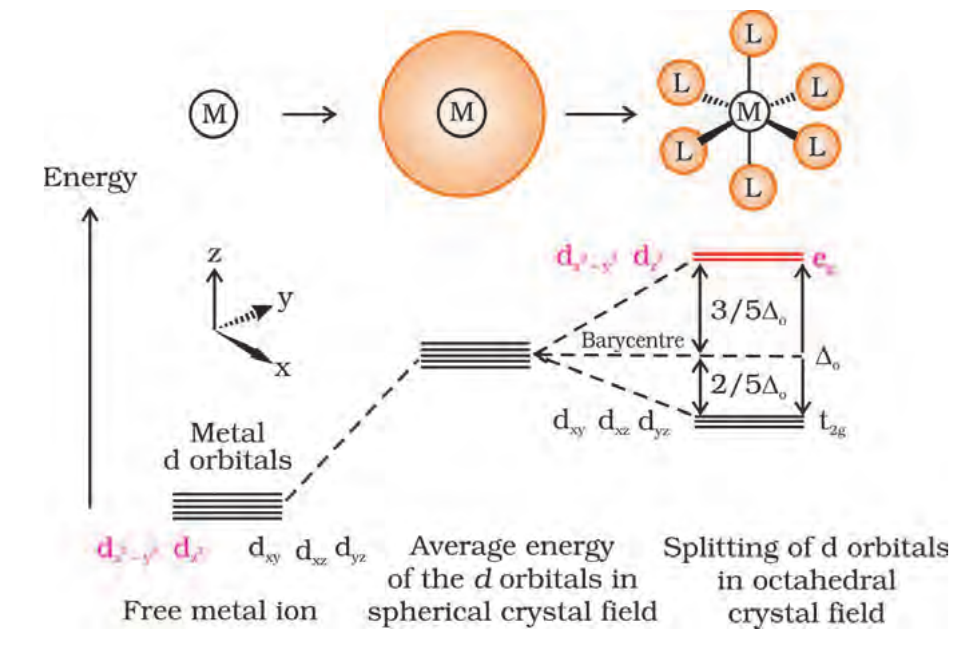
- The five d orbitals in an isolated gaseous metal atom/ion have the same energy, i.e., they are degenerate. This degeneracy is maintained if a spherically symmetrical field of negative charges surrounds the metal atom/ion. When this negative field is due to ligands in a complex, it becomes asymmetrical and the degeneracy of the d orbitals is lifted, which results in splitting of the d orbitals. The pattern of splitting depends upon the nature of the crystal field.
- In an octahedral coordination entity, the dx2-y2 and dz2 orbitals point towards the axes along the direction of the ligand, so they experience more repulsion and are raised in energy. The dxy, dyz and dxz orbitals are directed between the axes and are lowered in energy relative to the average energy in the spherical crystal field. The degeneracy is removed to yield three orbitals of lower energy, the t2g set, and two orbitals of higher energy, the eg set.
- This splitting of the degenerate levels due to the presence of ligands in a definite geometry is termed crystal field splitting, and the energy separation is denoted by Δo (the subscript o is for octahedral) (Fig. 5.8). The energy of the two eg orbitals increases by (3/5)Δo and that of the three t2g orbitals decreases by (2/5)Δo.
- The crystal field splitting, Δo, depends upon the field produced by the ligand and the charge on the metal ion. Some ligands produce strong fields with large splitting, while others produce weak fields with small splitting.
- The spectrochemical series, in order of increasing field strength: $I^-$ < $Br^-$ < $SCN^-$ < $Cl^-$ < $S^{2-}$ < $F^-$ < $OH^-$ < $C_2O_4^{2-}$ < $H_2O$ < $NCS^-$ < edta^4- < $NH_3$ < en < $CN^-$ < $CO$. It is an experimentally determined series based on the absorption of light by complexes with different ligands.
- Assigning electrons in octahedral entities: the single d electron occupies one of the lower energy t2g orbitals. In d2 and d3 entities, the d electrons occupy the t2g orbitals singly in accordance with Hund's rule. For d4 ions, two patterns arise: (i) if Δo < P, the fourth electron enters one of the eg orbitals, giving the configuration t2g3 eg1. Ligands for which Δo < P are known as weak field ligands and form high spin complexes. (ii) If Δo > P, the fourth electron occupies a t2g orbital, giving t2g4 eg0. Ligands which produce this effect are known as strong field ligands and form low spin complexes. P is the pairing energy, the energy required for electron pairing in a single orbital.
- Calculations show that d4 to d7 coordination entities are more stable for strong field as compared to weak field cases.
Suggest an edit
Tetrahedral splitting and colour in coordination compounds
- In tetrahedral coordination entity formation, the d orbital splitting (NCERT Fig. 5.9) is inverted and is smaller as compared to the octahedral field splitting. For the same metal, the same ligands and metal-ligand distances, Δt = (4/9)Δo. The orbital splitting energies are not large enough for forcing pairing, and therefore low spin configurations are rarely observed.
- The 'g' subscript is used for the octahedral and square planar complexes which have a centre of symmetry. Since tetrahedral complexes lack symmetry, the 'g' subscript is not used with their energy levels.
- Colour in coordination compounds (5.5.5): one of the most distinctive properties of transition metal complexes is their wide range of colours. Some of the visible spectrum is removed from white light as it passes through the sample, so the light that emerges is no longer white. The colour of the complex is complementary to that which is absorbed. If green light is absorbed by the complex, it appears red.
- Table 5.3, wavelength absorbed and colour observed: [CoCl($NH_3$)5]2+ absorbs 535 nm (yellow) and appears violet; [Co($NH_3$)5($H_2O$)]3+ absorbs 500 nm (blue green) and appears red; [Co($NH_3$)6]3+ absorbs 475 nm (blue) and appears yellow orange; [Co(CN)6]3- absorbs 310 nm (ultraviolet) and appears pale yellow; [Cu($H_2O$)4]2+ absorbs 600 nm (red) and appears blue; [Ti($H_2O$)6]3+ absorbs 498 nm (blue green) and appears violet.
- CFT attributes colour to d-d transition of the electron. In [Ti($H_2O$)6]3+, which is violet, the single electron ($Ti^{3+}$ is a 3d1 system) is in the t2g level in the ground state. If light corresponding to the energy of the blue-green region is absorbed, it excites the electron from the t2g level to the eg level (t2g1 eg0 to t2g0 eg1). The complex then appears violet (NCERT Fig. 5.10).
- In the absence of ligand, crystal field splitting does not occur and hence the substance is colourless. Removal of water from [Ti($H_2O$)6]Cl3 on heating renders it colourless. Similarly, anhydrous $CuSO_4$ is white, but $CuSO_4$.5H2O is blue.
- The influence of the ligand on colour: [Ni($H_2O$)6]2+ is green. Adding en in molar ratios en:Ni of 1:1, 2:1 and 3:1 gives [Ni($H_2O$)4(en)]2+ (pale blue), [Ni($H_2O$)2(en)2]2+ (blue/purple) and [Ni(en)3]2+ (violet). This sequence is shown in NCERT Fig. 5.11.
- Colour of some gem stones: ruby is aluminium oxide ($Al_2O_3$) containing about 0.5-1% $Cr^{3+}$ ions (d3), randomly distributed in positions normally occupied by $Al^{3+}$. These chromium(III) species act as octahedral chromium(III) complexes in the alumina lattice; d-d transitions at these centres give the colour. In emerald, $Cr^{3+}$ ions occupy octahedral sites in the mineral beryl ($Be_3Al_2Si_6O_{18}$). The absorption bands shift to longer wavelength, namely yellow-red and blue, causing emerald to transmit light in the green region (NCERT Fig. 5.12).
- Limitations of CFT (5.5.6): from the assumption that ligands are point charges, it follows that anionic ligands should exert the greatest splitting effect, but anionic ligands are actually found at the low end of the spectrochemical series. Further, CFT does not take into account the covalent character of bonding between the ligand and the central atom. These weaknesses are explained by ligand field theory (LFT) and molecular orbital theory, which are beyond the scope of the present study.
Suggest an edit
Practice1 question
Try it now. A wrong answer costs nothing here, try again until you get it.
How is the tetrahedral crystal field splitting energy Δt related to the octahedral splitting energy Δo?
NCERT 5.5.4(b): for the same metal, the same ligands and metal-ligand distances, Δt = (4/9)Δo. The tetrahedral splitting is inverted and smaller, so low spin configurations are rarely observed.
Bonding in metal carbonyls and importance of coordination compounds
- Bonding in metal carbonyls (5.6): homoleptic carbonyls (compounds containing carbonyl ligands only) are formed by most of the transition metals. Tetracarbonylnickel(0), Ni($CO$)4, is tetrahedral; pentacarbonyliron(0), Fe($CO$)5, is trigonal bipyramidal; hexacarbonylchromium(0), Cr($CO$)6, is octahedral.
- Decacarbonyldimanganese(0), [Mn2($CO$)10], is made up of two square pyramidal Mn($CO$)5 units joined by a Mn-Mn bond. Octacarbonyldicobalt(0), [Co2($CO$)8], has a Co-Co bond bridged by two $CO$ groups (NCERT Fig. 5.13).
- The metal-carbon bond in metal carbonyls possesses both sigma and pi character. The M-C sigma bond is formed by the donation of the lone pair of electrons on the carbonyl carbon into a vacant orbital of the metal. The M-C pi bond is formed by the donation of a pair of electrons from a filled d orbital of metal into the vacant antibonding pi* orbital of carbon monoxide. The metal to ligand bonding creates a synergic effect which strengthens the bond between $CO$ and the metal (NCERT Fig. 5.14).
- Importance and applications (5.7): coordination compounds are widely present in the mineral, plant and animal worlds and play many important functions in analytical chemistry, metallurgy, biological systems, industry and medicine.
- Analysis: colour reactions of metal ions with ligands (especially chelating ligands) form the basis for detection and estimation. Reagents include EDTA, DMG (dimethylglyoxime), alpha-nitroso-beta-naphthol and cupron. Hardness of water is estimated by titration with Na2EDTA: $Ca^{2+}$ and $Mg^{2+}$ ions form stable complexes with EDTA.
- Metallurgy: gold combines with cyanide in the presence of oxygen and water to form [Au(CN)2]- in aqueous solution, and gold is separated in metallic form by adding zinc. Impure nickel is converted to [Ni($CO$)4], which is decomposed to yield pure nickel.
- Biological systems: chlorophyll is a coordination compound of magnesium; haemoglobin, the red pigment of blood which acts as oxygen carrier, is a coordination compound of iron; vitamin B12, cyanocobalamine, the anti-pernicious anaemia factor, is a coordination compound of cobalt. Enzymes like carboxypeptidase A and carbonic anhydrase contain coordinated metal ions.
- Industry and medicine: the rhodium complex [(Ph3P)3RhCl], a Wilkinson catalyst, is used for the hydrogenation of alkenes. Articles are electroplated with silver and gold from solutions of [Ag(CN)2]- and [Au(CN)2]-. In black and white photography, the developed film is fixed by washing with hypo solution, which dissolves undecomposed AgBr to form [Ag($S_2O_3$)2]3-. In chelate therapy, excess copper and iron are removed by D-penicillamine and desferrioxime B; EDTA is used in the treatment of lead poisoning; cis-platin and related compounds inhibit the growth of tumours.
Suggest an edit
Ladder: inner orbital versus outer orbital complexes
- Inner orbital complexes use inner (n-1)d orbitals in hybridisation (d2sp3), are low spin and spin paired. Outer orbital complexes use outer nd orbitals (sp3d2), are high spin and spin free.
- [Co($NH_3$)6]3+ is inner orbital, d2sp3, low spin, diamagnetic with 0 unpaired electrons. [$CoF_6$]3- is outer orbital, sp3d2, high spin, paramagnetic with 4 unpaired electrons.
- [Fe(CN)6]3- is inner orbital, d2sp3, with 1 unpaired electron (weakly paramagnetic). [$FeF_6$]3- is outer orbital, sp3d2, with 5 unpaired electrons (strongly paramagnetic).
- [Mn(CN)6]3- is inner orbital, d2sp3, with 2 unpaired electrons. [$MnCl_6$]3- is outer orbital, sp3d2, with 4 unpaired electrons.
- [Co($C_2O_4$)3]3- is inner orbital, d2sp3, and diamagnetic.
- How to use the ladder in a question: first count the unpaired electrons from the magnetic data, then match it to the complex (e.g. [$CoF_6$]3- has 4 unpaired electrons, outer orbital, sp3d2; [Co($C_2O_4$)3]3- has 0, inner orbital, d2sp3). Do NOT use the ligand alone to decide inner vs outer orbital: $C_2O_4^{2-}$ is below $H_2O$ in the spectrochemical series (a weak-field ligand), so [Co($C_2O_4$)3]3- is inner orbital because of the high charge and large crystal field splitting of $Co^{3+}$ (NCERT 5.5.4), not because oxalate is a strong-field ligand.
- Do not assume the ligand alone decides it: [Ni($NH_3$)6]2+ is an outer orbital complex (sp3d2) because $Ni^{2+}$ is d8 and has no vacant pair of 3d orbitals to pair into, even though $NH_3$ pairs the electrons in [Co($NH_3$)6]3+.
Suggest an edit
Ladder: trap pairs
- Primary vs secondary valence: primary valences are normally ionisable and satisfied by negative ions; secondary valences are non ionisable, equal to the coordination number and fixed for a metal. The AgCl test counts only the primary (counter) chlorides.
- Double salt vs complex: a double salt dissociates into simple ions completely in water (carnallite, Mohr's salt, potash alum). A complex ion such as [Fe(CN)6]4- does not dissociate into Fe and CN ions.
- Coordination number counts donor atoms, not ligands: [Fe($C_2O_4$)3]3- has coordination number 6, not 3, because each oxalate is didentate. Only sigma bonds count; pi bonds are not counted.
- Geometrical isomerism: square planar [MX2L2] and octahedral [MX2L4] show cis-trans isomerism, but tetrahedral complexes never show geometrical isomerism.
- IUPAC names: the metal in a complex cation keeps the element name (cobalt), while in a complex anion it ends in -ate (cobaltate, ferrate for Fe). Anionic ligands end in -o or -ido (chlorido). The cation is named first.
- Inner vs outer orbital: [Co($NH_3$)6]3+ is inner orbital and diamagnetic, [$CoF_6$]3- is outer orbital with 4 unpaired electrons. The same metal with different ligands gives different magnetic behaviour.
- Colour: the colour observed is complementary to the colour absorbed. [Ti($H_2O$)6]3+ absorbs blue-green light (498 nm) and appears violet. Do not name the absorbed colour as the observed colour.
- High spin vs low spin: for d4 to d7 ions, Δo < P gives high spin (fourth electron enters eg) and Δo > P gives low spin (fourth electron pairs in t2g). The decision is a comparison of two energies, not a property of the metal alone.
- Tetrahedral splitting: Δt = (4/9)Δo, inverted and smaller than Δo, so low spin tetrahedral complexes are rarely observed. The 'g' subscript is not used for tetrahedral levels.
Suggest an edit
Trap Boxes
$CN^-$ is a weak field ligand at the bottom of the spectrochemical series?
Wrong idea: $CN^-$ is a weak field ligand, so the order of increasing field strength starts with $CN^-$ and ends with $F^-$.
The spectrochemical series is $I^-$ < $Br^-$ < $SCN^-$ < $Cl^-$ < $S^{2-}$ < $F^-$ < $OH^-$ < $C_2O_4^{2-}$ < $H_2O$ < $NCS^-$ < edta^4- < $NH_3$ < en < $CN^-$ < $CO$. $CN^-$ is a strong field ligand near the top of the series, and $F^-$ sits below $C_2O_4^{2-}$. NEET 2020 Q98 tests exactly this order.
NCERT XII, Ch 5, 5.5.4
EDTA is tridentate with three nitrogen donor atoms?
Wrong idea: EDTA is a tridentate ligand with three N donor atoms.
EDTA4- is a hexadentate ligand that binds through two nitrogen and four oxygen atoms, six donor atoms in all. NEET 2021 Q77 tests this: the correct option is the hexadentate ligand with four O and two N donor atoms.
NCERT XII, Ch 5, 5.2
A complex with two different ligands is homoleptic?
Wrong idea: Diamminechloridonitrito-N-platinum(II) is homoleptic because it has only one metal centre.
Homoleptic means the metal is bound to only one kind of donor group. Only potassium trioxalatoaluminate(III), K3[Al($C_2O_4$)3], has a single ligand type (oxalate). The other three mix ammine with chlorido, nitrito, carbonato or aqua ligands, so they are heteroleptic. NEET 2023 Q61 tests this.
NCERT XII, Ch 5, 5.2
A complex appears the colour it absorbs?
Wrong idea: The complex [Ti($H_2O$)6]3+ appears blue-green because it absorbs blue-green light, and adding en lowers the energy absorbed.
The colour observed is complementary to the colour absorbed. [Ti($H_2O$)6]3+ absorbs blue-green light (498 nm) and appears violet. Replacing $H_2O$ by en raises the field strength and the energy absorbed: [Ni(en)3]2+ > [Ni($H_2O$)2(en)2]2+ > [Ni($H_2O$)4(en)]2+. NEET 2022 Q98 tests this order.
NCERT XII, Ch 5, 5.5.5
The metal name is the same in a complex cation and a complex anion?
Wrong idea: The anion part of [Ag($H_2O$)2][Ag(CN)2] is named dicyanidosilver(I), the same way as the cation part.
The metal in a complex cation keeps the element name (cobalt), while in a complex anion it ends in -ate (cobaltate, ferrate for Fe). In [Ag($H_2O$)2][Ag(CN)2] the name is diaquasilver(I) dicyanidoargentate(I): the cation is named first and silver is +1 in both parts. NEET 2022 Q83 tests this.
NCERT XII, Ch 5, 5.3.2
Chapter test
5 NEET PYQs. +4 for a correct answer, -1 for a wrong answer, exactly like NEET. Finish the test to earn a medal.
Q1: NEET (UG) 2023, Code F1, Q61
Homoleptic complex from the following complexes is
NCERT 5.2(h): homoleptic means the metal is bound to only one kind of donor group. Only potassium trioxalatoaluminate(III), K3[Al($C_2O_4$)3], has a single ligand type, oxalate.
Q2: NEET (UG) 2022, Code R1, Q98
The order of energy absorbed which is responsible for the color of complexes (A) [Ni($H_2O$)2(en)2]2+ (B) [Ni($H_2O$)4(en)]2+ and (C) [Ni(en)3]2+ is
NCERT 5.5.5, Fig. 5.11: replacing $H_2O$ by en raises the field strength and the energy absorbed, so [Ni(en)3]2+ (C) > [Ni($H_2O$)2(en)2]2+ (A) > [Ni($H_2O$)4(en)]2+ (B).
Q3: NEET (UG) 2022, Code R1, Q83
The IUPAC name of the complex [Ag($H_2O$)2][Ag(CN)2] is:
NCERT 5.3.2 example 3 names [Ag($NH_3$)2][Ag(CN)2] as diamminesilver(I) dicyanidoargentate(I). With $H_2O$ in place of $NH_3$ the cation part is diaquasilver(I) and the anion part is dicyanidoargentate(I).
Q4: NEET (UG) 2021, Code P3, Q77
Ethylene diaminetetraacetate (EDTA) ion is :
NCERT 5.2(c): EDTA4- is an important hexadentate ligand. It can bind through two nitrogen and four oxygen atoms to a central metal ion.
Q5: NEET (UG) 2020, Code G5, Q98
Which of the following is the correct order of increasing field strength of ligands to form coordination compounds ?
NCERT 5.5.4 gives the spectrochemical series: $I^-$ < $Br^-$ < $SCN^-$ < $Cl^-$ < $S^{2-}$ < $F^-$ < $OH^-$ < $C_2O_4^{2-}$ < $H_2O$ < $NCS^-$ < edta^4- < $NH_3$ < en < $CN^-$ < $CO$. So $SCN^-$ < $F^-$ < $C_2O_4^{2-}$ < $CN^-$.
Score: 0 · Answered 0 of 5
Flashcards
Tap a card to flip it over and see the answer. Tap it again to flip it back.
How does the AgCl test fix the formulation of the cobalt(III) chloride-ammonia complexes in Table 5.1?
Tap to flipCount the moles of AgCl precipitated per mole of complex: 3 mol means all three chlorides are counter ions, [Co($NH_3$)6]Cl3. 2 mol means one chloride is inside the sphere, [CoCl($NH_3$)5]$Cl_2$. 1 mol means two chlorides are inside, [$CoCl_2$($NH_3$)4]Cl. The moles of AgCl equal the number of ionisable chloride ions.
Tap to flip backWrite the spectrochemical series in order of increasing field strength.
Tap to flip$I^-$ < $Br^-$ < $SCN^-$ < $Cl^-$ < $S^{2-}$ < $F^-$ < $OH^-$ < $C_2O_4^{2-}$ < $H_2O$ < $NCS^-$ < edta^4- < $NH_3$ < en < $CN^-$ < $CO$. It is an experimentally determined series based on the absorption of light by complexes with different ligands.
Tap to flip backBy how much do the eg and t2g sets shift from the barycentre in an octahedral field, and how is Δt related to Δo?
Tap to flipIn an octahedral field the two eg orbitals rise by (3/5)Δo and the three t2g orbitals fall by (2/5)Δo from the barycentre. In a tetrahedral field the splitting is inverted and smaller: Δt = (4/9)Δo.
Tap to flip backOrder the energy absorbed for (A) [Ni($H_2O$)2(en)2]2+, (B) [Ni($H_2O$)4(en)]2+ and (C) [Ni(en)3]2+.
Tap to flip(C) > (A) > (B). Replacing $H_2O$ by en raises the field strength, so the energy absorbed rises: [Ni(en)3]2+ absorbs the most, then [Ni($H_2O$)2(en)2]2+, then [Ni($H_2O$)4(en)]2+.
Tap to flip backOrder [Co(CN)6]3-, [Co($NH_3$)6]3+ and [Cu($H_2O$)4]2+ by the wavelength of light absorbed.
Tap to flip[Co(CN)6]3- absorbs at 310 nm, [Co($NH_3$)6]3+ at 475 nm and [Cu($H_2O$)4]2+ at 600 nm. So the order of wavelength absorbed is [Co(CN)6]3- < [Co($NH_3$)6]3+ < [Cu($H_2O$)4]2+.
Tap to flip backWhat is the spin only magnetic moment of [$MnBr_4$]2-, and what geometry does it prove?
Tap to flip5.9 BM. Five unpaired electrons mean a tetrahedral shape (sp3 hybridisation) rather than square planar (dsp2), which would have paired the electrons.
Tap to flip backWhat gives ruby and emerald their colours, and how much $Cr^{3+}$ does ruby contain?
Tap to flipRuby is aluminium oxide ($Al_2O_3$) containing about 0.5-1% $Cr^{3+}$ ions in octahedral sites. Emerald is beryl ($Be_3Al_2Si_6O_{18}$) with $Cr^{3+}$ in octahedral sites; its absorption bands shift to longer wavelength, so it transmits green light.
Tap to flip backHow does a double salt differ from a complex in water?
Tap to flipDouble salts such as carnallite ($KCl$.$MgCl_2$.6H2O), Mohr's salt ($FeSO_4$.($NH_4$)2SO4.6H2O) and potash alum (KAl($SO_4$)2.12H2O) dissociate into simple ions completely in water. Complex ions such as [Fe(CN)6]4- of K4[Fe(CN)6] do not dissociate into Fe and CN ions.
Tap to flip backWhy is [Fe(CN)6]3- weakly paramagnetic while [$FeF_6$]3- is strongly paramagnetic?
Tap to flip[Fe(CN)6]3- has one unpaired electron and is an inner orbital complex (d2sp3); [$FeF_6$]3- has five unpaired electrons and is an outer orbital complex (sp3d2). $CN^-$ is a strong field ligand that pairs the 3d electrons, while $F^-$ is a weak field ligand that does not.
Tap to flip backGive the colour sequence when en is added step by step to [Ni($H_2O$)6]2+.
Tap to flip[Ni($H_2O$)6]2+ (green) + en = [Ni($H_2O$)4(en)]2+ (pale blue) + 2H2O. Adding a second en gives [Ni($H_2O$)2(en)2]2+ (blue/purple). Adding a third en gives [Ni(en)3]2+ (violet). Each replacement of $H_2O$ by en raises the crystal field splitting.
Tap to flip backDescribe the two parts of the metal-carbon bond in a metal carbonyl.
Tap to flipThe M-C sigma bond is formed by donation of the lone pair on the carbonyl carbon into a vacant metal orbital. The M-C pi bond is formed by donation of a pair of electrons from a filled metal d orbital into the vacant antibonding pi* orbital of $CO$. The two donations strengthen each other, a synergic effect.
Tap to flip backClassify the types of isomerism in coordination compounds.
Tap to flipStereoisomerism: (i) geometrical isomerism, (ii) optical isomerism. Structural isomerism: (i) linkage isomerism, (ii) coordination isomerism, (iii) ionisation isomerism, (iv) solvate isomerism. Stereoisomers have the same bonds but different spatial arrangement; structural isomers have different bonds.
Tap to flip back