 NEET Notes
Home > Biology > Ecology > Biodiversity and Conservation
Biodiversity and Conservation
On this page · 20 sections
- 01Syllabus map
- 02What is biodiversity
- 03Three levels of biodiversity
- 04How many species are there on earth
- 05Who makes up the recorded species
- 06India: a mega diversity country
- 07Latitudinal gradients
- 08Why the tropics are so rich
- 09Species-area relationships
- 10Importance of species diversity to the ecosystem
- 11Loss of biodiversity
- 12The Evil Quartet: causes of biodiversity loss
- 13Why should we conserve biodiversity
- 14In situ conservation: hotspots, reserves and sacred groves
- 15Ex situ conservation
- 16Table 1: Key numbers at a glance
- 17Table 2: The species-area relationship
- 18Table 3: In situ vs ex situ conservation
- 19Trap pairs: the confusions NEET tests
- 20Evil Quartet: cause to example ladder
Biodiversity levels, species counts, latitudinal and species-area patterns, the Evil Quartet, and in situ and ex situ conservation, all from NCERT Chapter 13, with the PYQs NEET keeps repeating.
Syllabus map
- NMC Unit: BIO-U10, Ecology and Environment. NCERT Chapter 13, Biodiversity and Conservation (Class XII).
- Subtopics in this chapter (NCERT XII, Ch 13): biodiversity and its three levels; how many species there are on earth and in India; patterns of biodiversity (latitudinal gradients, species-area relationships); importance of species diversity to the ecosystem; loss of biodiversity and the Evil Quartet; why we should conserve biodiversity; in situ and ex situ conservation.
- Subtopic checklist: (1) genetic, species and ecological diversity; (2) Rauwolfia, rice strains and mango varieties; (3) IUCN 1.5 million described species and May's 7 million estimate; (4) animals over 70 per cent, plants 22 per cent, insects over 70 per cent of animals; (5) India 2.4 per cent land, 8.1 per cent species, 12 mega diversity countries; (6) latitudinal gradient examples (Colombia, New York, Greenland); (7) Amazon numbers; (8) three hypotheses for tropical richness; (9) species-area equation and Z ranges; (10) Tilman experiments and the rivet popper hypothesis; (11) IUCN Red List extinction numbers; (12) the Evil Quartet with examples; (13) narrowly utilitarian, broadly utilitarian and ethical reasons; (14) hotspots (34, 3 in India); (15) biosphere reserves, national parks, sanctuaries, sacred groves; (16) ex situ methods and the Rio 1992 and Johannesburg 2002 summits.
- Extra information (beyond NCERT): none.
- Excluded topics: organisms and populations (Chapter 11) and ecosystem (Chapter 12). Do not import their facts into this chapter.
- Estimated revision time: 10 minutes. Jump links: Syllabus Map, Biodiversity, Three Levels, How Many Species, Composition, India, Latitudinal Gradients, Tropics, Species-Area, Importance, Loss, Evil Quartet, Why Conserve, In Situ, Ex Situ, Tables, Trap Boxes, PYQs, Chapter Test.
Suggest an edit
What is biodiversity
If an alien from a distant galaxy were to visit our planet Earth, the first thing that would amaze and baffle him would most probably be the enormous diversity of life that he would encounter. Even for humans, the rich variety of living organisms with which they share this planet never ceases to astonish and fascinate us. The common man would find it hard to believe that there are more than 20,000 species of ants, 3,00,000 species of beetles, 28,000 species of fishes and nearly 20,000 species of orchids.
In our biosphere immense diversity (or heterogeneity) exists not only at the species level but at all levels of biological organisation ranging from macromolecules within cells to biomes. Biodiversity is the term popularised by the sociobiologist Edward Wilson to describe the combined diversity at all the levels of biological organisation. The most important of them are genetic diversity, species diversity and ecological diversity.
It has taken millions of years of evolution to accumulate this rich diversity in nature, but we could lose all that wealth in less than two centuries if the present rates of species losses continue. Biodiversity and its conservation are now vital environmental issues of international concern as more and more people around the world begin to realise the importance of biodiversity for our survival and well-being on this planet.
Suggest an edit
Three levels of biodiversity
Genetic diversity: a single species might show high diversity at the genetic level over its distributional range. The genetic variation shown by the medicinal plant Rauwolfia vomitoria growing in different Himalayan ranges might be in terms of the potency and concentration of the active chemical (reserpine) that the plant produces. India has more than 50,000 genetically different strains of rice, and 1,000 varieties of mango.
Species diversity: the diversity at the species level. For example, the Western Ghats have a greater amphibian species diversity than the Eastern Ghats.
Ecological diversity: at the ecosystem level, India, for instance, with its deserts, rain forests, mangroves, coral reefs, wetlands, estuaries, and alpine meadows has a greater ecosystem diversity than a Scandinavian country like Norway.
NEET tests the examples with the level: Rauwolfia reserpine variation is genetic diversity, Western Ghats vs Eastern Ghats amphibians is species diversity, and India's deserts to alpine meadows vs Norway is ecological diversity.
Suggest an edit
Practice1 question
Try it now. A wrong answer costs nothing here, try again until you get it.
The medicinal plant Rauwolfia vomitoria shows variation in the potency and concentration of reserpine across Himalayan ranges. Which level of biodiversity is this?
NCERT 13.1: genetic diversity is the variation at the genetic level within a single species, such as the variation in potency and concentration of reserpine in Rauwolfia vomitoria growing in different Himalayan ranges.
How many species are there on earth
Since there are published records of all the species discovered and named, we know how many species in all have been recorded so far, but it is not easy to answer the question of how many species there are on earth. According to the International Union for Conservation of Nature and Natural Resources (IUCN) (2004), the total number of plant and animal species described so far is slightly more than 1.5 million, but we have no clear idea of how many species are yet to be discovered and described.
Estimates vary widely and many of them are only educated guesses. For many taxonomic groups, species inventories are more complete in temperate than in tropical countries. Considering that an overwhelmingly large proportion of the species waiting to be discovered are in the tropics, biologists make a statistical comparison of the temperate-tropical species richness of an exhaustively studied group of insects and extrapolate this ratio to other groups of animals and plants to come up with a gross estimate of the total number of species on earth.
Some extreme estimates range from 20 to 50 million, but a more conservative and scientifically sound estimate made by Robert May places the global species diversity at about 7 million.
Suggest an edit
Who makes up the recorded species
More than 70 per cent of all the species recorded are animals, while plants (including algae, fungi, bryophytes, gymnosperms and angiosperms) comprise no more than 22 per cent of the total. Among animals, insects are the most species-rich taxonomic group, making up more than 70 per cent of the total. That means, out of every 10 animals on this planet, 7 are insects.
The number of fungi species in the world is more than the combined total of the species of fishes, amphibians, reptiles and mammals. In NCERT Figure 13.1, biodiversity is depicted showing species number of major taxa.
These estimates do not give any figures for prokaryotes. Biologists are not sure about how many prokaryotic species there might be. The problem is that conventional taxonomic methods are not suitable for identifying microbial species and many species are simply not culturable under laboratory conditions. If we accept biochemical or molecular criteria for delineating species for this group, then their diversity alone might run into millions.
Suggest an edit
India: a mega diversity country
Although India has only 2.4 per cent of the world's land area, its share of the global species diversity is an impressive 8.1 per cent. That is what makes our country one of the 12 mega diversity countries of the world. Nearly 45,000 species of plants and twice as many of animals have been recorded from India.
If we accept May's global estimates, only 22 per cent of the total species have been recorded so far. Applying this proportion to India's diversity figures, we estimate that there are probably more than 1,00,000 plant species and more than 3,00,000 animal species yet to be discovered and described.
Consider the immense trained manpower (taxonomists) and the time required to complete the job. The situation appears more hopeless when we realise that a large fraction of these species faces the threat of becoming extinct even before we discover them. Nature's biological library is burning even before we catalogued the titles of all the books stocked there.
Suggest an edit
Latitudinal gradients
The diversity of plants and animals is not uniform throughout the world but shows a rather uneven distribution. For many groups of animals or plants, there are interesting patterns in diversity, the most well-known being the latitudinal gradient in diversity. In general, species diversity decreases as we move away from the equator towards the poles. With very few exceptions, tropics (latitudinal range of 23.5 degrees N to 23.5 degrees S) harbour more species than temperate or polar areas.
Colombia located near the equator has nearly 1,400 species of birds while New York at 41 degrees N has 105 species and Greenland at 71 degrees N only 56 species. India, with much of its land area in the tropical latitudes, has more than 1,200 species of birds. A forest in a tropical region like Ecuador has up to 10 times as many species of vascular plants as a forest of equal area in a temperate region like the Midwest of the USA.
The largely tropical Amazonian rain forest in South America has the greatest biodiversity on earth. It is home to more than 40,000 species of plants, 3,000 of fishes, 1,300 of birds, 427 of mammals, 427 of amphibians, 378 of reptiles and of more than 1,25,000 invertebrates. Scientists estimate that in these rain forests there might be at least two million insect species waiting to be discovered and named.
Suggest an edit
Why the tropics are so rich
What is so special about tropics that might account for their greater biological diversity? Ecologists and evolutionary biologists have proposed various hypotheses; some important ones are:
(a) Speciation is generally a function of time, unlike temperate regions subjected to frequent glaciations in the past, tropical latitudes have remained relatively undisturbed for millions of years and thus, had a long evolutionary time for species diversification.
(b) Tropical environments, unlike temperate ones, are less seasonal, relatively more constant and predictable. Such constant environments promote niche specialisation and lead to a greater species diversity.
(c) There is more solar energy available in the tropics, which contributes to higher productivity; this in turn might contribute indirectly to greater diversity.
NEET 2024 asked exactly these three points and used 'more seasonal' as the wrong option: tropical environments are less seasonal, not more.
Suggest an edit
Species-area relationships
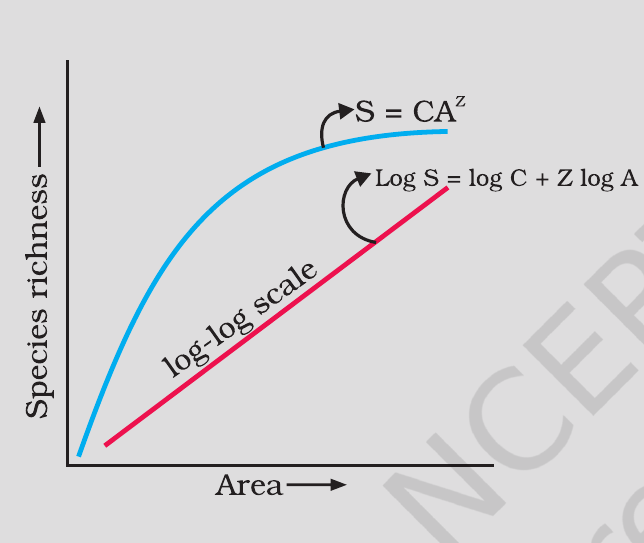
During his pioneering and extensive explorations in the wilderness of South American jungles, the great German naturalist and geographer Alexander von Humboldt observed that within a region species richness increased with increasing explored area, but only up to a limit. In fact, the relation between species richness and area for a wide variety of taxa (angiosperm plants, birds, bats, freshwater fishes) turns out to be a rectangular hyperbola (Figure 13.2). On a logarithmic scale, the relationship is a straight line described by the equation log S = log C + Z log A, where S is species richness, A is area, Z is the slope of the line (regression coefficient) and C is the Y-intercept.
Ecologists have discovered that the value of Z lies in the range of 0.1 to 0.2, regardless of the taxonomic group or the region (whether it is the plants in Britain, birds in California or molluscs in New York state, the slopes of the regression line are amazingly similar).
But, if you analyse the species-area relationships among very large areas like the entire continents, you will find that the slope of the line to be much steeper (Z values in the range of 0.6 to 1.2). For example, for frugivorous (fruit-eating) birds and mammals in the tropical forests of different continents, the slope is found to be 1.15.
Suggest an edit
Practice1 question
Try it now. A wrong answer costs nothing here, try again until you get it.
In the species-area relationship log S = log C + Z log A, what is the usual range of the slope Z?
NCERT 13.1.2: ecologists have discovered that the value of Z lies in the range of 0.1 to 0.2, regardless of the taxonomic group or the region.
Importance of species diversity to the ecosystem
Does the number of species in a community really matter to the functioning of the ecosystem? For many decades, ecologists believed that communities with more species, generally, tend to be more stable than those with less species. What exactly is stability for a biological community? A stable community should not show too much variation in productivity from year to year; it must be either resistant or resilient to occasional disturbances (natural or man-made), and it must also be resistant to invasions by alien species.
David Tilman's long-term ecosystem experiments using outdoor plots provide some tentative answers. Tilman found that plots with more species showed less year-to-year variation in total biomass. He also showed that in his experiments, increased diversity contributed to higher productivity.
We can develop a proper perspective through an analogy (the 'rivet popper hypothesis') used by Stanford ecologist Paul Ehrlich. In an airplane (ecosystem) all parts are joined together using thousands of rivets (species). If every passenger travelling in it starts popping a rivet to take home (causing a species to become extinct), it may not affect flight safety (proper functioning of the ecosystem) initially, but as more and more rivets are removed, the plane becomes dangerously weak over a period of time. Furthermore, which rivet is removed may also be critical. Loss of rivets on the wings (key species that drive major ecosystem functions) is obviously a more serious threat to flight safety than loss of a few rivets on the seats or windows inside the plane.
Suggest an edit
Loss of biodiversity
The colonisation of tropical Pacific Islands by humans is said to have led to the extinction of more than 2,000 species of native birds. The IUCN Red List (2004) documents the extinction of 784 species (including 338 vertebrates, 359 invertebrates and 87 plants) in the last 500 years. Some examples of recent extinctions include the dodo (Mauritius), quagga (Africa), thylacine (Australia), Steller's Sea Cow (Russia) and three subspecies (Bali, Javan, Caspian) of tiger. The last twenty years alone have witnessed the disappearance of 27 species.
Careful analysis of records shows that extinctions across taxa are not random; some groups like amphibians appear to be more vulnerable to extinction. More than 15,500 species world-wide are facing the threat of extinction. Presently, 12 per cent of all bird species, 23 per cent of all mammal species, 32 per cent of all amphibian species and 31 per cent of all gymnosperm species in the world face the threat of extinction.
From a study of the history of life on earth through fossil records, we learn that large-scale loss of species like the one we are currently witnessing have also happened earlier, even before humans appeared on the scene. During the long period (more than 3 billion years) since the origin and diversification of life on earth there were five episodes of mass extinction of species. How is the 'Sixth Extinction' presently in progress different from the previous episodes? The difference is in the rates; the current species extinction rates are estimated to be 100 to 1,000 times faster than in the pre-human times and our activities are responsible for the faster rates. Ecologists warn that if the present trends continue, nearly half of all the species on earth might be wiped out within the next 100 years.
In general, loss of biodiversity in a region may lead to (a) decline in plant production, (b) lowered resistance to environmental perturbations such as drought and (c) increased variability in certain ecosystem processes such as plant productivity, water use, and pest and disease cycles.
Suggest an edit
The Evil Quartet: causes of biodiversity loss
The accelerated rates of species extinctions that the world is facing now are largely due to human activities. There are four major causes ('The Evil Quartet' is the sobriquet used to describe them).
(i) Habitat loss and fragmentation: this is the most important cause driving animals and plants to extinction. The most dramatic examples of habitat loss come from tropical rain forests. Once covering more than 14 per cent of the earth's land surface, these rain forests now cover no more than 6 per cent. They are being destroyed fast. By the time you finish reading this chapter, 1000 more hectares of rain forest would have been lost. The Amazon rain forest (it is so huge that it is called the 'lungs of the planet') harbouring probably millions of species is being cut and cleared for cultivating soya beans or for conversion to grasslands for raising beef cattle. Besides total loss, the degradation of many habitats by pollution also threatens the survival of many species. When large habitats are broken up into small fragments due to various human activities, mammals and birds requiring large territories and certain animals with migratory habits are badly affected, leading to population declines.
(ii) Over-exploitation: humans have always depended on nature for food and shelter, but when 'need' turns to 'greed', it leads to over-exploitation of natural resources. Many species extinctions in the last 500 years (Steller's sea cow, passenger pigeon) were due to overexploitation by humans. Presently many marine fish populations around the world are over harvested, endangering the continued existence of some commercially important species.
(iii) Alien species invasions: when alien species are introduced unintentionally or deliberately for whatever purpose, some of them turn invasive, and cause decline or extinction of indigenous species. The Nile perch introduced into Lake Victoria in east Africa led eventually to the extinction of an ecologically unique assemblage of more than 200 species of cichlid fish in the lake. You must be familiar with the environmental damage caused and threat posed to our native species by invasive weed species like carrot grass (Parthenium), Lantana and water hyacinth (Eichhornia). The recent illegal introduction of the African catfish Clarias gariepinus for aquaculture purposes is posing a threat to the indigenous catfishes in our rivers.
(iv) Co-extinctions: when a species becomes extinct, the plant and animal species associated with it in an obligatory way also become extinct. When a host fish species becomes extinct, its unique assemblage of parasites also meets the same fate. Another example is the case of a coevolved plant-pollinator mutualism where extinction of one invariably leads to the extinction of the other.
Suggest an edit
Practice1 question
Try it now. A wrong answer costs nothing here, try again until you get it.
Among the Evil Quartet, which cause is considered the most important in driving species to extinction?
NCERT 13.1.4: habitat loss and fragmentation is the most important cause driving animals and plants to extinction.
Why should we conserve biodiversity
There are many reasons, some obvious and others not so obvious, but all equally important. They can be grouped into three categories: narrowly utilitarian, broadly utilitarian, and ethical.
The narrowly utilitarian arguments for conserving biodiversity are obvious; humans derive countless direct economic benefits from nature: food (cereals, pulses, fruits), firewood, fibre, construction material, industrial products (tannins, lubricants, dyes, resins, perfumes) and products of medicinal importance. More than 25 per cent of the drugs currently sold in the market worldwide are derived from plants and 25,000 species of plants contribute to the traditional medicines used by native peoples around the world. With increasing resources put into 'bioprospecting' (exploring molecular, genetic and species-level diversity for products of economic importance), nations endowed with rich biodiversity can expect to reap enormous benefits.
The broadly utilitarian argument says that biodiversity plays a major role in many ecosystem services that nature provides. The fast-dwindling Amazon forest is estimated to produce, through photosynthesis, 20 per cent of the total oxygen in the earth's atmosphere. Pollination (without which plants cannot give us fruits or seeds) is another service, ecosystems provide through pollinators layer: bees, bumblebees, birds and bats. There are other intangible benefits that we derive from nature: the aesthetic pleasures of walking through thick woods, watching spring flowers in full bloom or waking up to a bulbul's song in the morning.
The ethical argument for conserving biodiversity relates to what we owe to millions of plant, animal and microbe species with whom we share this planet. Philosophically or spiritually, we need to realise that every species has an intrinsic value, even if it may not be of current or any economic value to us. We have a moral duty to care for their well-being and pass on our biological legacy in good order to future generations.
Suggest an edit
In situ conservation: hotspots, reserves and sacred groves
When we conserve and protect the whole ecosystem, its biodiversity at all levels is protected: we save the entire forest to save the tiger. This approach is called in situ (on site) conservation.
Faced with the conflict between development and conservation, many nations find it unrealistic and economically not feasible to conserve all their biological wealth. On a global basis, this problem has been addressed by eminent conservationists. They identified for maximum protection certain 'biodiversity hotspots': regions with very high levels of species richness and high degree of endemism (that is, species confined to that region and not found anywhere else). Initially 25 biodiversity hotspots were identified but subsequently nine more have been added to the list, bringing the total number of biodiversity hotspots in the world to 34. These hotspots are also regions of accelerated habitat loss. Three of these hotspots: Western Ghats and Sri Lanka, Indo-Burma and Himalaya, cover our country's exceptionally high biodiversity regions. Although all the biodiversity hotspots put together cover less than 2 per cent of the earth's land area, the number of species they collectively harbour is extremely high and strict protection of these hotspots could reduce the ongoing mass extinctions by almost 30 per cent.
In India, ecologically unique and biodiversity-rich regions are legally protected as biosphere reserves, national parks and sanctuaries. India now has 14 biosphere reserves, 90 national parks and 448 wildlife sanctuaries.
India has also a history of religious and cultural traditions that emphasised protection of nature. In many cultures, tracts of forest were set aside, and all the trees and wildlife within were venerated and given total protection. Such sacred groves are found in Khasi and Jaintia Hills in Meghalaya, Aravalli Hills of Rajasthan, Western Ghats regions of Karnataka and Maharashtra and the Sarguja, Chanda and Bastar areas of Madhya Pradesh. In Meghalaya, the sacred groves are the last refuges for a large number of rare and threatened plants.
Suggest an edit
Practice1 question
Try it now. A wrong answer costs nothing here, try again until you get it.
Which of the following is an example of in situ conservation?
NCERT 13.2.2: in situ conservation protects the whole ecosystem in its natural habitat, such as biosphere reserves, national parks and sanctuaries. Zoological parks and botanical gardens are ex situ.
Ex situ conservation
When there are situations where an animal or plant is endangered or threatened (organisms facing a very high risk of extinction in the wild in the near future) and needs urgent measures to save it from extinction, ex situ (off site) conservation is the desirable approach.
In this approach, threatened animals and plants are taken out from their natural habitat and placed in special setting where they can be protected and given special care. Zoological parks, botanical gardens and wildlife safari parks serve this purpose. There are many animals that have become extinct in the wild but continue to be maintained in zoological parks.
In recent years ex situ conservation has advanced beyond keeping threatened species in enclosures. Now gametes of threatened species can be preserved in viable and fertile condition for long periods using cryopreservation techniques, eggs can be fertilised in vitro, and plants can be propagated using tissue culture methods. Seeds of different genetic strains of commercially important plants can be kept for long periods in seed banks.
Biodiversity knows no political boundaries and its conservation is therefore a collective responsibility of all nations. The historic Convention on Biological Diversity ('The Earth Summit') held in Rio de Janeiro in 1992, called upon all nations to take appropriate measures for conservation of biodiversity and sustainable utilisation of its benefits. In a follow-up, the World Summit on Sustainable Development held in 2002 in Johannesburg, South Africa, 190 countries pledged their commitment to achieve by 2010, a significant reduction in the current rate of biodiversity loss at global, regional and local levels.
Suggest an edit
Table 1: Key numbers at a glance
| Number | What it is |
|---|---|
| Slightly more than 1.5 million | Plant and animal species described so far (IUCN 2004) |
| About 7 million | Robert May's estimate of global species diversity |
| 20 to 50 million | Extreme estimates of global species diversity |
| More than 70 per cent | Share of recorded species that are animals |
| No more than 22 per cent | Share of recorded species that are plants |
| More than 70 per cent | Share of animals that are insects (7 of every 10 animals) |
| 2.4 per cent | India's share of the world's land area |
| 8.1 per cent | India's share of global species diversity |
| 45,000 | Plant species recorded from India |
| 90,000 (twice as many as plants) | Animal species recorded from India |
| More than 1,00,000 plants and 3,00,000 animals | Species in India yet to be discovered and described |
| 20 per cent | Share of the earth's atmospheric oxygen produced by the Amazon forest through photosynthesis |
| More than 25 per cent | Share of drugs sold worldwide derived from plants |
| 25,000 | Plant species contributing to traditional medicines |
Source: NCERT XII, Ch 13, 13.1.1 and 13.2.1.
Suggest an edit
Practice1 question
Try it now. A wrong answer costs nothing here, try again until you get it.
How many of the world's biodiversity hotspots cover India?
NCERT 13.2.2: three hotspots cover India's exceptionally high biodiversity regions: Western Ghats and Sri Lanka, Indo-Burma and Himalaya.
Table 2: The species-area relationship
| Item | Value |
|---|---|
| Equation (rectangular hyperbola) | S = CA raised to Z |
| Equation (log scale, straight line) | log S = log C + Z log A |
| S | Species richness |
| A | Area |
| Z | Slope of the line (regression coefficient) |
| C | Y-intercept |
| Usual Z range | 0.1 to 0.2, for most taxa and regions |
| Z for very large areas (continents) | 0.6 to 1.2 |
| Z for frugivorous birds and mammals in tropical forests of different continents | 1.15 |
| Who observed it | Alexander von Humboldt, in South American jungles |
| Taxa it holds for | Angiosperm plants, birds, bats, freshwater fishes |
Source: NCERT XII, Ch 13, 13.1.2.
Suggest an edit
Table 3: In situ vs ex situ conservation
| Feature | In situ conservation | Ex situ conservation |
|---|---|---|
| Meaning | On site: protect the whole ecosystem in its natural habitat | Off site: take the organism out of its natural habitat into special care |
| What is saved | The entire forest to save the tiger; biodiversity at all levels | The threatened animal or plant itself |
| Examples | Biosphere reserves, national parks, sanctuaries, sacred groves, biodiversity hotspots | Zoological parks, botanical gardens, wildlife safari parks, seed banks |
| India numbers | 14 biosphere reserves, 90 national parks, 448 wildlife sanctuaries | Gametes kept by cryopreservation, eggs fertilised in vitro, plants by tissue culture |
| When used | The general approach, wherever the ecosystem can be protected | When a species is endangered or threatened and needs urgent measures |
Source: NCERT XII, Ch 13, 13.2.2.
Suggest an edit
Trap pairs: the confusions NEET tests
- Genetic vs species vs ecological diversity: Rauwolfia reserpine variation across Himalayan ranges is genetic diversity; Western Ghats having greater amphibian diversity than Eastern Ghats is species diversity; India having deserts, rain forests, mangroves, coral reefs, wetlands, estuaries and alpine meadows is ecological diversity.
- Animals vs insects: more than 70 per cent of all recorded species are animals, and insects are more than 70 per cent of animals. Insects are not 70 per cent of all species; out of every 10 animals, 7 are insects.
- Z 0.1 to 0.2 vs Z 0.6 to 1.2: the slope is 0.1 to 0.2 for ordinary regions and groups; it is 0.6 to 1.2 only when very large areas like entire continents are analysed.
- In situ vs ex situ: national parks, biosphere reserves, sanctuaries, sacred groves and hotspots are in situ; zoological parks, botanical gardens, safari parks, cryopreservation, in vitro fertilisation, tissue culture and seed banks are ex situ.
- Hotspots: 34 hotspots in the world, only 3 cover India (Western Ghats and Sri Lanka, Indo-Burma, Himalaya). All hotspots together cover less than 2 per cent of the earth's land area.
- Habitat loss is the most important Evil Quartet cause, not alien species invasion or over-exploitation.
- Sacred groves are in situ protection by religious and cultural tradition, not ex situ gardens.
- The Amazon is called the 'lungs of the planet' and produces about 20 per cent of the total oxygen in the earth's atmosphere through photosynthesis; the figure belongs to the Amazon forest, not to all rain forests together.
Suggest an edit
Evil Quartet: cause to example ladder
- Habitat loss and fragmentation: tropical rain forests fell from more than 14 per cent to no more than 6 per cent of the earth's land surface; the Amazon is cut for soya beans and for grasslands to raise beef cattle; fragments hurt mammals and birds needing large territories and animals with migratory habits.
- Over-exploitation: Steller's sea cow and the passenger pigeon were wiped out by overexploitation; many marine fish populations are over harvested today.
- Alien species invasions: Nile perch in Lake Victoria wiped out more than 200 species of cichlid fish; carrot grass (Parthenium), Lantana and water hyacinth (Eichhornia) threaten native species; the African catfish Clarias gariepinus threatens indigenous catfishes in Indian rivers.
- Co-extinctions: when a host fish species becomes extinct, its unique parasites die too; in a coevolved plant-pollinator mutualism, extinction of one leads to extinction of the other.
- Recent extinctions to name with their places: dodo (Mauritius), quagga (Africa), thylacine (Australia), Steller's Sea Cow (Russia), and three tiger subspecies (Bali, Javan, Caspian).
Suggest an edit
Trap Boxes
Z is 0.6 to 1.2 in every species-area relationship?
Wrong idea: The slope Z of the species-area relationship is always 0.6 to 1.2.
Z is 0.1 to 0.2 for ordinary regions and groups. It is 0.6 to 1.2 only when very large areas like entire continents are analysed; for frugivorous birds and mammals it is 1.15.
NCERT XII, Ch 13, 13.1.2
National parks are ex situ conservation?
Wrong idea: National parks are a method of ex situ conservation.
National parks, biosphere reserves and sanctuaries protect the whole ecosystem in its natural habitat, so they are in situ. Zoological parks, botanical gardens, cryopreservation and seed banks are ex situ.
NCERT XII, Ch 13, 13.2.2
Alien species invasion is the most important cause of extinction?
Wrong idea: Alien species invasion is the most important cause driving species to extinction.
Habitat loss and fragmentation is the most important cause driving animals and plants to extinction, ahead of over-exploitation, alien species invasions and co-extinctions.
NCERT XII, Ch 13, 13.1.4
India has 34 biodiversity hotspots?
Wrong idea: India has 34 biodiversity hotspots of its own.
There are 34 hotspots in the world, and only 3 cover India: Western Ghats and Sri Lanka, Indo-Burma and Himalaya. All hotspots together cover less than 2 per cent of the earth's land area.
NCERT XII, Ch 13, 13.2.2
Insects are 70 per cent of all recorded species?
Wrong idea: Insects make up 70 per cent of all the species recorded on earth.
More than 70 per cent of recorded species are animals, and insects are more than 70 per cent of animals. Out of every 10 animals, 7 are insects; plants are no more than 22 per cent of recorded species.
NCERT XII, Ch 13, 13.1.1
Chapter test
5 NEET PYQs. +4 for a correct answer, -1 for a wrong answer, exactly like NEET. Finish the test to earn a medal.
Q1: NEET (UG) 2024, Code R3, Q142
Match List I with List II
| List I | List II |
|---|---|
| A. Robert May | I. Species-Area relationship |
| B. Alexander von Humboldt | II. Long-term ecosystem experiment using outdoor plots |
| C. Paul Ehrlich | III. Global species diversity at about 7 million |
| D. David Tilman | IV. Rivet popper hypothesis |
Robert May placed global species diversity at about 7 million (A-III); Alexander von Humboldt described the species-area relationship (B-I); Paul Ehrlich gave the rivet popper hypothesis (C-IV); David Tilman ran the long-term ecosystem experiments using outdoor plots (D-II).
Q2: NEET (UG) 2024, Code R3, Q113
Tropical regions show the greatest level of species richness because:
A. Tropical latitudes have remained relatively undisturbed for millions of years, hence more time was available for species diversification.
B. Tropical environments are more seasonal.
C. More solar energy is available in tropics.
D. Constant environments promote niche specialization.
E. Tropical environments are constant and predictable.
Choose the correct answer from the options given below:
Tropics stayed undisturbed for millions of years (A), receive more solar energy (C), and are constant and predictable, promoting niche specialisation (D, E). Tropical environments are less seasonal, not more, so B is wrong. The correct set is A, C, D and E.
Q3: NEET (UG) 2024, Code R3, Q104
These are regarded as major causes of biodiversity loss:
A. Over exploitation
B. Co-extinction
C. Mutation
D. Habitat loss and fragmentation
E. Migration
Choose the correct answer from the options given below:
The Evil Quartet causes of biodiversity loss are habitat loss and fragmentation, over-exploitation, alien species invasion and co-extinction. Mutation and migration are not among them, so A, B and D only is correct.
Q4: NEET (UG) 2023, Code F1, Q132
Among 'The Evil Quartet', which one is considered the most important cause driving extinction of species?
NCERT names habitat loss and fragmentation as the most important cause driving animals and plants to extinction, ahead of over-exploitation, alien species invasions and co-extinctions.
Q5: NEET (UG) 2022, Code R1, Q101
Which of the following is not a method of ex situ conservation?
Ex situ conservation takes threatened animals and plants out of their natural habitat into zoos, botanical gardens and similar settings, using cryopreservation, in vitro fertilisation and micropropagation. National parks protect the whole ecosystem in its natural habitat, so they are in situ, not ex situ.
Score: 0 · Answered 0 of 5
Flashcards
Tap a card to flip it over and see the answer. Tap it again to flip it back.
What is Robert May's estimate of the total number of species on earth?
Tap to flipAbout 7 million, the estimate made by Robert May. Extreme estimates range from 20 to 50 million, and slightly more than 1.5 million species have been described so far.
Tap to flip backOf all the species recorded so far, what share are animals and what share are plants?
Tap to flipMore than 70 per cent are animals, while plants (including algae, fungi, bryophytes, gymnosperms and angiosperms) comprise no more than 22 per cent of the total.
Tap to flip backWhat share of all animals are insects?
Tap to flipInsects make up more than 70 per cent of all animals. Out of every 10 animals on this planet, 7 are insects.
Tap to flip backHow does the number of fungi species compare with the combined total of fishes, amphibians, reptiles and mammals?
Tap to flipThe number of fungi species in the world is more than the combined total of the species of fishes, amphibians, reptiles and mammals.
Tap to flip backIndia has what share of the world's land area and what share of global species diversity, and how many plant species are recorded from India?
Tap to flipIndia has only 2.4 per cent of the world's land area but 8.1 per cent of the global species diversity. Nearly 45,000 species of plants and twice as many of animals have been recorded from India.
Tap to flip backGive the species-area relationship equation and what S, A, Z and C stand for.
Tap to fliplog S = log C + Z log A, where S is species richness, A is area, Z is the slope of the line (regression coefficient) and C is the Y-intercept. On a logarithmic scale the relationship is a straight line; on a normal scale it is a rectangular hyperbola, S = CA raised to Z.
Tap to flip backWhat is the usual range of Z in the species-area relationship, and what is it for very large areas?
Tap to flipZ lies in the range of 0.1 to 0.2 for most groups and regions. For very large areas like entire continents it is much steeper, 0.6 to 1.2. For frugivorous birds and mammals in tropical forests of different continents the slope is 1.15.
Tap to flip backList the Evil Quartet, the four major causes of biodiversity loss, in NCERT order.
Tap to flipHabitat loss and fragmentation, over-exploitation, alien species invasions and co-extinctions. Habitat loss and fragmentation is the most important cause driving animals and plants to extinction.
Tap to flip backGive the three hypotheses for why the tropics show the greatest species richness, in NCERT order.
Tap to flipTropics had a long evolutionary time because they stayed relatively undisturbed for millions of years; tropical environments are less seasonal, relatively more constant and predictable, which promotes niche specialisation; more solar energy is available in the tropics, which contributes to higher productivity.
Tap to flip backHow many biodiversity hotspots are there in the world, and how many cover India?
Tap to flipInitially 25 hotspots were identified, then nine more were added, bringing the total to 34. Three hotspots cover India: Western Ghats and Sri Lanka, Indo-Burma and Himalaya. All hotspots together cover less than 2 per cent of the earth's land area.
Tap to flip backHow many biosphere reserves, national parks and wildlife sanctuaries does India have, as given in NCERT?
Tap to flipIndia has 14 biosphere reserves, 90 national parks and 448 wildlife sanctuaries.
Tap to flip backHow many species does the IUCN Red List (2004) record as extinct in the last 500 years, and what share of bird, mammal, amphibian and gymnosperm species face extinction?
Tap to flipThe IUCN Red List (2004) documents the extinction of 784 species in the last 500 years, including 338 vertebrates, 359 invertebrates and 87 plants. More than 15,500 species world-wide face the threat of extinction. Presently 12 per cent of bird species, 23 per cent of mammal species, 32 per cent of amphibian species an
Tap to flip back